Russia Proposes 'Unconditional' Talks to Ukraine
Failure to Occupy Major Cities... "Ammunition and Logistics Shortages"
Putin Orders Strengthening of Nuclear Posture... "Political Rhetoric"
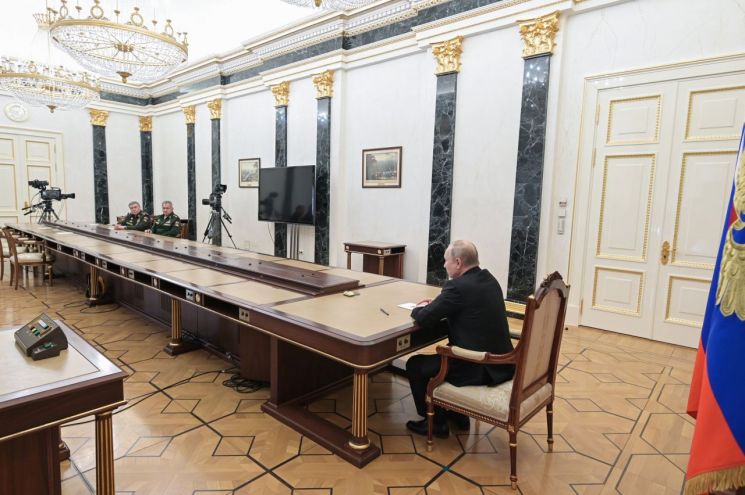 On the 27th (local time), Russian President Vladimir Putin (right) held a meeting with Russian Defense Minister Sergey Shoigu (center) and Chief of the General Staff Valery Gerasimov (left) in a conference room at the Moscow Kremlin. President Putin is reported to have ordered the strengthening of the alert status of nuclear weapons units during the meeting. The United States and Western countries have strongly opposed this, interpreting it as a direct nuclear threat from Russia. Moscow, Russia ? AP/Yonhap News Photo
[Asia Economy Reporter Hyunwoo Lee] The Russian invasion of Ukraine, which was expected to be swift and decisive, is facing stronger resistance than anticipated, raising concerns about a prolonged conflict. As the nature of the war led by Russia changes, the Russian military has announced it will halt its attacks and engage in 'unconditional' negotiations with Ukraine. Analysts interpret Russian President Vladimir Putin's extreme 'nuclear threat card' directed at the West as a reflection of Russia's growing anxiety.
According to the Associated Press (AP) on the 27th (local time), Ukrainian President Volodymyr Zelensky stated in a press release, "We have agreed to hold unconditional talks with the Russian delegation near the Pripyat River, close to the Belarus border," adding, "Although I do not trust the outcome of the talks, if there is even a small chance to end the war, I will participate."
AP also reported that Russia, which had previously rejected Ukraine's proposal for talks on the 25th, is now the one proposing unconditional talks. This shift is analyzed as a result of stronger-than-expected resistance from the Ukrainian military, which has failed to capture major cities early on, increasing concerns about a prolonged war. According to The Wall Street Journal (WSJ), even on the fourth day of the conflict, Russian forces have failed to capture Kyiv as well as Ukraine's second-largest city, Kharkiv.
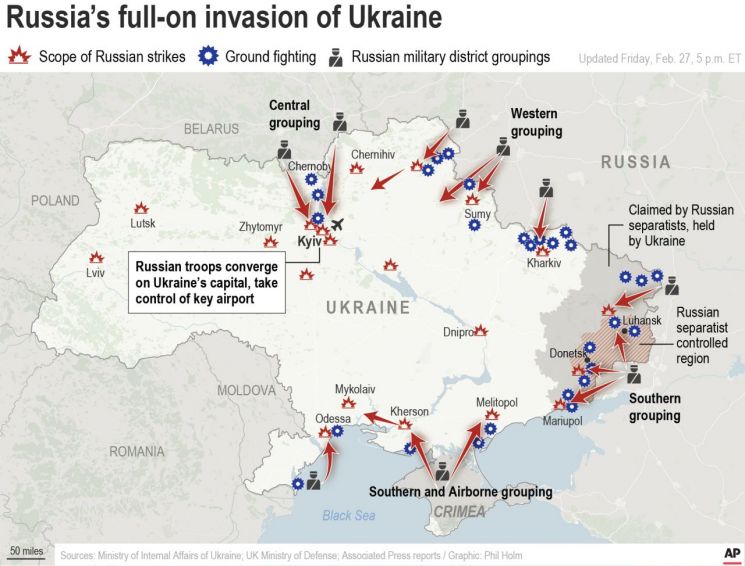 The Ukrainian military performed better than expected, and even on the fourth day of the conflict, Russian forces reportedly failed to capture Kyiv, the capital of Ukraine, as well as Kharkiv, the second-largest city. [Source=U.S. Department of State, AP News] [Image source=AP Yonhap News]
According to The New York Times (NYT), the U.S. think tank Institute for the Study of War (ISW) reported that "since the 26th, Russian forces have halted most combat operations due to shortages of ammunition and logistics, and it is difficult to resume attacks until the main forces capable of urban bombardment, such as artillery and armored units, gather in Kyiv."
Putin's indication of a possible nuclear threat is also seen as revealing Russia's anxiety. In a televised speech that day, President Putin announced, "I have ordered the Minister of Defense and the Chief of the General Staff to put the nuclear deterrence forces on special combat duty." The 'nuclear deterrence forces' refer to units operating nuclear weapons within Russia.
German daily Deutsche Welle (DW), citing a former Russian military official, reported, "The 'special combat duty' mentioned by President Putin is not a term used within the Russian military," and added, "It appears to be political rhetoric aimed at blocking further Western moves rather than an actual order to strengthen the readiness of nuclear forces."
As the nature of the war changes, there is also analysis that Russia will become more proactive in peace negotiations over time. According to the British Daily Mail, former Estonian Defense Commander Riho Terras tweeted, "Based on information from Russian intelligence sources, President Putin initially believed all operations would conclude within four days of the invasion and is now furious about the current frustrating situation," adding, "If the Russian military is forced into a prolonged conflict, it will cost $20 billion (approximately 24 trillion won) per day, so if the Ukrainian forces can hold off the Russian military for another 10 days, Putin will have no choice but to engage in peace talks."
© The Asia Business Daily(www.asiae.co.kr). All rights reserved.
![Clutching a Stolen Dior Bag, Saying "I Hate Being Poor but Real"... The Grotesque Con of a "Human Knockoff" [Slate]](https://cwcontent.asiae.co.kr/asiaresize/183/2026021902243444107_1771435474.jpg)

















