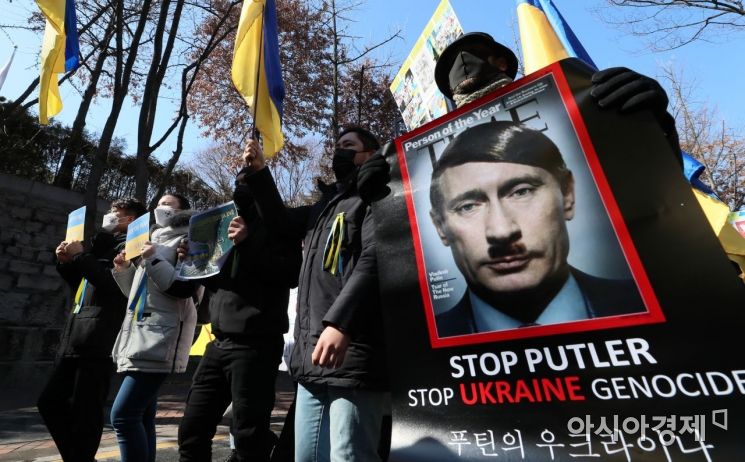
 Ukrainians residing in Korea are marching near the Russian Embassy in Jung-gu, Seoul on the 27th, condemning Russia's invasion of Ukraine. Photo by Yoon Dong-ju doso7@
[Asia Economy Reporter Seungjin Lee] In response to Russia's invasion of Ukraine, major U.S. big tech companies such as Google YouTube, Meta (formerly Facebook), and Twitter have imposed cyber sanctions. By blocking advertising revenue for Russian channels, this is expected to act as a political threat within Russia.
Hundreds of Billions in YouTube Ad Revenue from Russia Cut Off
According to major foreign media on the 28th, YouTube has temporarily banned monetization of advertisements on Russia's state-run media Russia Today (RT) and some other Russian channels. YouTube also stated that videos from Russian channels like RT will appear less frequently in user recommendations, and access to these channels will be blocked in Ukraine at the request of the Ukrainian government.
According to digital research firm Omelas, Russia is estimated to have earned up to $32 million (approximately 38.5 billion KRW) over the past two years through advertisements on 26 channels. Since YouTube has long been a popular platform among Russian government critics and state-run media, this measure is expected to inevitably cause damage not only to advertising revenue but also to Russia's external image.
Western countries have increased pressure on Google to sanction channels spreading pro-Russian content on YouTube following Russia's invasion of Ukraine. The European Union (EU) has included Russian journalist Vladimir Solovyov on its sanctions list.
Solovyov is a popular YouTuber with over 1.14 million subscribers, raising concerns that pro-Russian YouTube content could be exploited in information warfare. In fact, his live streaming broadcast on the 28th surpassed 6.2 million views within six hours.
YouTube did not disclose the names of other Russian channels subject to restrictions besides RT.
In response, Russia sent a letter to Google demanding that access to Russian-related channels be allowed in Ukrainian territory and that restrictions on advertising revenue be lifted.
Meta and Twitter Join Sanctions
Meta also banned advertisements from Russian state media and blocked ad revenue for these accounts. Additionally, it established a special operations center including native Russian and Ukrainian speakers to block posts with unverified facts.
Meta announced this on the 26th via its newsroom, emphasizing its commitment to providing the best assistance to maintain the safety of Ukrainian citizens. Meta has increased hacking security for Meta-related accounts by sending top-level alerts about privacy protection and account security to all Instagram users in Ukraine. This appears to be aimed at preventing accounts from being hijacked by Russian hackers and used for political propaganda.
Meta and Russia are engaged in a standoff. Previously, when Meta deleted and stopped advertising some content from pro-Russian news sites citing inaccuracies, Russia retaliated by blocking some access to Meta, accusing it of media censorship.
Twitter has also suspended all advertisements from both Russia and Ukraine. Furthermore, to suppress the spread of unverified and offensive content, Twitter has limited tweet recommendations so that users posting such content are not shown on other users' timelines.
© The Asia Business Daily(www.asiae.co.kr). All rights reserved.
![Clutching a Stolen Dior Bag, Saying "I Hate Being Poor but Real"... The Grotesque Con of a "Human Knockoff" [Slate]](https://cwcontent.asiae.co.kr/asiaresize/183/2026021902243444107_1771435474.jpg)
















