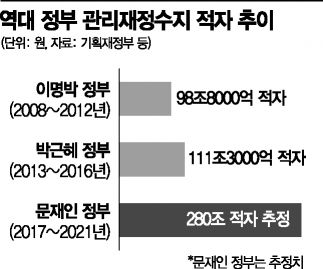
[Asia Economy Sejong=Reporter Kwon Haeyoung] The fiscal deficit during the five years of the Moon Jae-in administration is estimated to have reached about 280 trillion won, more than double that of the previous Park Geun-hye and Lee Myung-bak administrations. While revenues (tax income) have been lackluster, expenditures have only increased, causing the national finances to deteriorate rapidly. Despite this situation, presidential candidates from both ruling and opposition parties are competing to announce populist spending pledges, raising concerns that the country's creditworthiness could decline immediately after the new government takes office.
Based on data from the Ministry of Economy and Finance on the 27th, the managed fiscal balance, which reflects the actual state of national finances, is understood to have recorded a deficit of around 280 trillion won over the five years from 2017, when the Moon administration began, through 2021. The managed fiscal balance is an indicator that subtracts the net expenditure from the net revenue of the central government’s integrated fiscal balance, excluding the four major social security funds, providing a clear view of the government's actual financial condition.
The managed fiscal balance of the current administration was -18.5 trillion won in its first year, 2017; -10.6 trillion won in 2018; -54.4 trillion won in 2019; -112 trillion won in 2020; and is estimated to be in the -80 trillion won range in 2021. Earlier, the Ministry of Economy and Finance announced that the annual integrated fiscal balance for last year was in the -30 trillion won range, widening the deficit from the provisional figure of -22.4 trillion won for January to November. Based on this, the annual managed fiscal balance is calculated to have increased its deficit from the January to November figure of -77 trillion won to about -80 trillion won.
Thus, the fiscal deficit over the five years of the Moon administration is estimated to be about 280 trillion won, nearly 2.5 times that of the previous Park Geun-hye administration (2013?2016, 111.3 trillion won deficit) and 2.8 times that of the Lee Myung-bak administration (2008?2012, 98.8 trillion won deficit). The deterioration of national finances to this extent is largely due to the Moon administration increasing fiscal spending significantly, including drafting supplementary budgets totaling about 150 trillion won in 10 rounds. The expansion of government spending to support COVID-19 victims and manage the 'global pandemic' was a response to an unexpected variable, but there has been considerable criticism that government finances were wasted for political purposes, such as distributing disaster relief funds to all citizens ahead of elections.
Above all, the current administration had already loosened fiscal spending controls before the COVID-19 outbreak. The fiscal deficit in 2019, before the pandemic, was 54.4 trillion won, which was more than 10 trillion won higher than the 43.2 trillion won deficit in 2009, when a supplementary budget of 28.4 trillion won was drafted to overcome the global financial crisis.
As a result of the current government borrowing money to spend national funds, the national debt increased by 54% from 626.9 trillion won in 2016, before the administration took office, to 965.3 trillion won in 2021. This year, it is expected to reach 1,075.7 trillion won, with the ratio to gross domestic product (GDP) reaching 50.1%. Despite the red flags raised over national finances, the political sphere is obsessed with election-related spending. On the 21st, the National Assembly passed a supplementary budget of 16.9 trillion won, and on the same day during a presidential candidate TV debate, candidates from both ruling and opposition parties announced populist spending pledges such as "COVID debt credit forgiveness (Lee Jae-myung, Democratic Party candidate)" and "Additional supplementary budget support of 37 trillion won (Yoon Seok-youl, People Power Party candidate)."
As the international credit rating agency Moody’s began its annual consultation for evaluating South Korea’s sovereign credit rating on the day the supplementary budget was passed, concerns have emerged that the deterioration of fiscal soundness could lead to a downgrade of the country’s credit rating. Previously, Moody’s downgraded South Korea’s sovereign credit rating outlook from 'positive' to 'negative' by two notches in February 2003, just before the Roh Moo-hyun administration took office, citing economic policy uncertainty and North Korea’s nuclear issues.
Professor Kim Woo-cheol of the Taxation Department at the University of Seoul emphasized, "As national debt rapidly increases, fiscal soundness management should be a major topic in this presidential election, but all candidates’ pledges converge on expanding government spending. The next government must prioritize fiscal soundness management and pursue strengthening fiscal health as its top policy agenda."
© The Asia Business Daily(www.asiae.co.kr). All rights reserved.
![Clutching a Stolen Dior Bag, Saying "I Hate Being Poor but Real"... The Grotesque Con of a "Human Knockoff" [Slate]](https://cwcontent.asiae.co.kr/asiaresize/183/2026021902243444107_1771435474.jpg)
















