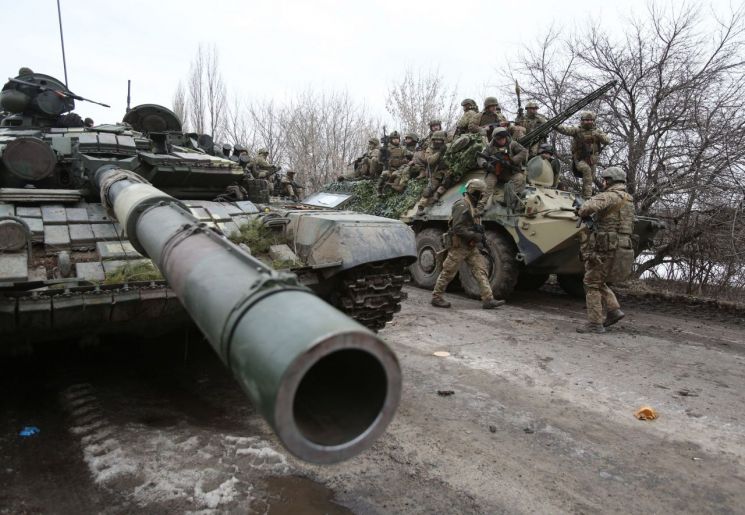
 The Ukrainian government forces are preparing to counterattack against the Russian army's assault in eastern Luhansk on the 24th (local time). [Image source=Yonhap News]
[Asia Economy Reporter Hwang Sumi] The United States and Western countries, including the North Atlantic Treaty Organization (NATO), are condemning Russia's invasion of Ukraine and imposing sanctions. However, they are refraining from direct military intervention.
According to foreign media on the 25th (local time), NATO Secretary General Stoltenberg stated at a virtual NATO summit, "Russia has shattered the peace of the European continent," and announced that NATO will significantly increase defensive forces to protect its eastern member states.
NATO plans to strengthen cyber network protection activities and deploy NATO rapid response forces in the context of collective defense. This will include thousands of troops, and more than 100 jets will maintain high alert status at 30 locations, according to foreign reports.
However, it was made clear that there are no NATO troops in Ukraine and there are no plans to send any in the future. This is because Ukraine is not a NATO member country, so there is no basis for intervention.
The United States, which does not have a legally binding relationship with Ukraine either, is taking the same stance. President Joe Biden condemned Russia's attack on Ukraine and announced plans for additional sanctions but emphasized that U.S. troops will not be deployed to Ukraine. The U.S. is only responding militarily by deploying thousands of additional troops to Germany.
Currently, the U.S. and NATO cannot send troops to Ukraine, which is not a member country, but they are reinforcing forces in Eastern European member states such as Poland to deter Russia and prevent escalation.
The U.S. and NATO are assisting Ukraine by providing military equipment. However, they have stated that if Russia attacks NATO member countries west of Ukraine, they will intervene automatically.
Another important reason for their hesitation to intervene directly is the possibility of escalation into a nuclear war.
According to the Federation of American Scientists (FAS), Russia currently possesses approximately 4,500 nuclear weapons. FAS estimates that the U.S. holds about 3,800 nuclear weapons, with 1,750 awaiting dismantlement.
Russian President Vladimir Putin has also reminded the world that Russia is the strongest nuclear power and warned that if a third country intervenes in this situation, Russia will respond in an unprecedented manner.
Meanwhile, a resolution condemning Russia's invasion of Ukraine, submitted at an emergency meeting of the UN Security Council held at the UN headquarters in New York on the same day, failed to pass. This was because Russia, a permanent member of the Security Council, exercised its veto power.
The resolution, led by the United States, included condemnation of Russia and demanded an immediate, complete, and unconditional withdrawal from Ukraine.
However, since Russia is a permanent member with veto power and a party to the conflict, the likelihood of the resolution being adopted was very low. Currently, Vasily Nebenzya, Russia's ambassador to the UN, is serving as the chair of the council this month.
Eleven of the Security Council members voted in favor, but Russia voted against, and three countries allied with Russia?China, India, and the United Arab Emirates?abstained.
© The Asia Business Daily(www.asiae.co.kr). All rights reserved.
![Clutching a Stolen Dior Bag, Saying "I Hate Being Poor but Real"... The Grotesque Con of a "Human Knockoff" [Slate]](https://cwcontent.asiae.co.kr/asiaresize/183/2026021902243444107_1771435474.jpg)











