Direct and Indirect Impact Inevitable Due to US-EU Sanctions
Emergency Measures from Exports to Raw Material Procurement
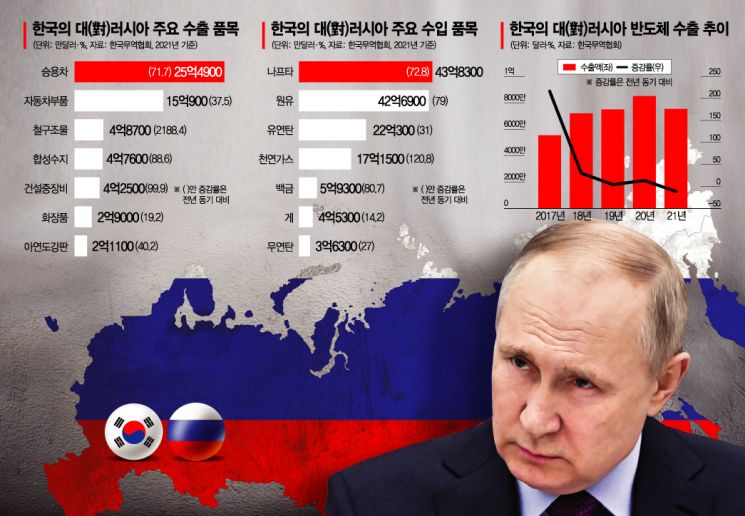
[Asia Economy Reporter Jin-ho Kim] Following Russia's full-scale invasion of Ukraine, the domestic semiconductor industry has been put on high alert. This is because it has become impossible to avoid direct and indirect impacts due to the United States' export control measures against Russia. Concerns have arisen that not only will exports face disruptions immediately, but the supply of rare gases essential for semiconductor processes will also be affected.
According to the industry on the 26th, companies such as Samsung Electronics and SK Hynix are paying close attention to the impact of export control sanctions on Russia for high-tech products including semiconductors, announced not only by the United States but also by the European Union (EU). While the immediate impact is expected to be limited, it is difficult to predict how far the effects will extend if the situation prolongs.
The United States applied the 'Foreign Direct Product Rule (FDPR),' which was the basis for sanctioning China's Huawei in the past, in the current Russia sanctions. This rule prohibits exports to Russia of products made in third countries if they use U.S. technology or software (SW). Most semiconductors produced by Korean companies rely on U.S. technology.
The problem is that semiconductors, which are core components of all electronic devices, are installed in most products that Korea exports to Russia. Since most semiconductors produced by Korean companies depend on U.S. technology, it is analyzed that they will have no choice but to comply with the sanctions. For example, if Samsung Electronics or SK Hynix exports semiconductors to Russia, they must undergo U.S. review.
In particular, there is also an analysis that the issue of raw material supply poses a greater risk than exports. The Korea International Trade Association's International Trade and Commerce Research Institute stated this in a report titled 'Current Status of the Russia-Ukraine Situation and Its Impact on Korean Companies' on the 18th.
Rare gases such as neon and krypton, used in semiconductor processes, account for about half of the supply from Russia and Ukraine. Last year, 30.7% of krypton imports came from Ukraine and 17.5% from Russia. Neon imports also had high proportions from Ukraine (23.0%) and Russia (5.3%). An industry official said, "There is sufficient inventory and supplies are being sourced from other countries, so there should be no immediate major problems," but expressed concern that "if the situation prolongs, it is difficult to predict the impact."
Meanwhile, the government plans to focus on minimizing the industrial impact related to Russia's full-scale invasion of Ukraine. On the previous day, Deputy Prime Minister and Minister of Economy and Finance Hong Nam-ki held a meeting with related ministers (Green Room Meeting) to review various countermeasures. It is reported that various measures have been prepared, including extending credit guarantees for export companies within a month and prompt insurance claim compensation.
© The Asia Business Daily(www.asiae.co.kr). All rights reserved.

















