Russia-Ukraine Full-Scale War Scenario Makes US Interest Rate Hike by 0.5% Point Unlikely
Stagflation Risk from Inflation and Growth Slowdown... Nasdaq Starts with Sharp Drop but Ends with Surge
[Asia Economy reporters Park Byung-hee and Cho Hyun-ui] As Russia launched a sudden invasion of Ukraine, dark clouds are casting over the global economy. This invasion, escalating into a full-scale war, is stronger than the market had anticipated, and the economic damage is expected to be significant. Wall Street experts analyze that the global economy is facing high inflation, low growth, and uncertainty.
Accordingly, there is also analysis that the U.S. central bank, the Federal Reserve (Fed), will find it difficult to pursue a rapid tightening policy.
◆ U.S. March rate hike of 0.5% point off the table = With Russia initiating military operations in Ukraine, uncertainty in the global economy has increased. There is now analysis that the risk of stagflation, a combination of recession and inflation, has risen beyond simple inflation concerns.
Bloomberg News analyzed that due to the Ukraine situation, uncertainty and inflation concerns have increased along with the risk of slowing growth. Ben Laidler, global investment strategist at virtual asset trading platform eToro, warned in an interview with Bloomberg, "The global economy will face a triple hit of higher inflation, lower economic growth, and increased uncertainty." Keith Lerner, chief market strategist at U.S. financial advisory firm Truist, also said, "This invasion was a more severe scenario than some investors had expected. Because it happened while investors were off guard, negative reactions are emerging."
There is also analysis that the possibility of a 0.5 percentage point rate hike at the Fed's March meeting is off the table. Based on trading trends in the U.S. federal funds rate futures market, the probability of a 0.5 percentage point rate hike at the March Federal Open Market Committee (FOMC) fell below 10% on that day. The probability was 33% the previous day.
Benjamin Jeffrey and Ian Linzen, investment strategists at BMO Capital Markets, released a report stating, "Price increases amid geopolitical uncertainty ultimately raise the risk of stagflation," and explained, "The energy crisis is the most direct and typical cause of stagflation."
Following Russia's military operation, the Fed immediately began reviewing how the Ukraine situation will affect the economy and the currently planned monetary policy operations. Loretta Mester, president of the Cleveland Federal Reserve Bank, said, "We need to examine how the Ukraine situation will affect the U.S. medium- to long-term economic outlook," adding, "This is something to consider when determining the appropriate pace of rate hikes."
◆ Stock market rebound... unease remains = On that day, the Dow Jones Industrial Average closed at 33,223.83, up 0.28% from the previous trading day, and the S&P 500 closed at 4,288.70, up 1.50%. The Nasdaq Composite surged 3.35% to 13,473.59. The Dow and S&P 500 initially fell as much as 2.59% and 2.62%, respectively, before rebounding. The Nasdaq fell 3.45% before rebounding, with intraday volatility reaching 6.8%. This was an unprecedented level of volatility.
Fueled by the New York stock market rebound, the domestic stock market also showed a sharp rise on the 25th. As of 10:25 a.m., the KOSPI index was trading at 2,680.42, up 31.62 points (1.19%) from the previous trading day. The KOSDAQ index was trading at 869.40, up 21.19 points (2.50%).
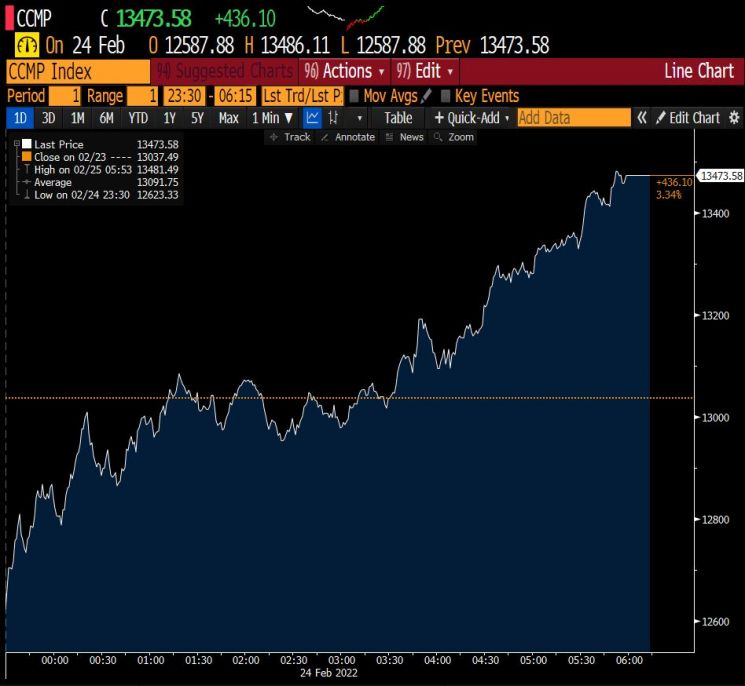
The market has rebounded for now, but unease remains. The Wall Street Journal (WSJ) analyzed that although the New York stock market started with a sharp drop, optimism spread in the market after U.S. President Joe Biden announced sanctions against Russia.
In this regard, Stephan Kreuzkamp, Chief Investment Officer at U.S. asset management firm DWS, predicted, "The market will remain very unsettled over the next few days depending on the clarity of the West's sanctions against Russia and whether President Vladimir Putin stops (the invasion) at the Ukrainian border."
Binky Chada, chief investment strategist at Deutsche Bank, said, "Russia's invasion is a worse outcome than the market had expected," adding, "Basically, the stock market will fall another 5 to 6%."
Germany announced that it would not approve the operation of the Nord Stream 2 gas pipeline directly connecting Russia and Germany immediately after Russia's invasion of Ukraine, but no direct sanctions against Russian energy companies have followed. Moreover, Russian state-owned gas company Gazprom announced that it would continue gas exports to Europe through Ukraine.
Relief was also confirmed in the bond market. The yield on the 10-year U.S. Treasury note fell 0.14 percentage points from the previous trading day to 1.85%, then trimmed the decline to close at 1.97%, down 0.3 percentage points. Bond yields move inversely to prices. This means that the price of the safe-haven U.S. Treasury bonds rose sharply early in the session before closing.
© The Asia Business Daily(www.asiae.co.kr). All rights reserved.
![Clutching a Stolen Dior Bag, Saying "I Hate Being Poor but Real"... The Grotesque Con of a "Human Knockoff" [Slate]](https://cwcontent.asiae.co.kr/asiaresize/183/2026021902243444107_1771435474.jpg)

















