Russia Warns Countries Joining Economic Sanctions
Internet Promotion Agency Maintains Alert Level 'Interest'
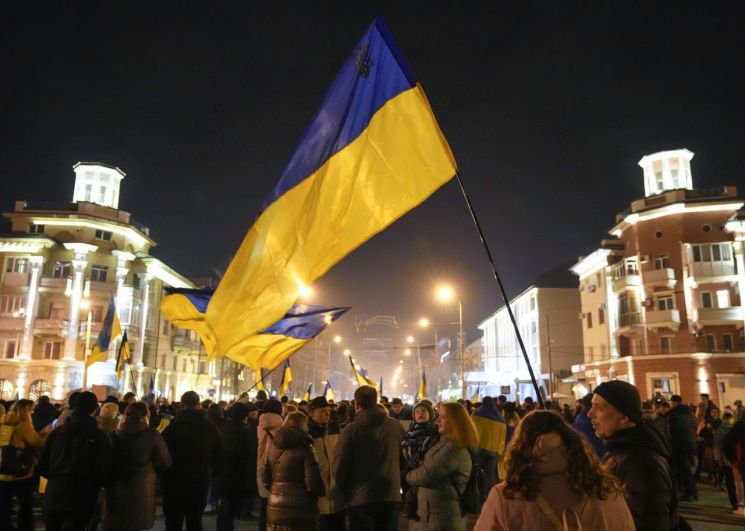 Residents attend a rally shouting "Mariupol is Ukrainian land" on the 22nd (local time) in Mariupol, a southeastern city where the Ukrainian government forces and pro-Russian rebels are confronting each other.
 [Image source=Yonhap News]
[Asia Economy Reporter Seungjin Lee] Websites of several Ukrainian government agencies and banks have been paralyzed by distributed denial-of-service (DDoS) attacks. With Russia suspected as the culprit, concerns are rising that South Korea, which has joined economic sanctions against Russia, could also be exposed to cyberattacks such as DDoS attacks.
West Warns of "Russian Cyber Attacks"
On the 25th, major countries participating in economic sanctions against Russia, including the United States, the United Kingdom, and Canada, issued cyberattack warnings to government agencies and major companies. This move follows Russian President Vladimir Putin’s warning that if foreign forces intervene in the situation while he ordered the invasion of Ukraine, they will "pay the price." Earlier, on the 23rd (local time), Mykhailo Fedorov, Ukraine’s Deputy Prime Minister and Minister of Digital Transformation, announced that DDoS attacks had begun targeting national institutions such as the parliament, cabinet, Ministry of Foreign Affairs, and banks. As a result, the operation of sites for intelligence agencies like the Security Service, Ministry of Interior (police), and Ministry of Defense was significantly disrupted for a considerable time.
Large-scale cyberattacks have occurred whenever there have been conflicts between Russia and neighboring countries. During the 2014 Crimean Peninsula referendum on Russia’s annexation of Ukraine, cyberattacks targeted anti-Russian forces, with Russia identified as the main culprit. Going further back, Russia was also blamed for cyberattacks in Estonia in 2007 and Georgia in 2008. These incidents led to the establishment of the NATO Cooperative Cyber Defence Centre of Excellence (CCDCOE).
South Korea Maintains ‘Interest’ Alert Level
With South Korea deciding to join economic sanctions against Russia, the situation is no longer reassuring. Government agencies such as the Korea Internet & Security Agency (KISA) are closely monitoring domestic and international internet traffic conditions, DDoS attacks, and the emergence of new worms (viruses). DDoS is a type of cyberattack that attempts massive access (traffic) to a specific internet site, making it difficult to use the site normally; a sudden surge in traffic is a typical sign.
A KISA official explained, "We are closely monitoring the situation due to the DDoS attacks on Ukraine, and so far, no unusual trends such as sudden traffic spikes have been detected."
The current domestic cyber threat alert level is at the ‘Interest’ stage. This indicates concern over the spread of overseas cyberattack damage potentially entering the country. If political or military crises occur domestically or internationally, raising the possibility of cyber security threats, the alert level will be raised to ‘Caution.’ A KISA official stated, "The cyberattacks on Ukraine have been resolved for now, so it is unlikely that the alert level will be raised."
There is also analysis that even if cyberattacks targeting South Korea begin, fatal damage can be avoided. Professor Hyungjoong Kim, a special professor at Korea University Graduate School of Information Security, said, "Although cyberattack methods continue to evolve, making it impossible to be completely safe, a high-level security system has been established due to past DDoS attacks, enabling rapid blocking and bypassing. Therefore, it is unlikely that the internet of major institutions and companies will be paralyzed."
© The Asia Business Daily(www.asiae.co.kr). All rights reserved.

















