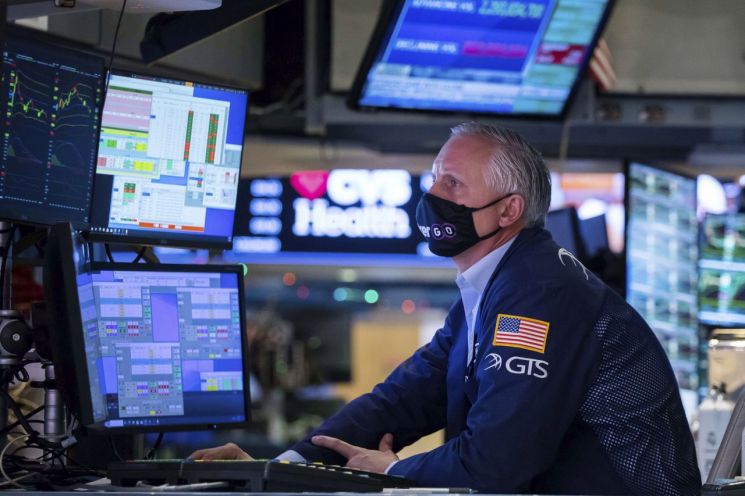
[Asia Economy New York=Special Correspondent Joselgina] On the morning of the 24th (local time), following news that Russia had invaded Ukraine, major indices on the U.S. New York Stock Exchange all showed sharp declines. International oil prices surpassed $100 per barrel, and Wall Street's "fear index" approached its highest level of the year.
As of 10:41 a.m. that day, the Dow Jones Industrial Average on the New York Stock Exchange (NYSE) was trading at 32,418.71, down 713.05 points (2.15%) from the previous close. The large-cap-focused S&P 500 index fell 67.08 points (1.59%) to 4,158.42, while the tech-heavy Nasdaq index dropped 165.39 points (1.27%) to 12,872.10. The small-cap-focused Russell 2000 index also declined 16.35 points (0.84%) to 1,927.74.
Investors focused on the news late the previous night that Russia had launched simultaneous invasions in Ukraine. As a result, risk-averse sentiment grew in the market, causing stock prices to plunge and a notable shift toward safe-haven assets.
On that day, the U.S. 10-year Treasury yield briefly fell to the 1.84% range. A decline in Treasury yields indicates a rise in prices of these representative safe-haven assets. Gold futures rose compared to the previous close, surging to $1,976.50 per ounce before settling around $1,930.
In contrast, European stock markets plunged. Germany's DAX index and the UK's FTSE 100 index fell 4.28% and 3.90%, respectively. Bitcoin prices also dropped about 5%, trading near $35,780. Ethereum similarly declined nearly 7%. The Chicago Board Options Exchange (CBOE) Volatility Index (VIX), known as the fear index, reached 37.79 intraday, approaching its yearly high of 38.94.
With geopolitical risks rising, the market is also assessing a lower likelihood that the U.S. central bank, the Federal Reserve (Fed), will pursue aggressive tightening. According to the Chicago Mercantile Exchange (CME) FedWatch tool, the federal funds (FF) futures market reflects a 9.5% chance of a 0.5 percentage point rate hike by the Fed in March. The probability of a 0.25 percentage point increase has risen to the 90% range.
Cash Bostian, Chief Economist at Oxford Economics, expressed concern that "the worst-case scenario of Russia invading Ukraine shocks the stock and oil markets." He added, "This will have negative repercussions on the European economy and also slow U.S. growth," and predicted, "Facing uncertainty, the Fed is likely to limit the March rate hike to just 0.25 percentage points."
Economic indicators released that day showed improvement. The U.S. fourth-quarter (October to December) GDP was preliminarily estimated to have increased at an annualized rate of 7.0% compared to the previous quarter. This figure exceeded the flash estimate of 6.9% growth and met market expectations.
The number of weekly U.S. unemployment insurance claims was recorded at 232,000, down 17,000 from the previous week. The Chicago Federal Reserve Bank reported that the January National Activity Index (NAI) rose to 0.69 from 0.07 in the previous month.
Geopolitical risks surrounding Ukraine have caused international oil prices to surge. As of 10:38 a.m., the April West Texas Intermediate (WTI) crude oil price was $97.93 per barrel, up 6.32% from the previous close. The April Brent crude oil price rose 7.43% to $104.04 per barrel. WTI prices at one point climbed more than 9% that day, reaching $100.54 per barrel.
© The Asia Business Daily(www.asiae.co.kr). All rights reserved.

















