Bank of Korea Holds Base Rate at 1.25%
Inflation Forecast Raised from 2% to 3.1%
Inflation Fears Amid Ukraine-Driven Oil Price Surge
BOK Signals Possible Future Rate Hikes
Monetary Policy Committee: "Inflation Expected to Exceed 3% Significantly"

The Bank of Korea has significantly raised its consumer price inflation forecast for this year from 2.0% to 3.1%, an increase of 1.1 percentage points. This is the first time in about 10 years since April 2012 (3.2%) that the Bank of Korea has projected inflation above 3%. The inflation forecast for next year was also raised from 1.7% to 2.0%. This reflects the assessment that the recent surge in international oil prices due to heightened military tensions between Russia and Ukraine, as well as the global spread of inflation, could continue into next year. Accordingly, the market expects that although the Bank of Korea kept the base interest rate unchanged this month, it may raise rates to the 2.0% range in the future to respond to inflation.
Inflation Forecast Above 3% for the First Time in 10 Years
On the 24th, the Monetary Policy Board of the Bank of Korea held a monetary policy meeting and decided to keep the base interest rate unchanged at 1.25% per annum. This decision avoided the unprecedented 'three consecutive interest rate hikes.' Previously, the Monetary Policy Board had lowered the base rate to a historic low of 0.5% by May last year to counter the economic downturn caused by COVID-19, then raised it by 0.25 percentage points each in August and November of the same year, and again in January this year, bringing it up to 1.25%. The current freeze reflects concerns that although inflationary pressures are strong, a sharp rate hike could burden the economy amid the spread of COVID-19 and geopolitical risks between Russia and Ukraine.
However, signals for future rate hikes have become stronger. This is because the Bank of Korea significantly raised its domestic inflation forecast, which is linked to monetary policy. After the Monetary Policy Board meeting, the Bank announced a revised economic outlook, raising this year's domestic inflation forecast to 3.1%. The Bank explained that it had forecast 2% inflation in November last year, but adjusted the forecast upward within two months due to sharp inflation in the U.S. caused by global supply bottlenecks and geopolitical instability such as the Ukraine crisis. The Bank’s projection of inflation above 3% for the first time in 10 years indicates growing concerns about economic deterioration due to inflation.
Regarding the inflation outlook, the Monetary Policy Board stated, "Consumer price inflation is expected to exceed 3% significantly for a considerable period, higher than the November forecast path. On an annual basis, inflation is expected to be in the low 3% range, and core inflation is also expected to rise to the mid-2% range this year."
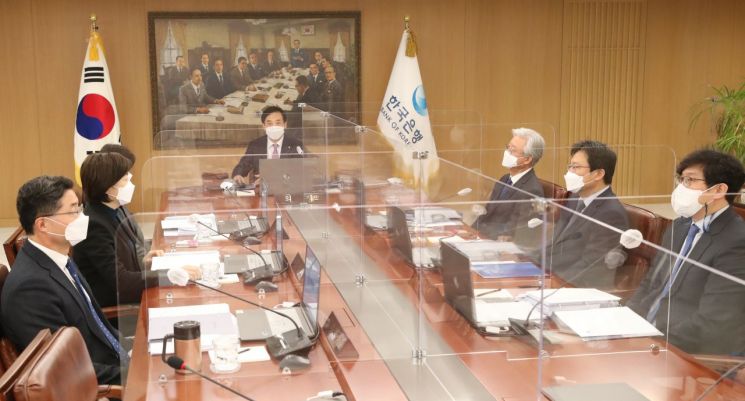 Lee Ju-yeol, Governor of the Bank of Korea, is presiding over the Monetary Policy Committee's main meeting on the monetary policy direction for February 2022, held on the morning of the 24th at the Bank of Korea in Jung-gu, Seoul. (Photo by Bank of Korea) [Image source=Yonhap News]
Heightened Anxiety from Ukraine Crisis... Inflation Likely to Rise Further
Warning signs due to inflation concerns have already been lit domestically. Last month, the domestic Consumer Price Index (CPI) recorded 104.69 (2020=100), a 3.6% increase compared to the same month last year. Consumer prices have risen in the 3% range for four consecutive months since October last year. The Producer Price Index (PPI), which directly causes the rise in consumer prices, also increased by 8.7% compared to a year ago, reaching 114.24 (2015=100) last month. Most categories, including manufactured goods (13.9%) and agricultural, forestry, and fishery products (1.5%), rose due to increases in raw material prices such as international oil prices.
The market widely fears that inflation instability will worsen further. The Bank of Korea, whose main goal is domestic price stability, is expected to face deeper challenges ahead. Analysts warn that if international oil prices continue to rise and supply chain disruptions persist, soaring inflation could trigger stagflation?simultaneous inflation and economic stagnation?negatively impacting Korea’s economic growth. In fact, international oil prices are approaching $100 per barrel as Russian military intervention in eastern Ukraine intensifies.
Given the steeper-than-expected inflation rise and the imminent interest rate hikes by the U.S. Federal Reserve (Fed), there are expectations that the Bank of Korea may raise its base rate into the 2% range this year. One major variable is the possibility that the Fed will implement a 0.5 percentage point rate hike, known as a ‘big step,’ as soon as next month.
Professor Sung Tae-yoon of Yonsei University’s Department of Economics explained, "Since inflationary pressures are currently very strong, liquidity withdrawal through interest rate hikes is necessary," but added, "Considering the burden of consecutive rate hikes and the upcoming presidential election, it seems the Bank of Korea decided to keep rates unchanged this time."
© The Asia Business Daily(www.asiae.co.kr). All rights reserved.


















