[Asia Economy Reporter Lim Hye-seon] The game company providing the shooting game ‘Fortnite’ offers a service called ‘Party Royale,’ where users can watch movies or music videos and enjoy concerts and other performances within a virtual space. When performances or live acts take place in a metaverse (extended virtual world) space, is there recognition of any infringement of rights related to performances in the real world?
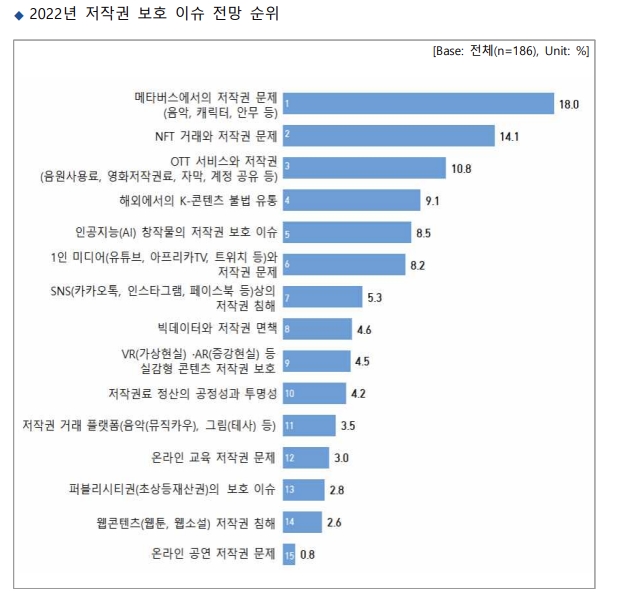
According to the ‘2022 Copyright Protection Issue Outlook Report’ published by the Korea Copyright Protection Agency on the 23rd, the survey results on copyright protection issues this year showed that copyright problems related to ‘Metaverse’ and ‘Non-Fungible Token (NFT) transactions’ ranked highest at 18.0% and 14.1%, respectively. Following these were ‘Online Video Services (OTT) and Copyright (10.8%)’ and ‘Illegal distribution of K-content overseas (9.1%).’
In the metaverse space, users become so-called ‘prosumers,’ new creators themselves. Therefore, various issues under the current copyright law are being raised.
Jung Won-jun, Associate Research Fellow at the Korea Legislation Research Institute, explained, “When attempting to transfer and implement real-world copyrighted works into the virtual world, the question of copyright infringement arises. If a person directly performs choreography or music of a specific singer, there may be no particular legal issues, but if users publicly perform these, copyright infringement issues may arise.”
There is also controversy over whether copyright infringement is recognized when using real-world copyrighted works to compose backgrounds in virtual spaces. Unauthorized use of copyrighted works such as musical works, artistic works, or applied works in virtual spaces can be problematic.
There are also copyright issues related to the creation and trading of NFTs. Kim Hyun-kyung, Professor at the Graduate School of IT Policy at Seoul National University of Science and Technology, said, “NFTs may be considered the same as artworks, but NFTs only include a link that can be downloaded in digital form, and may not provide the actual high-resolution file or printed copy that corresponds to a replica. Licenses may be unclear, so it is necessary to clearly inform consumers of the important context and reality of the transaction and guarantee verification and authenticity confirmation of the content linked to the NFT.”
© The Asia Business Daily(www.asiae.co.kr). All rights reserved.
![Clutching a Stolen Dior Bag, Saying "I Hate Being Poor but Real"... The Grotesque Con of a "Human Knockoff" [Slate]](https://cwcontent.asiae.co.kr/asiaresize/183/2026021902243444107_1771435474.jpg)
















