H Plus Yangji Hospital Spine and Joint Center Director Yoon Hyungjo
"Complications in Recovery Process Can Lower Quality of Life, Caution Needed"
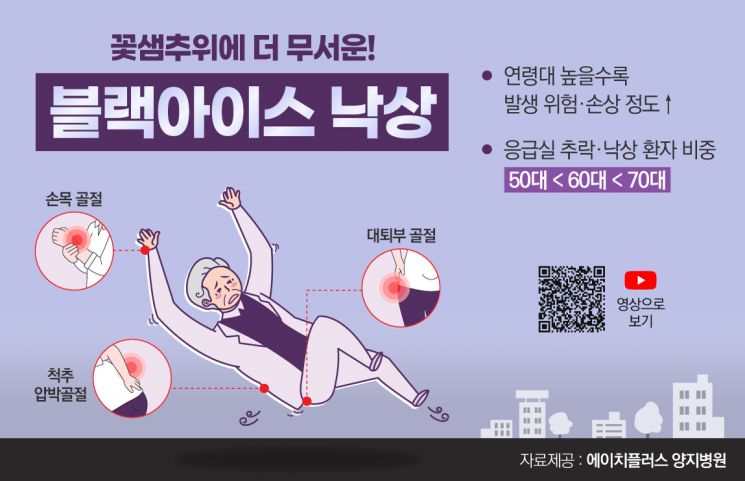
[Asia Economy Reporter Lee Gwan-ju] Despite the arrival of Ipchun and Usu, which mark the beginning of spring according to the solar terms, the cold snap caused by late winter chill continues to persist. The Korea Meteorological Administration forecasts that the cold weather will last until the end of this month, with temperature differences between day and night reaching up to 10 degrees Celsius. In cold weather, the body tends to contract, reducing agility and reflexes, making it easy to slip and fall due to minor carelessness. In particular, the ‘black ice’ on roads, which is hard to see, can lead to fatal injuries for the elderly.
Yoon Hyung-jo, Director of the Spine and Joint Center at H Plus Yangji Hospital, points out that the problem of fall accidents is not limited to simple physical injuries. He emphasizes, “Direct injuries such as wrist fractures, spinal compression fractures, and femur fractures caused by falls are problematic, but during treatment and recovery, various complications and declines in mental and social functions can occur, leading to a decrease in quality of life, so caution is necessary.”
The representative injury sites from falls are the wrist, spine, and femur. In cold weather, the body inevitably contracts overall, causing muscles and ligaments to tighten and flexibility to decrease. When falling, people instinctively put their hands out to break the fall, which makes wrist fractures likely. Especially, if a femur fracture occurs due to a fall, surgery is usually required. Recovery after surgery takes a long time, from 6 to 12 months, and even after recovery, functional limitations may remain. Moreover, prolonged bed rest during the recovery period can lead to systemic complications such as pressure ulcers, pneumonia, and pulmonary embolism, which are quite dangerous.
Furthermore, the risk of fall accidents and the severity of injuries increase with age, so extra caution is needed. According to the 2020 Emergency Room Injury Patient In-depth Survey by the Korea Disease Control and Prevention Agency, the proportion of patients visiting emergency rooms due to falls and slips is 30.1% for those in their 50s, 38.9% for those in their 60s, and a staggering 62.9% for those aged 70 and above. For the elderly, recovery periods are longer when fractures occur, and during this time, not only physical and mental functions but also social functions decline due to mobility difficulties, which contributes to a reduced quality of life.
Preventing fall accidents is of utmost importance. When going out, avoid roads where black ice is expected, which is hard to see, and wear shoes with good slip resistance. When walking, shorten your stride as much as possible, do not put your hands in your pockets, and wear gloves. Also, as muscle mass decreases with age, leading to weakened lower body strength and loss of balance, it is advisable to engage in regular exercise. Director Yoon Hyung-jo advises, “In the elderly, joint flexibility decreases rapidly, and fractures can occur even from light impacts, so do not neglect injuries or rely on folk remedies; professional treatment must be sought.”
© The Asia Business Daily(www.asiae.co.kr). All rights reserved.

















