Observation Results by International Joint Research Team Including Korea Astronomy and Space Science Institute
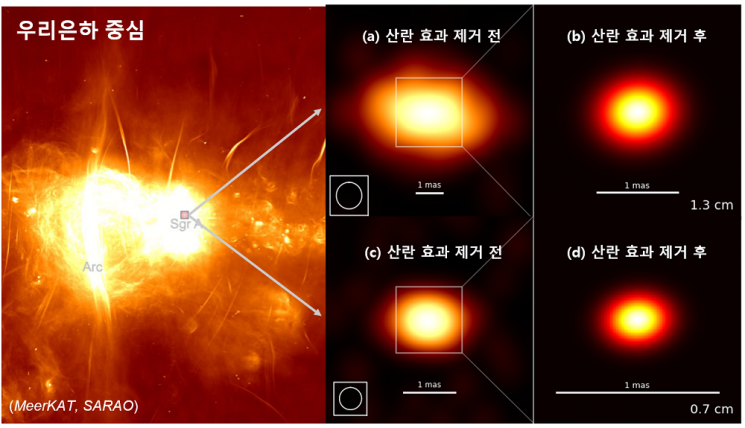
[Asia Economy Reporter Kim Bong-su] The supermassive black hole at the center of our galaxy, the closest to Earth, known as 'Sagittarius A Black Hole (Sgr A),' has been confirmed to have a round, circular shape.
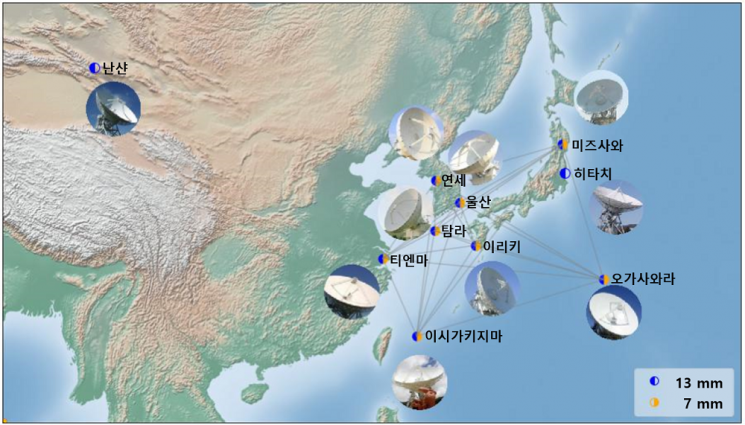
An international joint research team involving the Korea Astronomy and Space Science Institute announced on the 22nd that they revealed this fact through observations at 7mm and 13mm wavelengths using the East Asian VLBI Network (EAVN), centered on the Korean VLBI Network (KVN).
Since Sagittarius A is the closest supermassive black hole to Earth, it is the optimal target for studying phenomena occurring around black holes. Astronomers used VLBI (Very Long Baseline Interferometry) technology, which connects multiple radio telescopes on Earth to create a virtual telescope with an aperture as large as the distance between the telescopes, to reveal the detailed structure of this black hole. Additionally, to remove the scattering of light caused by gas clouds around the center of our galaxy, the latest scattering model research results were applied to the EAVN observation data.
As a result, the research team confirmed that the structure of Sagittarius A black hole is nearly circular. The East Asian VLBI Network consists of a total of 21 radio telescopes, including three KVN telescopes owned by Korea. In this study, 10 telescopes participated in observations at the 1.3cm wavelength band, and 8 telescopes participated in the 7mm wavelength observations. All three KVN telescopes participated in both wavelength observations.
The observation of Sagittarius A black hole as a circular shape implies that the rotation axis of the accretion flow formed by the black hole pulling in surrounding gases by gravity is pointing toward our solar system. The size of the black hole observed this time indicates that the accretion flow around the black hole contains electrons accelerated to speeds close to the speed of light and magnetic fields.
Regarding the origin of the radio emission from Sagittarius A black hole, a long-standing debate continues over whether it comes from the accretion flow or jets. This study improved the predictions of the accretion flow model, but the jet origin theory cannot yet be ruled out. To more definitively identify the origin of the radio emission, the research team plans to conduct long-term monitoring observations using Earth-sized VLBI telescopes with shorter wavelengths such as the Event Horizon Telescope, space VLBI using satellite radio telescopes, and multi-wavelength receivers. Based on this, they aim to clarify the detailed structure of Sagittarius A black hole and the locations of radio emission at different wavelength bands, thereby elucidating the origin of radio emission at the center of our galaxy.
Dr. Cho Il-je, the first author of this study, said, “Although Sagittarius A black hole is much closer than the M87 black hole, which was observed for the first time in history, it is surrounded by gas clouds causing scattering, making it a more difficult celestial object to observe,” adding, “Through observations with the East Asian VLBI Network, we corrected the scattering effects and were able to see the true appearance of the black hole close to us.”
The results of this study were published on the same day in The Astrophysical Journal.
© The Asia Business Daily(www.asiae.co.kr). All rights reserved.
![Clutching a Stolen Dior Bag, Saying "I Hate Being Poor but Real"... The Grotesque Con of a "Human Knockoff" [Slate]](https://cwcontent.asiae.co.kr/asiaresize/183/2026021902243444107_1771435474.jpg)

















