Ministry of Industry Holds 'Ukraine Situation and Export Status Review Meeting'
"Ukraine Situation, Real Economy Risk Factor... Must Prepare Thoroughly"
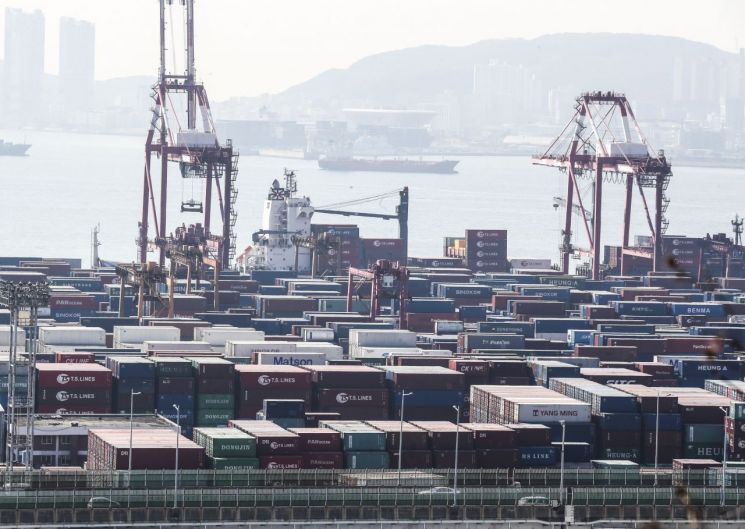 Exports Decreased by 12.6% from February 1 to 10 Due to Reduced Working Days During Lunar New Year Holiday
(Busan=Yonhap News) Photo by Kang Deok-cheol = On the morning of the 11th, container unloading operations are underway at Gamman Pier, Busan Port. The Korea Customs Service announced on the 11th that the export amount (provisional customs clearance basis) from February 1 to 10 was 15.7 billion dollars, down 12.6% compared to the same period last year. The number of working days during this period was 6.5 days, two days fewer than last year. Last year, the Lunar New Year holiday was from February 11 to 13, but this year it was about ten days earlier. Considering the number of working days, the average daily export amount increased by 14.2%. 2022.2.11
kangdcc@yna.co.kr
(End)
<Copyright(c) Yonhap News Agency, Unauthorized reproduction and redistribution prohibited>
[Asia Economy Sejong=Reporter Lee Jun-hyung] As the trade deficit continues for the second consecutive month and tensions surrounding Ukraine escalate, the government has decided to inject trade insurance worth 100 trillion won in the first half of this year.
On the 22nd, the Ministry of Trade, Industry and Energy held a 'Major Industry Ukraine Situation and Export Status Review Meeting' chaired by Yeohangu, Director General of Trade Negotiations, to discuss such measures. At the meeting, Director Yeoh reviewed recent import-export trends and export prospects by industry, and devised support measures to boost export vitality, stating, "The current situation of rapidly escalating military tensions surrounding Ukraine is a real economic risk factor that could hinder our export growth momentum."
Director Yeoh emphasized that proactive response is crucial at this point. This judgment is based on the fact that global supply chain issues, logistics difficulties, and rising raw material prices could pose potential risks to exports. Accordingly, the government decided to support 100 trillion won out of the 175 trillion won worth of trade insurance scheduled to be supplied this year in the first half. For export marketing such as export voucher payments, 110 billion won will be invested in the first half of this year to actively support export SMEs' financial difficulties and overseas market development. In addition, until the global logistics crisis eases, the government will expand joint public-private efforts to increase shipping space supply and logistics cost support, and expand logistics and port facilities.
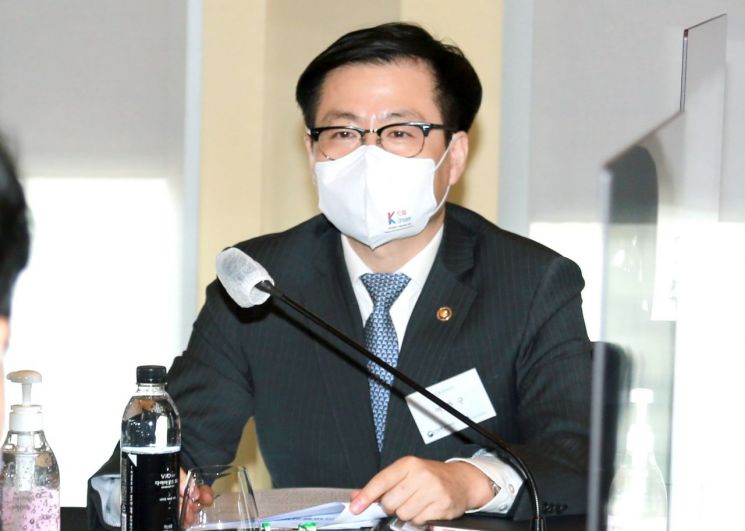 Yeo Han-gu, Chief Negotiator for Trade, Attending the International Trade Security Forum
(Seoul=Yonhap News) Yeo Han-gu, Chief Negotiator for Trade at the Ministry of Trade, Industry and Energy, is delivering a greeting at the 1st International Trade Security Forum held at the Four Seasons Hotel in Gwanghwamun, Seoul, on the 17th. 2022.2.17
[Provided by the Ministry of Trade, Industry and Energy. Redistribution and DB reproduction prohibited]
photo@yna.co.kr
(End)
<Copyright (c) Yonhap News, Unauthorized reproduction and redistribution prohibited>
The Ministry of Trade, Industry and Energy expects the trade balance to gradually improve. The trade balance recorded a deficit for two consecutive months from December last year due to the impact of soaring energy prices. If the trade balance records a deficit until this month, it will be the first three consecutive months of deficit since the 2008 global financial crisis. However, exports last year achieved record-high results and maintained double-digit growth rates since March last year. The ministry believes that the trade balance hit its bottom last month as export fundamentals remain solid, centered on semiconductors and petrochemicals.
However, the increasing supply chain risks due to the Ukraine situation and other factors remain variables. Accordingly, the ministry actively utilizes the newly established 'Global Supply Chain Analysis Center' as of the 9th of this month to continuously analyze early warning signs of supply chain crises by country. The 'Supply Chain Solidarity and Cooperation Partnership' will also be expanded, focusing on key supply chain countries possessing core mineral and raw material production capabilities.
Director Yeoh stated, "As our companies operate on the global stage, external risks such as supply chain restructuring and trade and commerce issues are emerging as key challenges," adding, "We plan to firmly establish the foundation for $700 billion in exports this year and promote a 'wealth-creating trade policy' that can overcome supply chain crises."
© The Asia Business Daily(www.asiae.co.kr). All rights reserved.


















