Asking the Four Leading Candidates for the Next Bank of Korea Governor
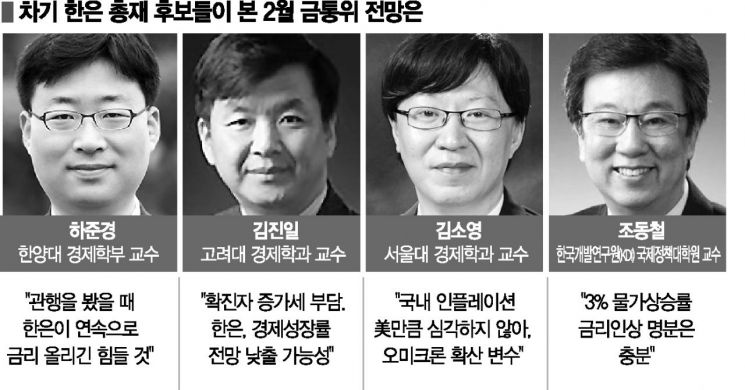
[Asia Economy reporters Seo So-jung and Moon Je-won] With the Financial Monetary Policy Committee of the Bank of Korea, which decides the base interest rate, just one day away, economic experts who are considered candidates for the next Bank of Korea governor weighed in favor of maintaining the current 1.25% rate.
On the 23rd, Asia Economy conducted a survey of four economic experts from government and academia who are being considered as candidates for the next Bank of Korea governor regarding whether the base interest rate would be raised in February. Three of them predicted that the rate would be held steady. Since the base rate was raised by 0.25 percentage points in August and November last year and again in January this year, it is highly likely that the Bank of Korea will take a breather this month.
Professor Ha Jun-kyung of Hanyang University’s Department of Economics, who is participating in the campaign of Lee Jae-myung, the Democratic Party candidate, said, "The Bank of Korea will maintain its rate hike stance, but whether it will raise rates in February is another matter," adding, "Unless unusual data emerges, it is highly likely that they will pause this time." Professor Ha explained, "If rates are raised consecutively in January and February, that itself could send a signal to the market," and "This means the shock to the market could be even greater." He also predicted, "Depending on how quickly U.S. monetary policy normalizes and the domestic inflation situation, there will be around two rate hikes this year."
Professor Kim So-young of Seoul National University’s Department of Economics, who serves as head of the economic policy division in Yoon Seok-youl’s campaign headquarters, also predicted a rate freeze and emphasized the need to closely watch inflation data. Professor Kim diagnosed, "While the U.S. experienced severe inflation with the January Consumer Price Index (CPI) showing the largest increase in 40 years, Korea’s indicators were relatively milder, so it is likely to adopt a wait-and-see approach." She added, "It is also crucial to see whether the recent rapid spread of Omicron will negatively impact the economy."
Professor Kim Jin-il of Korea University’s Department of Economics also forecasted a rate freeze. He said, "The minutes of the January Monetary Policy Committee meeting show remarks by some members that after two rate hikes in August and November last year, it is necessary to observe the ripple effects," adding, "Such expressions have been a ‘code word’ indicating that rates would not move for one or two more times, and considering this is Governor Lee Ju-yeol’s last Monetary Policy Committee meeting, I expect a freeze." There are concerns that a sharp increase in the base interest rate could lead to higher loan interest rates, increasing the interest burden on ordinary households and self-employed individuals.
On the other hand, Professor Cho Dong-chul of the Korea Development Institute (KDI) Graduate School of International Policy responded with ‘no comment’ regarding a February rate hike but emphasized, "A 3% inflation rate is sufficient justification for a rate hike," and stressed, "What the Bank of Korea needs to focus on is predicting and responding to how long domestic inflation will persist and how high it will rise."
© The Asia Business Daily(www.asiae.co.kr). All rights reserved.
![Clutching a Stolen Dior Bag, Saying "I Hate Being Poor but Real"... The Grotesque Con of a "Human Knockoff" [Slate]](https://cwcontent.asiae.co.kr/asiaresize/183/2026021902243444107_1771435474.jpg)
















