YouTube Premium Service Includes YouTube Music for 10,450 KRW per Month
Domestic Companies Lagging in Price Competitiveness
[Asia Economy Reporter Kang Nahum] "Google is dominating the domestic music streaming platform market through bundling, threatening the survival of the music platform industry, yet the government is completely hands-off, which is frustrating."
YouTube Music has risen to become the second-largest music streaming platform in South Korea. Domestic industry players are expressing dissatisfaction, claiming that Google is increasing its market share by bundling 'YouTube Music' with the YouTube Premium service. The Fair Trade Commission is also closely monitoring this issue.
Google's Bundling Pushes It to 2nd Place in Korean Music Platform Market
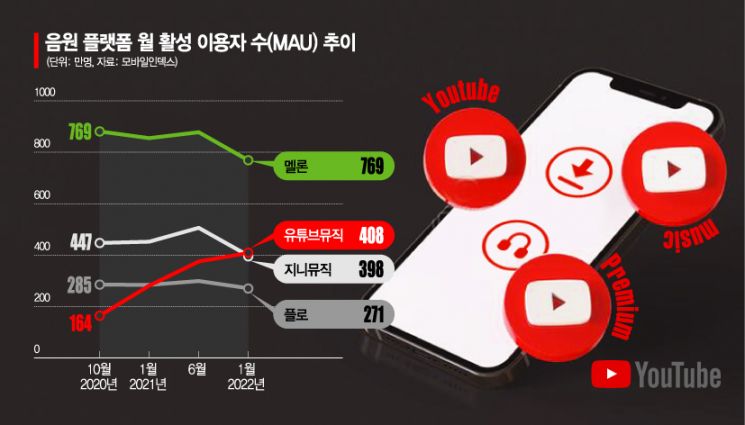
According to mobile big data analytics firm Mobile Index, in January, Google’s YouTube Music had 4.08 million monthly active users (MAU), surpassing Genie Music’s 3.98 million to become the second-largest player in the domestic market.
Google, which ranked fourth in 2020 with 1.64 million users, has increased its user base by over 2 million in two years. While YouTube Music’s user numbers have surged, domestic music platform service providers have either stagnated or declined. Melon, the market leader, had 8.81 million MAU in 2020 but dropped to 7.69 million in January. Genie Music, previously the second-largest with 5 million MAU, also fell to 3.98 million in January. If this trend continues, some predict that YouTube Music could surpass Melon (7.69 million) by next year.
Google bundles YouTube Music with its YouTube Premium service. The YouTube Premium service, priced at 10,450 KRW per month, is used to remove ads on YouTube, and YouTube Music is provided free of charge. Domestic music platform providers offer unlimited streaming services at around 10,000 KRW per month. Given that YouTube Premium offers ad-free YouTube viewing plus music service at a similar price, domestic companies inevitably lose out in price competitiveness.
The majority of consumers subscribe to YouTube Premium to remove ads on YouTube. YouTube Music focuses more on streaming than downloads and initially lacked competitiveness due to its emphasis on international music rather than domestic tracks. However, by securing a large volume of domestic music and instilling the perception that "YouTube Music is free with YouTube Premium," subscriber numbers have surged. Meanwhile, domestic companies that only provide music services face declining competitiveness both in price and service quality.
The domestic music platform industry is preparing countermeasures against Google’s bundling of YouTube Music. An industry insider said, "All YouTube Premium purchasers can be converted into paid music users, which puts domestic pure music platforms at a significant disadvantage in securing users." He added, "Although specific countermeasures have not yet been formulated, domestic music service providers are facing unfair discrimination and plan to request a fair judgment from the authorities."
There are also concerns that YouTube’s monopolistic position is being transferred to other platforms. Professor Yoo Byung-jun of Seoul National University’s Business School stated, "This should be seen as the dominant position of the world’s number one video platform transferring to the music platform." He added, "The government should examine fairness to ensure that domestic consumers and businesses are not harmed by Google’s different policies by country."

Google Faces Repeated Penalties but Continues Same Practices
Google’s expansion of market dominance based on its monopolistic position is nothing new. Leveraging its operating system (OS) monopoly, Google has extended its dominance across search, app markets, YouTube, and browsers. In South Korea, until the so-called ‘Google Gapjil Prevention Act (Amendment to the Telecommunications Business Act)’ was passed, Google only allowed its own payment system in its app market and forced Samsung smartphones to pre-install its OS, resulting in a 200 billion KRW fine from the Fair Trade Commission.
Google Photos, which started as an ‘unlimited free’ service, surpassed 1 billion users worldwide. When competitors exited the market, Google suddenly revamped the service into ‘Google One’ and switched to a paid model. This has drawn criticism for attracting users through free or bundled services, driving competitors out, and then monetizing the service.
An IT industry insider said, "Antitrust issues around Google always arise because when Google’s services thrive, related industries suffer or disappear." He added, "Authorities should closely monitor Google’s platform monopoly and the transfer of its dominance."
The authorities are also keeping a close watch on Google’s actions. A Fair Trade Commission official said, "Whether the bundling of YouTube Music restricts competition is a matter to be examined," adding, "We are currently monitoring the entire music platform industry."
© The Asia Business Daily(www.asiae.co.kr). All rights reserved.
!["The Woman Who Threw Herself into the Water Clutching a Stolen Dior Bag"...A Grotesque Success Story That Shakes the Korean Psyche [Slate]](https://cwcontent.asiae.co.kr/asiaresize/183/2026021902243444107_1771435474.jpg)

















