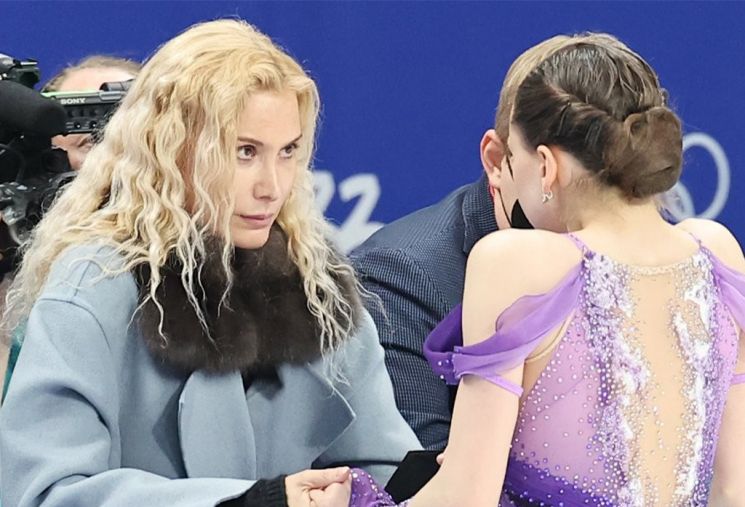
 Coach Eteri Tutberidze advising Kamila Valieva ahead of the short program in figure skating at the 2022 Beijing Winter Olympics.
 [Photo by Yonhap News]
[Asia Economy Reporter Kwon Seoyoung] Criticism is intensifying against Eteri Tutberidze, the coach of Kamila Valieva (15), a figure skater representing the Russian Olympic Committee (ROC) who participated in the Olympics but became embroiled in a doping scandal.
On the 17th, Tutberidze came under fire for her attitude toward Valieva after the women's singles free skating event at the 2022 Beijing Winter Olympics. Despite the doping controversy, Valieva was allowed to compete in the individual event following the decision of the Court of Arbitration for Sport (CAS), but she made multiple mistakes in the free skate and finished in 4th place, failing to win a medal. Afterwards, she left the ice rink covering her tears with both hands.
However, Tutberidze immediately scolded Valieva, asking, "Why did you give up? Why did you stop competing?" This scene was broadcast worldwide. Tutberidze, who coached all three ROC athletes participating in this Olympics, previously produced gold medalists such as Yulia Lipnitskaya, the 2014 Sochi Winter Olympics team event gold medalist, Alina Zagitova, the 2018 Pyeongchang Winter Olympics women's singles gold medalist, and silver medalist Evgenia Medvedeva, but her harsh coaching methods have always been controversial.
 A video circulated online showing coach Eteri Tutberidze's violent training methods.
 [Photo by Online Community Capture]
Some criticize Tutberidze for treating teenage athletes like disposable items. Figure skaters before puberty, who have lighter bodies, can perform spins and jumps more easily and are less likely to suffer injuries during training. However, as their bodies begin to change, these athletes often lose their skills rapidly and are easily replaced by younger skaters who can perform more difficult techniques. In fact, most of the athletes she coached retired before reaching adulthood.
On the 18th, European sports media outlet EuroPost reported that Tutberidze has used extremely harsh training methods while developing teenage athletes. According to the report, Tutberidze made young skaters practice quadruple jumps for 12 hours a day and imposed extreme diets, such as feeding them only powdered food to delay their secondary sexual characteristics.
As Tutberidze's coaching methods became controversial, some domestic online communities posted threads titled "Tutberidze Training Methods," sparking public outrage. These posts included videos showing Tutberidze grabbing and spinning a skater by the hair. Netizens reacted with comments such as, "This is not strictness but close to abuse," and "Even without knowing the full context, it seems like a rather extreme training method."
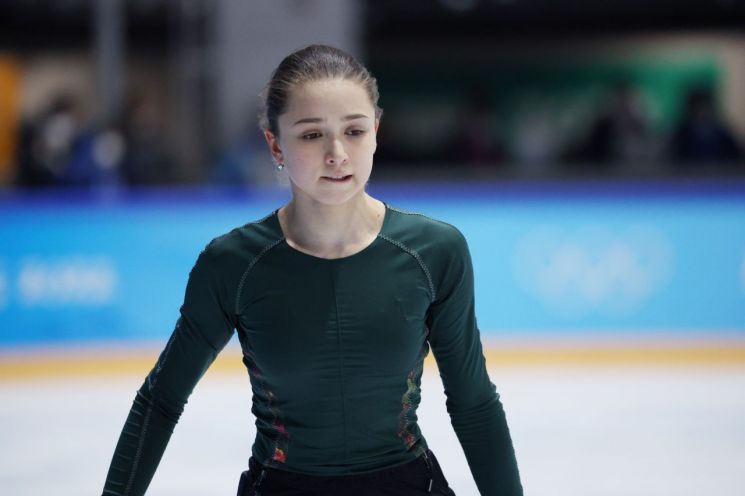 Kamila Valieva, a figure skating athlete of the Russian Olympic Committee (ROC), who caused controversy by testing positive for doping.
 [Photo by Yonhap News]
However, the Russian side expressed a different opinion. On the 20th, the American magazine Sports Illustrated (SI) reported that Dmitry Peskov, spokesperson for the Kremlin, defended Tutberidze. At a press conference on the 18th, he said, "Thomas Bach, the IOC president, is a very authoritative figure in the global sports community," but added, "We respect his opinion but do not necessarily agree with it."
Peskov stated, "President Bach does not like the strictness of our coaches, but everyone knows that in high-level sports, this is the key to athletes' victories." He continued, "Let's be proud. Congratulations to the medalists," and added, "Valieva finished 4th, but in high-level sports, that was the strongest victory."
Meanwhile, President Bach previously said at a post-event press conference, "Watching Valieva's performance, I was pained by the enormous pressure she must have felt," and "I was horrified by how those close to Valieva (such as her coach) treated her." He also emphasized the coach's responsibility regarding doping issues, stating, "It is rare for a minor athlete to take banned substances on their own," and "The use of banned substances usually starts with assistance from those close to the athlete."
© The Asia Business Daily(www.asiae.co.kr). All rights reserved.



















