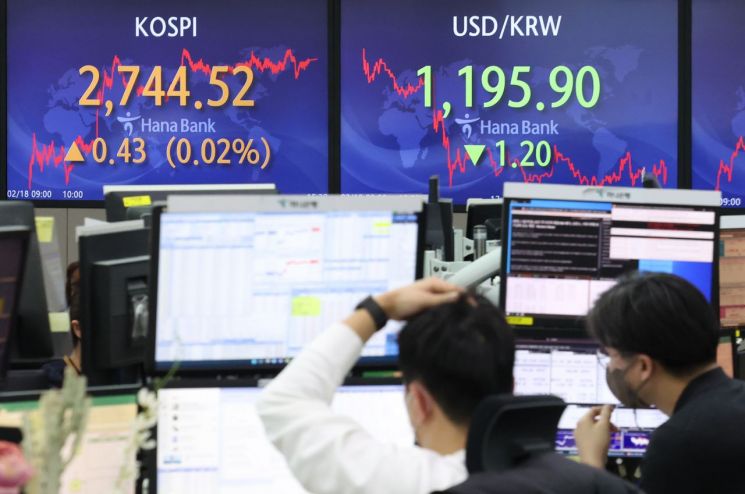
[Asia Economy Reporter Lee Seon-ae] This week (21st-25th), the KOSPI index is expected to continue a volatile market as investors remain cautious of risks stemming from the Ukraine conflict and the sharp rise in international oil prices.
Market analysts identified the biggest variables for the KOSPI index from the 21st to the 25th as geopolitical risks between Russia and Ukraine and international oil prices, expecting fluctuations around the 2700 level.
Yumi Kim, a researcher at Kiwoom Securities, explained, “Both Russia and Ukraine seem to be avoiding the extreme choice of war for now,” but added, “Since it is difficult for the two countries to narrow their differences in the short term and the situation is hard to predict, geopolitical risks will continue to weigh on the market for the time being.”
The sharp rise in international oil prices caused by these geopolitical risks is also expected to be a factor pulling down the KOSPI index. The average price per barrel of West Texas Intermediate (WTI), the benchmark for international oil prices, was around $57.8 in the first quarter of last year but recently surged to the $90 range.
Woongchan Lee, a researcher at Hi Investment & Securities, said, “For oil prices to fall, geopolitical risks need to ease further and oil supply and demand must stabilize,” adding, “Oil inventories recently hit their lowest level in five years, and production is rapidly increasing in major OPEC countries, but the pace of production increase in the U.S. is slow, and it is uncertain whether other major countries will increase production further.”
Views on concerns about U.S. monetary tightening are divided. Although the minutes of the January Federal Open Market Committee (FOMC) meeting highlighted a less hawkish stance than the market expected, caution is likely to persist until the March meeting. The Federal Reserve (Fed) is also showing mixed hawkish and dovish comments.
Hee-chan Park, a researcher at Mirae Asset Securities, explained, “The possibility of a big step rate hike at the March meeting cannot be ruled out, and since there are no scheduled public remarks by Fed Chair Jerome Powell for the time being, cautious sentiment will continue.” Eun-taek Lee, a researcher at KB Securities, added, “The Fed’s ambiguous stance inevitably leads to market uncertainty.”
Meanwhile, securities firms unanimously agreed that reopening stocks deserve attention in a market exposed to various external variables.
Jae-seon Lee, a researcher at Hana Financial Investment, said, “Expectations for a rebound in reopening stocks have increased due to the easing of domestic and international quarantine guidelines,” adding, “Reopening stocks have not risen sufficiently because of the constantly changing quarantine policies, so it is hard to say that current prices are overvalued.”
He continued, “For a sustained rebound, it is important that profit influence expands, but operating profits have not yet shown a clear upward trend this year,” and added, “Sectors with upward revisions in operating profits since February include transportation and IT, including semiconductors.”
Notable events this week include the release of South Korea’s February export and import data on the 21st, the consumer sentiment index on the 22nd, and the U.S. manufacturing and services Purchasing Managers’ Index (PMI) announcements.
© The Asia Business Daily(www.asiae.co.kr). All rights reserved.