From the 21st, 'Annual 9% Interest Effect' Youth Hope Savings Launched
Subscription Eligibility Inquiries Reach 2 Million
Government Budget Limits Make It Difficult to Accept All Applicants
[Asia Economy Reporter Sim Nayoung] Ahead of the launch of the Youth Hope Savings Account, which offers an 'annual 9% interest rate effect,' interest among people in their 20s and 30s is high, with inquiries about eligibility reaching 2 million cases. According to the financial sector on the 20th, the number of preview applications to check eligibility for the Youth Hope Savings Account at the five major commercial banks (KB, Shinhan, Hana, Woori, NongHyup) exceeded 1.5 million as of the 18th. Including the remaining six banks (Industrial Bank, Busan, Daegu, Gwangju, Jeonbuk, Jeju) among the total 11 banks launching the product, the total number of inquiries is estimated to reach 2 million, according to the financial sector.
As a youth financial policy that resonates strongly with the public has appeared, not only finance influencers but also economic blogs and even job seekers' internet cafes are abuzz. Eventually, a delay occurred in the 'preview service' that allows customers to check their eligibility for the savings account at each bank.
Within the Financial Services Commission, there is surprise, saying, "We thought young people these days would only be into coins or stocks, but we did not expect such a big response to savings accounts." However, there is concern that since the government budget limit is fixed, it will be difficult to accept all applicants, and that even with a 9% annual rate, the interest calculation methods for fixed deposits and savings accounts differ, which could lead to misunderstandings among subscribers.
Government Budget Limit Set,
Difficult to Accept All Applicants
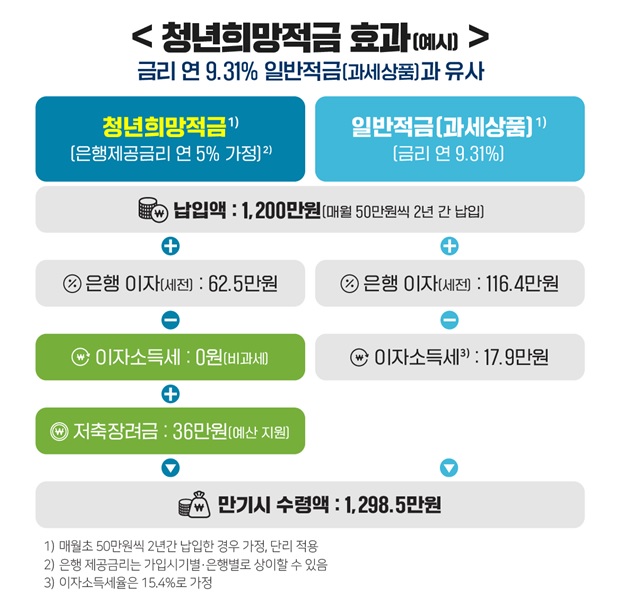
The total budget set by the Financial Services Commission for the Youth Hope Savings Account product is 45.6 billion KRW. The interest is paid by the banks, and this budget is used for a savings incentive added on top of the interest. A Financial Services Commission official explained, "The bank pays subscribers an annual 5% interest rate, and if the two-year term is completed, a savings incentive of 2% of the first-year payment and 4% of the second-year payment is provided from the government budget." He added, "With exemptions from interest income tax and special rural tax, it can effectively yield an annual interest rate of about 9%." If one deposits 500,000 KRW monthly for two years, they will receive a total of 985,000 KRW in interest, including 625,000 KRW in interest and 360,000 KRW in savings incentives.
 On the 29th, ahead of the start of the second semester of the 2021 academic year, the bulletin board announcing boarding houses, one-room apartments, and monthly rental rooms near Chung-Ang University in Dongjak-gu, Seoul, is empty. Photo by Jinhyung Kang aymsdream@
Since the payment amounts vary by subscriber, it will only be clear how quickly the 45.6 billion KRW budget will be exhausted once subscriptions start on the 21st. The financial sector predicts, "Budget exhaustion is only a matter of time." Assuming subscribers pay the maximum monthly amount (500,000 KRW), the budget can support about 380,000 people, providing 120,000 KRW per person (2% of the first-year payment). Given that preview inquiries alone have exceeded 2 million, competition for applications may be fierce. Banks are also fueling subscription enthusiasm by offering luxury wallets worth 700,000 KRW as prizes to attract young customers. Starting from the 21st, applications will be accepted on a first-come, first-served basis at 11 banks, with Gyeongnam Bank launching on the 28th and SC First Bank scheduled to launch in June. However, the Financial Services Commission explains that once the budget runs out, further product launches will be difficult.
Different Interest Calculation Methods for Fixed Deposits and Savings Accounts May Cause Misunderstandings
Complaints About Eligibility Based Solely on Age and Income
The Financial Services Commission also urges, "We want young people to understand that the interest calculation methods for fixed deposits and savings accounts differ." If a youth deposits 500,000 KRW monthly for two years, the total is 12 million KRW, but the interest earned differs greatly from putting the entire amount into a fixed deposit at 9% annual interest from the start. Simple calculations show that 2.16 million KRW in interest would be earned with a 9% fixed deposit over two years, but the Youth Hope Savings Account yields only about 985,000 KRW, less than half. A Financial Services Commission official said, "Since some are new to savings accounts, if they do not fully understand this, they may be disappointed to find the interest received is much smaller than expected."
The Youth Hope Savings Account is available to those who meet the age (18 to 34 years old) and income (total annual salary of 36 million KRW or less in 2021) criteria. There are no restrictions based on occupation or company size. However, there are complaints about eligibility being determined solely by age and income. Since there is no separate asset ceiling, those who own houses or commercial properties can apply, while those without assets but with an annual salary exceeding the eligibility criteria may be unable to subscribe. Some applicants who failed to meet the income requirements expressed dissatisfaction, saying it was unfair. There are cases where unemployed or part-time workers cannot apply because they have no income records, even though their economic situation is more difficult.
© The Asia Business Daily(www.asiae.co.kr). All rights reserved.
![Clutching a Stolen Dior Bag, Saying "I Hate Being Poor but Real"... The Grotesque Con of a "Human Knockoff" [Slate]](https://cwcontent.asiae.co.kr/asiaresize/183/2026021902243444107_1771435474.jpg)

















