Three New Smart City Services Utilizing Advanced ICT Technologies such as Robots, AI, and IoT
'Autonomous Robots' Patrol Children’s Grand Park and Tancheon Dullegil to Detect and Alert Emergency Situations, Support Daily Quarantine
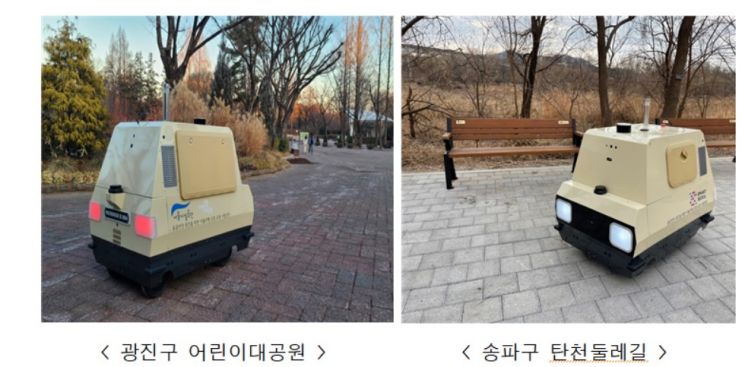
[Asia Economy Reporter Lim Cheol-young] On the 20th, the Seoul Metropolitan Government announced that it will introduce smart city services based on advanced ICT technologies such as robots, artificial intelligence (AI), and the Internet of Things (IoT) to solve everyday problems faced by citizens, including crime patrols, illegal parking detection, and separation of household waste.
Seoul has established and begun full operation of ▲‘Autonomous Patrol Robot’ service ▲‘Electric Vehicle Charging Zone Monitoring’ service ▲‘IoT Transparent PET Bottle Recycling Bin’ service. The ‘Autonomous Patrol Robot’ is a service combining various ICT technologies such as robots, AI, and IoT, measuring 751mm in width, 1,102mm in length, and 1,077mm in height. In case of emergencies in public places, it enables rapid response to prevent accidents and crimes, helping citizens use parks more safely even at night, and supplements patrol and disinfection duties.
Two units are operated, one each in Gwangjin-gu Children’s Grand Park and Songpa-gu Tancheon Trail, popular spaces for citizens to relax and exercise such as walking and jogging. This autonomous patrol robot was approved as a regulatory sandbox demonstration special zone, where legal regulations are waived or exempted under certain conditions to allow the application of new industries and technologies.
Seoul plans to enhance the service by operating the robot with multi-environment sensing and AI-based incident recognition, accelerating the commercialization of autonomous patrol robot services and responding to the increased demand for non-face-to-face services due to COVID-19. The collected driving data will be used as basic data to improve legal regulations on autonomous driving robots.
Additionally, the ‘Electric Vehicle Charging Zone Monitoring’ service uses IoT parking detection sensors to recognize vehicle license plates entering the parking zone through the Ministry of Environment’s vehicle number inquiry system, verifying whether the vehicle is electric. If it is not an electric vehicle, the service alerts illegal parking with voice guidance saying, “This is an electric vehicle charging zone. Please park elsewhere,” and activates a warning light. This service expands the ‘Disabled Parking Zone Monitoring’ service currently implemented in Yangcheon-gu and Gangnam-gu to prevent illegal parking in electric vehicle charging zones.
The service is implemented at 10 electric vehicle charging spots in public parking lots (Doksan 4-dong, Siheung 4-dong, Multipurpose) within Geumcheon-gu. The city expects this service to contribute to securing electric vehicle charging zones, improving charging convenience for electric vehicle drivers, and enhancing parking culture in charging zones. In fact, during the one-month trial in December last year, about 80% of vehicles immediately left within 5 minutes after receiving the warning light and voice guidance, confirming the educational effect.
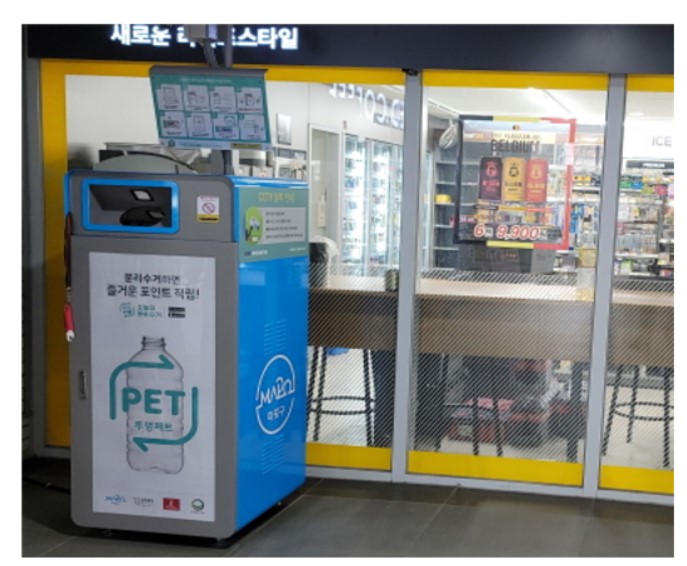
The ‘IoT Transparent PET Bottle Recycling Bin’ is a recycling bin based on IoT technology. When transparent PET bottles are disposed of here and a QR code is scanned using a dedicated mobile app, points are accumulated in the user’s app. It is expected to increase the recycling rate of transparent PET bottles as eco-friendly raw materials, thereby expanding the resource circulation effect of household waste. The built-in camera on the recycling bin applies deep learning technology, automatically opening and closing the input slot when a PET bottle is recognized.
Citizens earn 10 points per PET bottle deposited, which can be used to purchase items at convenience stores and other places. When 100 points are accumulated, users can redeem a 200ml milk, and with 2,000 points, they can purchase pizza or upcycled T-shirts. Additionally, the amount of collected PET bottles is transmitted online so that managers can immediately check the status.
A total of 10 units have been installed in Mapo-gu in areas densely populated or frequented by single-person households and young people, universities, public libraries, youth housing, and art centers. Although transparent PET bottles are eco-friendly raw materials capable of producing long fibers, their recycling rate is low. Due to the continuous increase in plastic consumption caused by the rise of single-person households and young adults in their 20s and 30s, recycling bins have been installed in locations heavily used by young people.
Park Jong-su, Director of Seoul’s Smart City Policy Division, said, “Seoul is actively discovering and promoting smart city services to solve various safety and environmental problems arising in citizens’ living environments through cutting-edge ICT technologies. In the future, services with high citizen satisfaction and efficiency will be expanded citywide to realize a safer and more convenient smart city Seoul.”
© The Asia Business Daily(www.asiae.co.kr). All rights reserved.
![Clutching a Stolen Dior Bag, Saying "I Hate Being Poor but Real"... The Grotesque Con of a "Human Knockoff" [Slate]](https://cwcontent.asiae.co.kr/asiaresize/183/2026021902243444107_1771435474.jpg)

















