Bank Loan Interest Rates Rise Sharply
Monthly Mortgage Interest Payments Increase by Tens of Thousands of Won
Salary Workers with Personal Loans Also Face Rising Interest Rate Burdens
[Asia Economy Reporters Sim Nayoung and Song Seungseop] As bank loan interest rates rise sharply, the new term ‘Yeongkkeul Interest’ is spreading. Bank loan interest rates have been on the rise since the third quarter of last year. Following the Bank of Korea’s three consecutive base rate hikes from August last year to January this year, the mortgage loan interest rates at commercial banks, which were in the 2-3% range, have increased to 3-5%.
"Now I have to gather even my soul to pay the interest," comments from borrowers poured in under a post on an office worker community. "I was shocked when I went to extend my loan and the interest rate jumped from 2% to 4%," "In the era of Yeongkkeul interest, the homeless have a mysterious first victory."
"Those who bought houses by Yeongkkeul will face even greater pressure ahead"
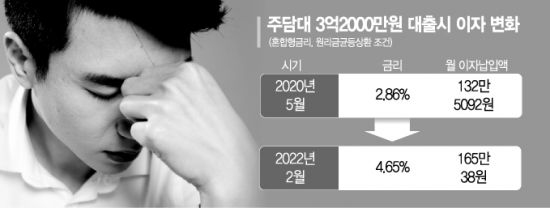
Compared to those who bought homes during the ‘zero base rate’ period, office workers trying to buy apartments amid the current interest rate hike have to pay much more interest. For example, someone who took out a 320 million KRW mortgage loan (hybrid type) in May 2020 at an interest rate of 2.86% paid 1,325,092 KRW monthly in interest. Applying the same conditions to a mortgage loan application in February now, with an interest rate of 4.65%, the monthly interest alone reaches 1,650,038 KRW (see table). This means paying about 320,000 KRW more per month than two years ago for the same house.
Those who took out loans with variable interest rates have also seen their interest burdens increase. A representative from a commercial bank said, "People who bought homes with variable interest rates when rates were at their lowest one to two years ago have also been affected by the recent rate hikes, likely increasing their monthly interest payments by tens of thousands of KRW."
Office workers with unsecured loans have also faced increased interest burdens. For example, an office worker who took out a 50 million KRW overdraft loan from an internet bank saw the loan interest rate rise from 2.64% in February last year to 4.58% now, resulting in an additional 970,000 KRW in annual interest payments. During this period, the bank raised the loan interest rate by 0.89 percentage points, reflecting the 1-year financial bond rate increase of 1.05 percentage points, which is the benchmark for unsecured loans. The government’s policy to strengthen mid-interest loans also influenced this, as existing high-credit borrowers who applied for loan extensions faced increased interest rates.
Professor Kim Sangbong of Hansung University’s Department of Economics said, "Along with the increased interest burden, the government’s expansion of housing supply will further increase the pressure on office workers who bought homes by Yeongkkeul."
As the base interest rate hikes push up loan interest rates at private banks, a paradoxical phenomenon is occurring where high-credit borrowers in need of loans are turning to secondary financial institutions. This ‘loan interest rate inversion’ caused by government and financial authorities’ regulations has continued into the beginning of the year. Some mutual savings banks have even been offering ultra-low interest unsecured loans, which are rarely found, to meet this demand.
Asia Economy reviewed the loan interest rates by credit rating at 1,297 Saemaeul Geumgo (mutual savings banks) nationwide and found that as of the end of last month, 991 of them provided loans to high-credit borrowers rated 1 to 3. Among these, six mutual savings banks offered ultra-low interest unsecured loans in the 1% range. The five major banks?KB Kookmin, Shinhan, Hana, Woori, and NH Nonghyup?offered unsecured loan interest rates of 3.42% to 3.78% to high-credit borrowers rated 1 to 2 last month. This means loans at Saemaeul Geumgo, a secondary financial institution, were more than 2 percentage points cheaper than those at primary financial institutions.
The Saemaeul Geumgo with the lowest interest rate was Hwagog Geumgo, with an average unsecured loan interest rate of 1.38% for high-credit borrowers rated 1 to 3. It was followed by Sangok 2 and 4-dong Geumgo at 1.48%, Kumho (1.55%), Sejong (1.73%), Uijeongbu Singok (1.77%), and Yongdu (1.87%). Among these, only Sejong Geumgo was a workplace mutual savings bank; the other five were regional mutual savings banks.
Sixteen mutual savings banks offered unsecured loans in the low-interest 2% range. Additionally, 118 mutual savings banks provided loans in the 3% range, similar to commercial banks.
Even if secondary financial institutions offer lower rates, credit score drops are inevitable
It is unusual for loan interest rates at secondary financial institutions to be lower than those at commercial banks. Commercial banks, which belong to the primary financial sector, have many ways to raise funds cheaply, such as bond issuance, due to their high credit ratings, and have lower default costs, allowing them to maintain lower loan interest rates. On the other hand, secondary financial institutions rely almost exclusively on deposits for funding and face higher default risks, so their interest rates are generally higher than those of primary financial institutions.
This financial distortion is observed across the mutual savings bank sector. According to the Bank of Korea, the average unsecured loan interest rate at mutual savings banks was 4.30% at the end of last year, 0.82 percentage points lower than the 5.12% at commercial banks. Over the past three years, mutual savings banks’ loan interest rates were generally 0.2 to 0.6 percentage points higher than commercial banks, but since the second half of last year, the rates have inverted and this trend continues.
The financial authorities have attributed the cause of the interest rate inversion to ‘ample liquidity,’ ‘narrowing funding cost gaps,’ and ‘regulatory easing for secondary financial institutions.’ At the end of last year, the Financial Services Commission issued a statement saying, "(The interest rate inversion) has continued since the beginning of the year and is unlikely to be the result of recent total debt management," and "It is essentially due to aggressive marketing by mutual savings banks targeting high-credit borrowers similar to banks."
However, industry insiders believe the ongoing interest rate inversion is closely related to government and financial authorities’ regulations. A mutual savings bank official explained, "Since mutual savings banks are secondary financial institutions, their funding costs and loan interest rates should be higher. However, as household loans at commercial banks exploded, regulations began, and interest rates were adjusted to reduce loan demand in the primary financial sector."
Nevertheless, many caution against blindly turning to secondary financial institutions just because their loan interest rates are lower. Loan execution at secondary financial institutions can cause credit score drops. This may lead to disadvantages in interest rates and loan limits when applying for additional loans at other financial institutions.
© The Asia Business Daily(www.asiae.co.kr). All rights reserved.


















