Delivered to Blockchain Network
Receive Cryptocurrency as Reward for Operational Participation
[Asia Economy Reporter Lee Jung-yoon] In the cryptocurrency trading market, where prices fluctuate multiple times a day, investors are recently flocking to "staking," which pays returns simply by entrusting cryptocurrencies for 1 to 2 years, similar to bank deposits. Staking refers to investors depositing their cryptocurrencies into a blockchain network to participate in the platform's operation and verification, receiving cryptocurrency rewards in return.
According to the industry on the 18th, recently, investors have been flocking to staking recruitment on cryptocurrency exchanges such as Upbit, Bithumb, and Korbit, centered around Ethereum. In the case of Upbit, the 6th round of staking for 5,120 Ethereum, which started on the 15th, was closed within two days. Converted to market value, this amounts to approximately 17.92 billion KRW (as of 9 a.m. on the 18th). Previously, the company's 1st recruitment of 640 Ethereum was closed in just 5 minutes. Korbit also sold out all 20 rounds of Ethereum staking recruitment, each round consisting of 320 Ethereum, and is currently recruiting for the 21st round.
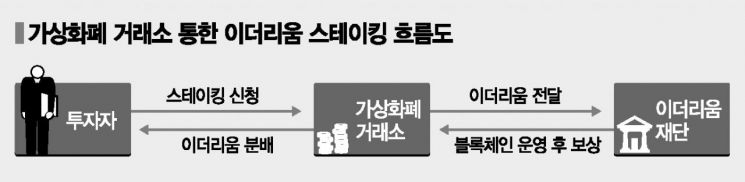
Ethereum staking is mainly conducted through exchanges. Although the Ethereum Foundation is the staking entity, the process is complicated and requires a minimum amount, making it difficult for general investors to participate directly. When an exchange receives an investor's Ethereum and transfers it to the blockchain, it is used for blockchain operation, verification, and upgrading the Ethereum ecosystem. Afterwards, investors receive back the increased amount of Ethereum at a certain rate. The staking completion is expected to take 1 to 2 years.
The reason investors are flocking to staking is due to the expected reward rates. Considering that Upbit currently offers an expected annual reward rate of 4.9%, it is higher than bank fixed deposits, which offer around 1 to 2% annually. Additionally, some cryptocurrencies offer double-digit reward rates for staking. For example, Bithumb offers an expected annual reward rate ranging from a minimum of 10% to a maximum of 15% for the cryptocurrency 'IPX.' Coinone explains that it offers 5.63% annually for cryptocurrencies Klaytn and Tezos, and 8.27% annually for Cosmos Atom.
Besides the high reward rates, the expectation that the price of staked cryptocurrencies may rise also attracts investors. Among Ethereum investors, there is talk that the price may increase after the ecosystem is upgraded upon staking completion. An industry official explained that the growing interest in staking, which requires long-term investment of 1 to 2 years, means "there are more investors taking a relatively long-term view in a cryptocurrency trading market dominated by short-term trading."
However, it should be noted that staking is not a safe product like bank deposits that pay interest at a fixed rate. During the staking period, investors cannot retrieve their cryptocurrencies, and if the cryptocurrency price falls, they must bear the losses.
© The Asia Business Daily(www.asiae.co.kr). All rights reserved.


















