Some Consumers' 'Customer Gapjil' Growing More Serious
Injuring Employees Over Attitude Displeasure
68.6% of Part-Timers Cite 'Customers' as Cause of Gapjil Experience
Experts Say "Preventive Measures Needed to Protect Workers"
 Recently, at a cafe in Anyang, Gyeonggi Province, a customer dissatisfied with the service poured hot coffee on a staff member's thigh, causing burns. / Photo by JTBC
[Asia Economy Reporter Lim Juhyung] The intensity of some customers' "gapjil" (abusive behavior by those in a superior position) toward business owners and employees in the service industry is increasingly severe. Beyond raising complaints or hurling insults, incidents of violence and injury are occurring. Critics point out that this is a problem stemming from some consumers perceiving the relationship between service workers and customers as a "gap-eul" (superior-subordinate) relationship. Experts advise that businesses need to implement various preventive measures to protect service workers.
According to a recent report by 'JTBC' on the 14th, an employee working at a cafe in Anyang, Gyeonggi Province, suffered burns on the thigh due to a customer's gapjil.
At the time, a customer in his 40s, Mr. A, who had ordered coffee for takeout, was waiting outside the store for his turn. The cafe is known to operate by taking orders from outside, then having an employee inside prepare the drink and hand it to the customer.
An employee at the cash register inside the store prepared the drink and handed it to Mr. A, but he suddenly became angry. He questioned, "Wasn't that the coffee you made earlier? Why are you giving it to me now?" He also verbally abused the employee, saying, "Is this how you were trained to make coffee?"
Flustered, the employee said, "I will make it again," and took the coffee from Mr. A's hand. However, Mr. A demanded, "Give it to me again," and when the employee extended the cup of coffee, he struck it with his hand, spilling the hot liquid onto the employee's thigh. This scene was fully captured on the store's closed-circuit television (CCTV).
The police plan to summon Mr. A after investigating the victim to accurately determine the circumstances of the incident.
Incidents of 'customer gapjil' are not new. In September last year, a customer Mr. B threw hot oil at the owner of a hotteok (Korean sweet pancake) shop in Daegu, causing burns, which sparked public outrage.
 Last year, a man in his 60s, Mr. A, was seen throwing hotteok at the oil container in a hotteok shop in Daegu / Photo by KBS Broadcast Capture
At that time, Mr. B ordered two hotteok at a shop in Daegu and requested to have them cut to share with his companions. However, the shop owner refused, citing a "cutting not allowed" sign posted inside the store. Mr. B became angry, cursed, and threw the hotteok into the frying oil.
The hot oil splattered everywhere, causing the shop owner to suffer second- and third-degree burns on the back of the right hand, shoulder, and chest. The owner was immediately transported to a nearby hospital and hospitalized for treatment.
Subsequently, Mr. B was prosecuted for causing burns to the shop owner, and on the 1st, the Daegu District Court Criminal Division 8 (Presiding Judge Park Seongjun) sentenced him to one year in prison.
The court stated, "The crime was committed in a moment of uncontrolled emotion, and the victim will live with lifelong scars and psychological pain. Considering that the defendant did not sincerely apologize or make efforts to compensate the victim, and that the victim requested severe punishment, these factors were taken into account in sentencing."
It is not only business owners who suffer from 'customer gapjil.' Employees and part-time workers who directly interact with customers also frequently experience such abusive behavior.
According to a 2020 survey conducted by the job search site 'AlbaMon' targeting 2,279 part-time workers, 75.5% responded that they had experienced gapjil while working.
The group that caused the most gapjil experiences for part-time workers was customers (68.6%), followed by bosses (40.8%), supervisors or seniors (25.7%), and regular employees (12.3%). For those in face-to-face service jobs, 'customer gapjil' is a bigger hardship than workplace gapjil.
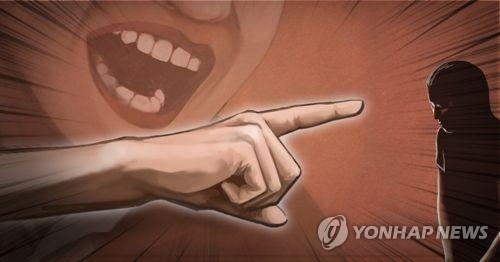 The most common power abuse experience among part-time workers in Korea was also power abuse from customers (68.6%). / Photo by Yonhap News
Experts point out that the biggest cause of 'customer gapjil' is some consumers' mistaken perception of the service purchase act. Many mistakenly believe that simply paying money to a service worker establishes a 'gap-eul' relationship.
Mr. C, a man in his 30s who has worked in the food service industry for five years, said, "Among some customers who engage in gapjil, many mistakenly think they are superior to the employees. They believe, 'I paid, so I have the right to be treated like a king while using the service.' I think this perception leads to 'customer gapjil.'"
Ms. D, a college student in her 20s who has worked part-time at cafes and convenience stores for about a year, said, "Not only older customers but also customers my age have treated me abusively. Employees are not servants; once the paid service is provided, that's it. No one has the right to demand excessive kindness and engage in gapjil," she emphasized.
Experts advise that business owners or commercial associations need to establish preventive measures to curb excessive gapjil behavior.
Professor Lee Eunhee of Inha University's Department of Consumer Studies explained, "If a customer commits serious gapjil involving verbal or physical violence, business owners should be able to take preventive measures to protect themselves and their employees. This could include posting warning signs about gapjil customers inside the store or installing CCTV to prepare for emergencies."
She added, "If the situation escalates to the point of legal action such as filing a police complaint, it may be difficult for the business owner to handle it alone. In such cases, commercial associations responsible for merchants' concerns should establish appropriate systems to manage these issues, which will help protect service workers."
© The Asia Business Daily(www.asiae.co.kr). All rights reserved.



















