Detailed procurement plans for each pledge vague... "Populist pledges without fiscal constraints lead to policy trust decline"
An's COVID-19 loss compensation pledge is specific... "Creating 7 trillion won annually by cutting 10% each from VAT and individual consumption tax"
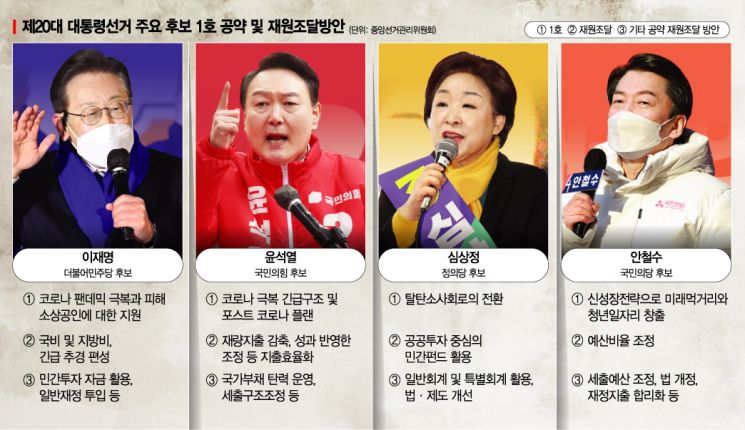
[Asia Economy Reporter Baek Kyunghwan] It has been revealed that the funding plans for the pledges presented by the presidential candidates from both ruling and opposition parties remain inadequate. Although the overall funding for the pledges was mentioned, the specific funding plans for each pledge were vaguely referred to as ‘utilizing national and local government funds’ or ‘restructuring expenditure,’ which does not help voters make informed decisions. There are also concerns that populist pledges that do not reflect fiscal constraints could lead to a decline in trust in the policies of the next government.
On the 16th, reviewing the ‘Pledges of Candidates for the 20th Presidential Election’ registered with the National Election Commission, each candidate selected and disclosed their top 10 pledges, but none prepared detailed funding plans.
In the case of Lee Jae-myung, the Democratic Party candidate, he introduced his top 10 pledges including overcoming the COVID-19 pandemic, support for affected small business owners, achieving $1 trillion in exports, guaranteeing economic basic rights for women and youth, and supplying 3.11 million housing units. However, regarding funding plans, he vaguely mentioned ‘utilizing national and local government funds and emergency supplementary budgets.’
In particular, for land reform and real estate tax reform, he explained that funds would be secured by strengthening property taxes. This includes surplus funds from the Housing and Urban Fund. Considering that Lee previously announced a guideline to ‘strengthen property taxes such as comprehensive real estate tax but provide exemptions for exceptional cases like long-term owners of one house and temporary owners of two houses,’ it is difficult to estimate additional funding sources.
Yoon Seok-youl, the People Power Party candidate, is no different. For his first pledge, the emergency COVID-19 recovery and post-COVID plan, he submitted a vague funding plan stating, ‘In case of a mismatch between the timing of fiscal expenditure and funding procurement, we will adjust the expenditure timing and flexibly utilize national debt.’
The plan to supply 2.5 million housing units over five years was subdivided by type and region, but the funding plan included a condition of ‘assuming economic recovery.’ The phrase ‘securing funds through adjustment of expenditure timing and restructuring of discretionary spending’ is interpreted as meaning that public rental housing will be supplied according to the level of economic recovery.
Sim Sang-jung, the Justice Party candidate who emphasized the ‘transition to a decarbonized society,’ only presented a plan to ‘convert the Korea Development Bank into a Green Investment Bank and invest 500 trillion won in green public investments by 2030.’ The rest of the funding plan relies on legal and institutional improvements, with formal alternatives such as utilizing general accounts and funds attached.
Ahn Cheol-soo, the People’s Party candidate, proposed a funding plan based on ‘budget ratio adjustments through organizational restructuring and regulatory reform.’ He claimed this would enable future growth engines and job creation, and also suggested ‘legal amendments and social consensus’ as alternatives. However, unlike other candidates, Ahn provided a more concrete plan for compensation measures related to COVID-19 losses. He stated that he would secure 7 trillion won annually from value-added tax at 10% and individual consumption tax at 10%, and more than 3 trillion won annually through government workforce restructuring. Additionally, he proposed forming a ‘Public-Private Joint Tax Special Cases Evaluation Committee’ to add measures such as the sunset of unnecessary tax special cases under the Restriction of Special Taxation Act and the adjustment of tax reductions under individual tax laws.
In recent pledge inquiries conducted by the Korea Manifesto Practice Headquarters targeting each political party, none of the candidates presented the scale of required funding. Lee estimated the budget needed for about 270 pledges at over 300 trillion won but did not provide funding plans for each pledge, citing that the details of each pledge had not been finalized.
Yoon mentioned that 266 trillion won would be needed to implement about 200 pledges. However, Yoon’s side presented a similar alternative to the one submitted to the National Election Commission, stating that ‘the funding will be covered by reducing expenditure budgets and increasing additional revenue.’ Sim has not yet submitted a plan, and Ahn also avoided specific answers such as tax increases or cuts.
Professor Choi Chang-ryeol of Yongin University stated, “While it is difficult to require candidates or parties to present exact funding details for pledges that appear every election, it is necessary to introduce a process that encourages them to prepare reasonable and somewhat detailed funding plans for the benefit of voters.”
© The Asia Business Daily(www.asiae.co.kr). All rights reserved.
![Clutching a Stolen Dior Bag, Saying "I Hate Being Poor but Real"... The Grotesque Con of a "Human Knockoff" [Slate]](https://cwcontent.asiae.co.kr/asiaresize/183/2026021902243444107_1771435474.jpg)
















