'The Olympic Games as a "Place of Peace and Harmony"... Deterioration of Public Sentiment Between Korea and China Following Hanbok and Biased Judging Controversies
Chinese Netizens Flood Korean Celebrities' Photos Wearing Hanbok with Malicious Comments
Even Olympic Athletes Face Nitpicking
Seogyeongdeok: "Malicious Comments Are Human Rights Violations... A Manifestation of Misguided Patriotism"'
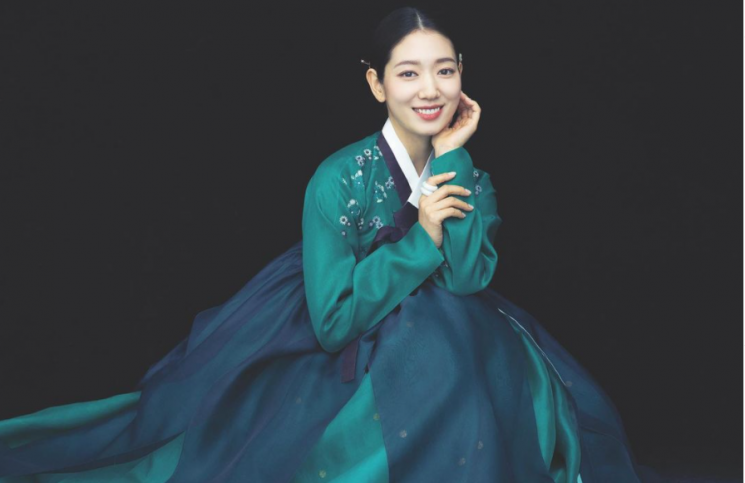 When the so-called 'Hanbok controversy' arose at the 2022 Beijing Winter Olympics, actress Park Shin-hye posted a photo of herself wearing a hanbok on her Instagram. Photo by Park Shin-hye Instagram capture.
[Asia Economy Reporter Yoon Seul-gi] Amid ongoing controversies surrounding the 2022 Beijing Winter Olympics, including hanbok and biased judging disputes, anti-Korean sentiment among Chinese citizens is growing. Chinese netizens have launched collective online attacks against celebrities who posted photos wearing hanbok and Korean athletes who performed ceremonies on the podium, leading to criticism that the Olympic spirit of "peace and harmony" is being undermined.
On the 4th, at the opening ceremony of the 2022 Beijing Winter Olympics held at the Beijing National Stadium, a performer appeared wearing hanbok, sparking a "cultural engineering" controversy. During the ceremony, a "flag handover by ordinary citizens" event involving representatives of China's 56 ethnic groups took place, but the incident began when a woman dressed in what appeared to be a pink skirt and white jeogori hanbok with braided hair performed the Chinese five-star red flag handover.
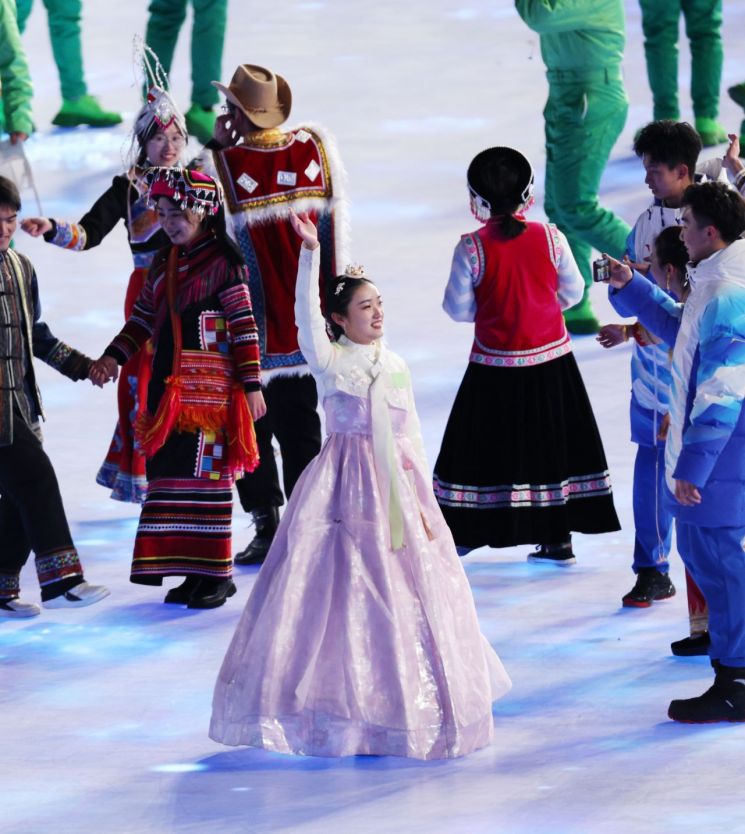 On the afternoon of the 4th, at the National Stadium in Beijing, China, a performer wearing hanbok waved their hand during the opening ceremony of the 2022 Beijing Winter Olympics.
 [Image source=Yonhap News]
This led to criticism that there might be ulterior motives in featuring a Joseonjok (ethnic Korean Chinese) wearing Korea's traditional hanbok at the Olympics, watched by the world. Some compared it to the "Northeast Project," which aims to incorporate Korean history into China, and called it "Hanbok engineering."
Previously, China has emphasized that the history and culture of ethnic minorities within China belong to the Chinese nation to promote national unity. Through the 2002 Northeast Project, Goguryeo and Balhae relics were excavated and designated as Chinese cultural heritage, later registered as UNESCO World Cultural Heritage. Given this precedent, the appearance of Joseonjok in hanbok was criticized for portraying them as part of China. The Chinese Embassy in Korea dismissed the claims, stating that hanbok belongs both to Korea and the Joseonjok, denying any cultural engineering.
Korean celebrities indirectly criticized China's "Hanbok engineering" by posting photos wearing hanbok. Actors Park Shin-hye, BTS member Suga, Girls' Generation member Hyoyeon, and others shared photos in hanbok, emphasizing that hanbok is part of Korea's heritage.
In response, Chinese netizens left malicious comments on celebrities' Twitter and Facebook accounts, collectively protesting. Comments such as "Hanbok is Chinese," "Hanbok is a developed garment based on traditional Chinese clothing," were posted, along with vomiting emojis and multiple upside-down thumbs-up emojis expressing displeasure. Due to the flood of hateful comments from Chinese netizens, Hyoyeon temporarily closed the comment section on her SNS.
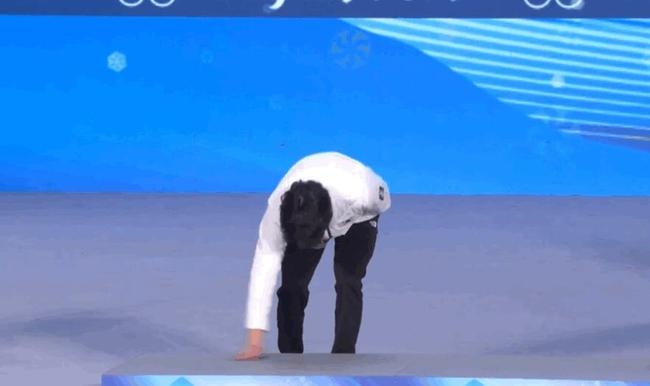 Chinese netizens reacted negatively to speed skating athlete Cha Min-kyu, who won a silver medal at the 2022 Beijing Winter Olympics, making a hand gesture mimicking writing on the podium before stepping onto it.
 Photo by Wang Yimang, Yonhap News Agency.
Meanwhile, anti-Korean sentiment has also surfaced during the Beijing Olympics. Korean speed skater Cha Min-kyu (29, Uijeongbu City Hall) was criticized by Chinese netizens after performing a ceremony of wiping the podium before stepping onto it at the 500m medal ceremony. They accused him of protesting the previously raised short track "biased judging" controversy.
Some netizens mocked, saying, "Does he think this is curling? If you wipe it quickly, it gets slippery," or criticized, "Blame your skills, not the referees," and "Why don't Koreans accept defeat?" Cha Min-kyu's ceremony video ranked first on Weibo's hot issues the day before, garnering nearly 200 million views.
After the Beijing Olympics, Chinese netizens have expressed nationalist anti-Korean sentiment through online attacks, drawing criticism that this contradicts the Olympic spirit of peace.
In this regard, an expert pointed out that the behavior of Chinese netizens reflects misguided patriotism. Professor Seo Kyung-deok of Sungshin Women's University explained, "After Chinese President Xi Jinping met then U.S. President Trump in 2017 and referred to Korea as a vassal state of China, the phenomenon of Chinese citizens claiming Korean culture as their own has become more overt. It appears that the cultural center in Asia shifting from China to Korea has caused anxiety, leading to 'cultural engineering.'"
Professor Seo also described the "malicious comment barrage" by Chinese netizens as "a clear human rights violation," adding, "It is wrong to vent frustrations in this way over legitimate Korean claims such as the 'Hanbuk engineering' issue."
© The Asia Business Daily(www.asiae.co.kr). All rights reserved.



















