US Urges "Diversification of Semiconductor Raw Material Sources"... Neon Imports 90% from US, 23% from Korea, Ukraine
Russia Leads Global Palladium Exports with 7.3% Price Increase This Year... US Sanctions Could Impact Samsung and LG Electronics
[Asia Economy Reporters Byunghee Park, Sunmi Park, Jieun Lee] Amid the Ukraine crisis shaking the entire raw materials market, it has been revealed that the dependence on Russia and Ukraine is high not only for oil, natural gas, and wheat but also for neon and palladium, key raw materials for semiconductors. If Russia invades Ukraine, the import routes for these major raw materials could be cut off.
◆ US: "Semiconductor companies should diversify imports" = On the 13th (local time), according to major foreign media, the White House recently urged semiconductor companies to diversify their sources of imports, anticipating that Russia might retaliate against Western economic sanctions by halting exports of key raw materials for semiconductor production. While the West is reportedly considering banning semiconductor exports to Russia as part of sanctions, there are forecasts that Russia could respond by stopping exports of raw materials such as neon and palladium.
Peter Harrell, Senior Director at the White House National Security Council (NSC), has recently contacted semiconductor companies one after another to inquire about their dependence on semiconductor raw materials from Russia and Ukraine and urged them to diversify their import sources. A White House official explained, "This is part of the measures being prepared with companies in case Russia takes actions that disrupt supply chains."
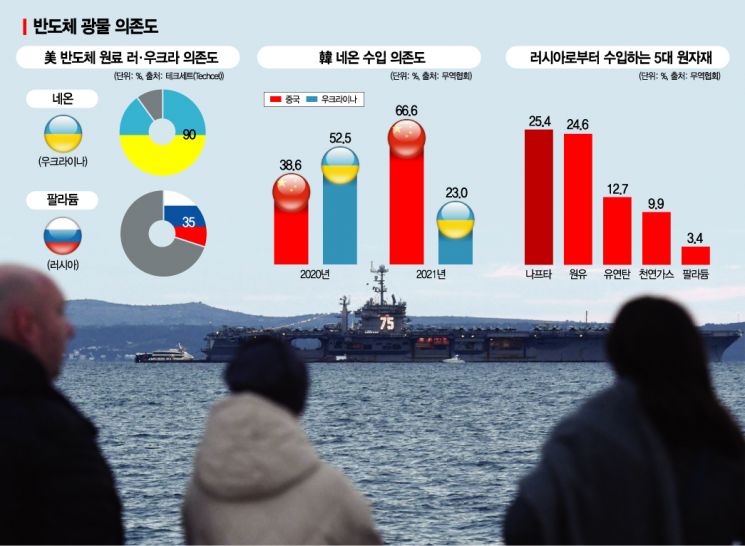
The reason the White House launched an urgent review of the semiconductor industry appears to be influenced by a report released on the 1st by market research firm Techcet. Techcet estimated that U.S. semiconductor companies import 90% of neon from Ukraine and 35% of palladium from Russia, analyzing that sanctions on Russia could damage the semiconductor industry. According to the U.S. International Trade Commission (ITC), when Russia invaded Crimea in 2014, neon prices surged by 600%. Joe Pasetti, Vice President of the Semiconductor Equipment and Materials International (SEMI), sent an email to member companies last week requesting information on their dependence on Russia and Ukraine for essential raw materials such as hexafluorobutadiene (C4F6), palladium, helium, neon, and scandium.
◆ South Korea imports 23% of neon from Ukraine = Domestic companies also point out that if the Ukraine crisis worsens, there could be difficulties in producing raw materials necessary for semiconductor production.
According to the Korea International Trade Association, last year, Ukraine accounted for 23% of South Korea's neon imports, ranking second after China (66.6%). In 2020, Ukraine's import share was 66.6%, ranking first.
Russia ranks first in the world in exporting palladium, a raw material for semiconductor production. As the conflict surrounding Ukraine deepens, palladium prices have risen 7.3% this year. Although direct imports from Russia account for only 3.4% for domestic companies, the burden from price surges could increase.
If the U.S. imposes semiconductor export restrictions on Russia, concerns are raised that Samsung Electronics and LG Electronics' local factories in Russia will inevitably be affected. There is also a possibility that exports of Samsung smartphones containing advanced semiconductors to Russia could be blocked.
A representative from the domestic semiconductor industry said, "If the U.S. uses semiconductor sanctions to block semiconductors produced using U.S. technology from being exported to Russia, the domestic semiconductor industry is also expected to be impacted." However, the representative added, "Since the U.S. and Chinese markets account for most of the volume, the amount going to Russia is minimal."
Senior Researcher Kim Kkotbyeol of the Korea International Trade Association predicted, "If tensions surrounding Ukraine continue, industries with a high proportion of raw material imports such as aviation, shipping, petrochemicals, and cement could be affected."
◆ President Moon presides over the Foreign Economic Security Strategy Meeting = Meanwhile, on the afternoon of the 14th, President Moon Jae-in will preside over the Foreign Economic Security Strategy Meeting at the Blue House to discuss supply chain response issues triggered by the Ukraine crisis. This is the first time President Moon has presided over the Foreign Economic Security Strategy Meeting since it was established in October last year. At this meeting, President Moon is expected to emphasize the importance of economic security and issue directives on the Ukraine crisis and global supply chain response measures.
© The Asia Business Daily(www.asiae.co.kr). All rights reserved.
![Clutching a Stolen Dior Bag, Saying "I Hate Being Poor but Real"... The Grotesque Con of a "Human Knockoff" [Slate]](https://cwcontent.asiae.co.kr/asiaresize/183/2026021902243444107_1771435474.jpg)
















