First Trial Unconstitutional → Second Trial Constitutional → Overturned to Unconstitutional in Third Trial
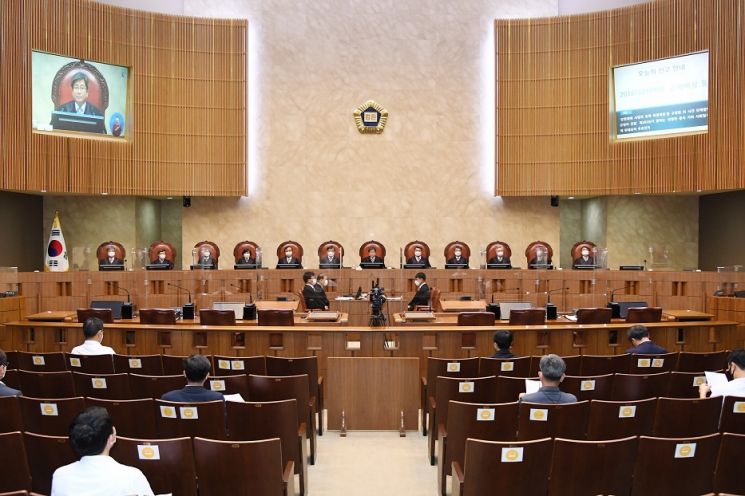
[Asia Economy Reporter Choi Seok-jin, Legal Affairs Specialist] The Supreme Court has ruled that an ordinance prohibiting mixed-gender seating in study rooms and allowing study room operators to face suspension of teaching or deregistration if violated is unconstitutional and therefore invalid.
The Supreme Court's Third Division (Presiding Justice Lee Heung-gu) announced on the 13th that it overturned the lower court ruling, which had ruled against study room operator Company A in its appeal against the suspension of teaching order issued by the Jeonju Office of Education in Jeollabuk-do, and remanded the case to the Gwangju High Court.
The court stated, "The ordinance provision in this case violates the principle of proportionality by infringing on the freedom of occupation of study room operators and the general freedom of conduct or self-determination rights of study room users, and thus should be considered unconstitutional."
It added, "Nevertheless, the lower court ruled that the ordinance provision was not unconstitutional and that the administrative disposition based on it was lawful. This judgment involved a misunderstanding of the constitutional limits on public authority intervention in private autonomous areas and the limits on restricting constitutional rights, including the principle of proportionality, which affected the ruling."
According to the court, Company A registered and began operating Study Room B in Deokjin-gu, Jeonju, Jeollabuk-do, on October 12, 2017, submitting a seating layout plan that separated male and female seats to the education authorities.
Article 8 (Facility Standards) of the "Act on the Establishment, Operation, and Private Tutoring of Academies" (Academy Act) stipulates that "academies (including study rooms) must be equipped and maintained with facilities and equipment necessary for teaching and learning according to unit facility standards prescribed by ordinances of cities and provinces for each teaching course." This delegates the detailed standards for academy facilities to local governments such as cities and provinces.
Also, Article 17 (Administrative Dispositions) Paragraph 1, Subparagraph 3 of the Academy Act allows for deregistration or suspension of all or part of teaching courses for up to one year if the academy falls below the facility standards under Article 8. Paragraph 4 of the same article provides that the standards for administrative dispositions (such as suspension of teaching) and other necessary matters shall be prescribed by ordinance.
Based on the delegation in Article 8 of the Academy Act, the "Jeollabuk-do Ordinance on the Establishment, Operation, and Private Tutoring of Academies" at the time stipulated in Article 3-3 regarding study room reading rooms that "the reading room shall be at least 60 square meters, with a capacity of no more than 0.8 persons per square meter, and seats shall be arranged separately by gender. However, partitions may be used if necessary for user convenience," thereby prohibiting mixed-gender seating.
Furthermore, Article 11 of the ordinance states that "the subjects, standards, procedures, and other necessary matters for administrative dispositions shall be determined by educational regulations," allowing detailed administrative disposition standards to be set by regulations. Accordingly, the "Enforcement Rules of the Jeollabuk-do Ordinance on the Establishment, Operation, and Private Tutoring of Academies" prescribed that for mixed-gender seating in study rooms, a first violation would result in a suspension of teaching for 10 days or more, and a second violation could lead to deregistration.
On December 1, 2017, the Jeonbuk Office of Education inspected Study Room B and found that contrary to the seating layout submitted at registration, women were sitting in seats designated for men and men were sitting in seats designated for women. Consequently, Company A was ordered to suspend teaching for 10 days from December 22 to December 31, 2017.
Company A filed an administrative appeal with the Jeollabuk-do Education Administrative Appeals Committee on December 18, 2017, but after it was dismissed, they filed a lawsuit.
The key issue in the trial was whether the ordinance provision that formed the basis for the suspension order violated the principle of proportionality and infringed on the constitutional rights of study room operators or users. While the Constitutional Court has the final authority to review laws for constitutionality, courts also have the power to review the constitutionality of orders, regulations, and ordinances.
The first trial court ruled that the ordinance provision prohibiting mixed-gender seating, which was not present in the higher-level Academy Act, exceeded the limits of delegated legislation and canceled the suspension order.
At that time, the court stated, "The Academy Act delegates the establishment of facility standards necessary for teaching and learning and the specific standards for suspension orders when these standards are not met, but this delegation pertains to 'facilities and equipment necessary for learning' and does not extend to the 'operation methods' of the facilities."
The court further stated, "Since the Academy Act does not contain provisions prohibiting mixed-gender seating as an operation method of reading rooms, the ordinance and enforcement rules in this case, which prohibit mixed-gender seating as an operation method and impose suspension of teaching for even a first violation, expand the scope of punitive administrative dispositions without delegation from the higher law, thus exceeding the limits of delegated legislation."
Finally, the court rejected the Jeonbuk Office of Education's claim that the prohibition of mixed-gender seating was the minimum necessary measure to prevent crimes.
The court stated, "It is questionable whether distinguishing seating arrangements in the same space can prevent crimes, and even if prohibiting mixed-gender seating is considered the minimum measure to prevent domestic crimes, imposing suspension of teaching for a first violation is excessively severe compared to other city and provincial ordinances operating on a penalty point system, violating the principle of proportionality and thus invalid."
However, the appellate court overturned this first-instance ruling.
The appellate court held, "The mixed-gender seating prohibition clause, which requires separate seating arrangements for men and women in reading rooms, and the suspension clause, which imposes administrative dispositions such as suspension for violations, do not exceed the limits delegated by the Academy Act."
The court explained, "The delegation clause in this case grants local governments the discretion to decide whether to separate male and female seats in reading rooms according to local educational circumstances and to set administrative disposition standards for violations."
It also stated, "Depending on the age and other usage environments of the main users of study rooms, frequent conversations or actions between mixed-gender users may disrupt the study atmosphere for others seated nearby. While it cannot be definitively said that mixed-gender seating increases the likelihood of sex crimes, separating male and female seats can help prevent unwanted contact with the opposite sex," rejecting Company A's claim that the mixed-gender seating prohibition and suspension clauses are unconstitutional.
The court also dismissed Company A's claim that the prohibition causes business losses by limiting female users when female seats are fully occupied, stating, "This can be resolved by changing the number and arrangement of seats, and there is no basis to interpret the Academy Act or the ordinance as prohibiting such changes."
However, the Supreme Court reversed the appellate court's decision, ruling otherwise.
The court pointed out, "The ordinance provision requires study room operators to arrange male and female seats separately and imposes suspension of teaching for 10 days or more without any prior warning upon violation, but it does not consider individual and specific circumstances such as operating hours, reading room structure, the gender and age of main users, or supervision conditions, excessively restricting the freedom of occupation of study room operators."
It further stated, "Even considering the purpose of preventing sex crimes by prohibiting mixed-gender seating, this is based on an unreasonable perception that the presence of men and women in the same space inherently increases the likelihood of sex crimes regardless of the purpose or use of the place, making it difficult to recognize its legitimacy."
The court added, "Even if one accepts the legitimacy of the purpose of fostering a study atmosphere or preventing sex crimes, it remains questionable whether separating male and female seats within the same reading room is an appropriate means to achieve that purpose."
The court explained, "If the reading room itself is not separated and only the seating arrangement is distinguished by gender within the same room, men and women cannot sit side by side but can sit at desks in front or behind each other, and since they use the same entrance, they inevitably encounter each other, so it does not effectively prevent contact. Moreover, given that there are many other private study spaces such as libraries or study cafes where mixed-gender seating is allowed, prohibiting mixed-gender seating only in study rooms subject to the Academy Act does not effectively prevent contact in private study spaces."
© The Asia Business Daily(www.asiae.co.kr). All rights reserved.
![Clutching a Stolen Dior Bag, Saying "I Hate Being Poor but Real"... The Grotesque Con of a "Human Knockoff" [Slate]](https://cwcontent.asiae.co.kr/asiaresize/183/2026021902243444107_1771435474.jpg)
















