Third Highest Operating Profit Ever Surpasses 7 Trillion Won
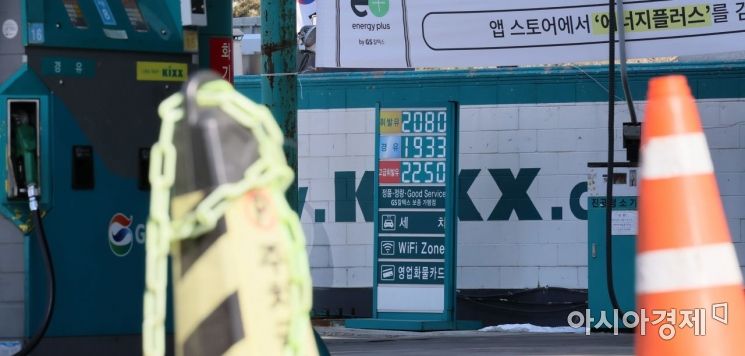 As international oil prices rose to around $90 per barrel, the highest in seven years, domestic gasoline prices have been on the rise for 25 consecutive days. On the 6th, the gasoline price at a gas station in Seoul reached the 2,000 won range. Photo by Yoon Dong-joo doso7@
[Asia Economy Reporter Oh Hyung-gil] Last year, the export value of petroleum products in the domestic refining industry recorded the highest growth rate in 10 years. The export value of petroleum products from the four domestic refiners?SK Energy, GS Caltex, S-Oil, and Hyundai Oilbank?reached $33.23534 billion (approximately 39.9 trillion KRW). The export growth rate was 54.6% compared to 2020, when demand for petroleum products sharply declined due to the COVID-19 pandemic, marking the highest rate since 64.2% in 2011, ten years ago.
Refiners are achieving record-high performance due to expanded exports and a booming domestic market. Refining margins also improved in the second half of last year, continuing the positive trend. This year, with the rise in international oil prices, refining margins are expected to remain strong, signaling a positive outlook for earnings.
According to the refining industry, the operating profit of the four domestic refiners exceeded 7 trillion KRW last year.
SK Innovation achieved sales of 46.8429 trillion KRW and an operating profit of 1.7656 trillion KRW. GS Caltex followed with sales of 34.5384 trillion KRW, a 54.9% increase from the previous year, and turned to a profit with an operating income of 2.0189 trillion KRW.
S-Oil’s annual sales expanded by 63.2% to 27.6639 trillion KRW, and operating profit turned positive at 2.3064 trillion KRW. During the same period, Hyundai Oilbank’s sales increased by 50.5% to 20.6065 trillion KRW, and operating profit also turned positive at 1.1424 trillion KRW.
The operating profits of the four refiners surpassed 7 trillion KRW for the third time, following 7.8588 trillion KRW in 2016 and 7.7470 trillion KRW in 2017. Although refining margins fell into negative territory due to the COVID-19 impact, profits turned positive from September last year, driving performance.

The industry predicts that the strong performance of refiners will continue into the first quarter as international oil prices show renewed strength.
Refiners import crude oil and sell products 2 to 3 months after the refining process. When international oil prices rise, a lagging effect occurs where margins (profits) increase when the products are actually sold. Additionally, the chemical divisions of refiners, which underperformed in the fourth quarter of last year, are expected to improve in the first quarter.
Global energy organizations forecast that oil demand will recover to 2019 levels this year. The Organization of the Petroleum Exporting Countries (OPEC) projected in its January report that global oil demand will average 100.79 million barrels per day this year, exceeding the pre-COVID-19 level of 2019. The International Energy Agency (IEA) also expects oil demand to reach 99.7 million barrels this year, surpassing 99.55 million barrels in 2019.
An industry official explained, “Due to the strong international oil prices, inventory gains have increased, leading to improved refining margins. Given the ongoing geopolitical risks, oil demand is expected to rise, making the business environment positive.”
© The Asia Business Daily(www.asiae.co.kr). All rights reserved.


















