Deposit 300 Million Won and Election Expenses Up to 51.39 Billion Won
If You Receive Over 10% of Votes, More Than Half Will Be Reimbursed
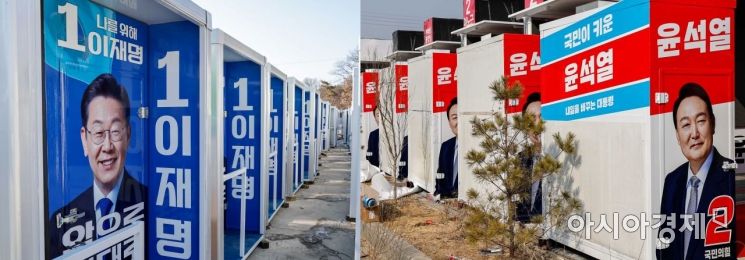 About a month before the 20th presidential election, on the 8th, podiums to be used in election campaigns for Lee Jae-myung, the Democratic Party presidential candidate, and Yoon Seok-youl, the People Power Party presidential candidate, are being produced at Evada, a vehicle advertising company in Gimpo, Gyeonggi Province, and MediaMax in Paju. / Gimpo ? Photo by Kang Jin-hyung aymsdream@
[Asia Economy Reporter Park Jun-yi] Candidate registration for the presidential election will begin on the 13th. Candidates who register will be able to officially start their election campaigns from the 15th. So, how much does it cost to become a presidential candidate? It is generally known to cost from several billion to hundreds of billions of Korean won.
When registering as a presidential candidate, a mandatory deposit of 30 million won must be paid to the election commission of the relevant electoral district. The deposit amounts are 30 million won for the presidential election, 15 million won for local constituency National Assembly elections, and 50 million won for mayoral and gubernatorial elections.
Once the election campaign officially begins, a significant amount of money is spent on campaign materials, campaign vehicles, advertising costs, and other preparations. In the 2017 19th presidential election, the total election expenditure for 15 candidates was 138.77351 billion won, averaging 9.25156 billion won per candidate.
To ensure fairness among candidates, the election commission sets a spending limit on election costs, and candidates can only spend within this limit. The spending limit for this presidential election is 51.309 billion won, which is 315 million won higher than the previous election.
However, candidates do not bear all these costs themselves. After the election, candidates may receive a refund of their deposit and part of their election expenses depending on the results. Candidates who win or receive at least 15% of the total votes are reimbursed the full deposit and election expenses. Those who receive between 10% and less than 15% of the votes get half refunded.
Each political party also receives "election subsidies" from the election commission. For the presidential election, the amount is calculated by multiplying the total number of eligible voters by 800 won and then distributed to parties based on the number of seats and vote shares.
However, while candidates who receive more than 10% of the total votes can get back from half to all of their election expenses, minor candidates who receive less than 10% do not get reimbursed for tens or hundreds of billions of won spent, raising concerns about fairness.
In reality, minor candidates, whose parties are small and rely on donations, often cannot invest large amounts in their campaigns. Kim Dong-yeon, the presidential candidate of Saerounmulgyeol (New Wave), stated, "The election subsidies and support funds for the major parties, which amount to hundreds of billions of won, are all taxpayers' money. I do not receive a single won from the national treasury, but I will conduct my campaign differently from the existing parties."
© The Asia Business Daily(www.asiae.co.kr). All rights reserved.

![User Who Sold Erroneously Deposited Bitcoins to Repay Debt and Fund Entertainment... What Did the Supreme Court Decide in 2021? [Legal Issue Check]](https://cwcontent.asiae.co.kr/asiaresize/183/2026020910431234020_1770601391.png)