Acting US Ambassador to Korea Also Fuels Discord... Concerns Over Anti-China Sentiment After Short Track Disqualification
Calls for Strengthening Bilateral Exchanges to Mark 30th Anniversary of Korea-China Diplomatic Relations
[Asia Economy Beijing=Special Correspondent Jo Young-shin] A Chinese state-run media outlet expressed concern over the conflict between Korean and Chinese citizens triggered after the men's 1000m short track semifinals at the 2022 Beijing Winter Olympics and urged the strengthening of exchanges between the two countries. It also criticized the Western camp, including the United States, for exploiting the discord between Korean and Chinese people to incite deterioration in Korea-China relations.
The state-run Global Times reported that more exchanges are needed to calm anti-China sentiment that arose at the ice rink, and since this year marks the 30th anniversary of Korea-China diplomatic relations, more proactive measures are necessary to promote friendly relations between the two countries.
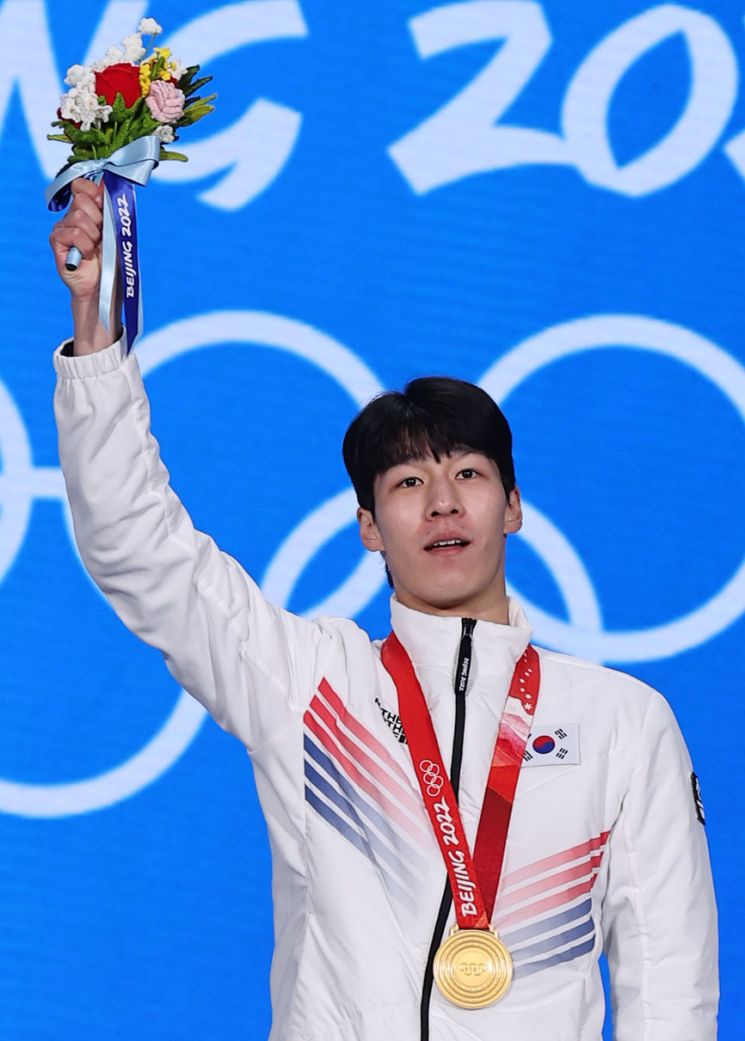
The outlet reported that after Korean athletes Hwang Dae-heon and Lee Jun-seo were disqualified in the men's 1000m short track semifinals held on the 7th, Chinese athletes Ren Ziwei and Li Wenlong won the gold and silver medals respectively, sparking controversy over biased judging. It added that Korea, a short track powerhouse, was deeply disappointed by the failure to win medals.
Lu Chao, a researcher at the Liaoning Academy of Social Sciences, stated, "Short track is a sport where controversies such as disqualifications frequently occur," and claimed, "Some Korean netizens' reactions are somewhat irrational, and some Korean politicians are stirring up anti-China sentiment ahead of the presidential election."
The Global Times pointed out that after the disqualification, Korean netizens have been criticizing Viktor An (Ahn Hyun-soo), who joined the Chinese short track national team's coaching staff in 2020, and urged that the criticism against Viktor An should stop.
It also mentioned the hanbok that appeared at the Beijing Winter Olympics opening ceremony, emphasizing that the ethnic Koreans living in China share the same bloodline as those on the Korean Peninsula and that Chinese ethnic Koreans share traditional culture and clothing with those in Korea.
It referred to Lee So-young, a member of the Democratic Party of Korea, who wrote on Facebook, "This is not the first time China has introduced Korean culture as its own," and labeled her as a politician exploiting anti-China sentiment to gain votes in the presidential election.
The outlet sarcastically criticized Christopher Del Corso, the acting U.S. ambassador to Korea, for also using anti-China sentiment. It condemned Ambassador Del Corso for fueling angry Korean netizens by posting on his Twitter, "What comes to mind when you think of Korea? Kimchi, K-pop, K-drama, and hanbok."
Da Zhi Gang, director of the Northeast Asia Research Institute at the Heilongjiang Academy of Social Sciences, said, "China and Korea share close ties in geography, history, and trade, and there is potential to further promote friendly relations," adding, "Korea-China relations should not be broken over trivial issues." He also emphasized the need to promote more active human exchanges to resolve misunderstandings between the peoples of the two countries.
© The Asia Business Daily(www.asiae.co.kr). All rights reserved.

















