Public Health Medical Support Group Publishes 'Health of Gwangju Citizens This Year'
Improved Drinking Habits Including Risky Drinking Rate and Increased Flu Vaccination Rate
Average Life Expectancy at Mid-Level and Large Life Expectancy Gap
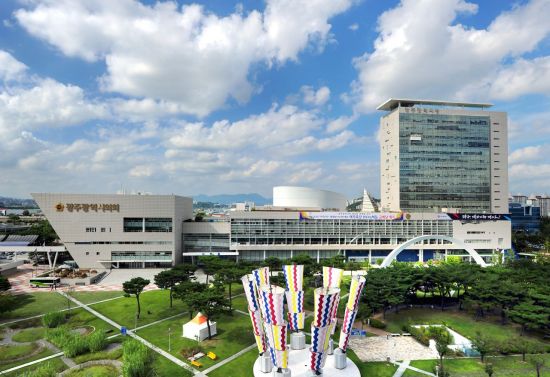
[Asia Economy Honam Reporting Headquarters Reporter Yoon Jamin] As COVID-19 has prolonged, changes have been observed in the medical usage patterns of Gwangju Metropolitan City residents.
According to the recently published "Health of Gwangju Citizens This Year" by the Gwangju Public Health Medical Support Group (Director Kwon Soon-seok, Professor at Chonnam National University) on the 8th, the influenza vaccination rate in the Gwangju area in 2020 increased by 4.6 percentage points compared to the previous year, reaching 44.6%.
Although the influenza vaccination rate has been steadily increasing, the larger increase in 2020 is believed to be due to improved awareness of vaccination amid the COVID-19 pandemic.
On the other hand, the health screening participation rate decreased compared to the previous year. The first general and lifetime health screening participation rate dropped by 5.5 percentage points to 67.9%, and the cancer screening participation rate decreased by 3.8 percentage points to 44.6%.
The general screening rate and cancer screening rate for persons with disabilities also declined. Since preventive medical activities such as screenings may be suppressed due to the COVID-19 pandemic, continuous monitoring and countermeasure preparation are necessary.
The medical usage related to hypertension and diabetes among Gwangju citizens showed different patterns depending on the disease.
One-year medication adherence and one-year control rates after diagnosis improved for both hypertension and diabetes compared to the previous year, but were not relatively favorable compared to the eight metropolitan cities.
In the case of hypertension, among the eight metropolitan cities, the medical usage rate (19.4%) and one-year medication adherence rate (63.1%) were low, but the one-year control rate was 78.8%, ranking second highest.
For diabetes, compared to the eight metropolitan cities, the medical usage rate (8.7%) was high, but the one-year diabetes medication adherence rate was 62.4%, and the one-year diabetes control rate was 38.6%, the lowest among the eight metropolitan cities.
Additionally, the preventable hospitalization rate for chronic complications of diabetes was 8.2 per 1,000 population, the highest among the eight metropolitan cities.
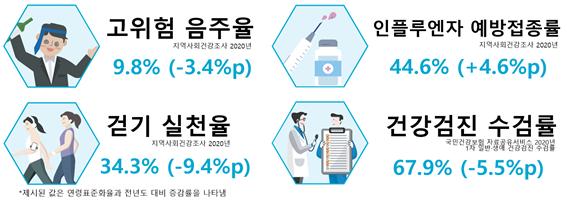
The life expectancy of Gwangju citizens is 84.1 years, ranking fourth among the national metropolitan cities, but the gap in life expectancy according to income level was 8.6 years, the largest disparity observed.
The overall mortality rate and cancer mortality rate of Gwangju citizens were 308.8 and 88.0 per 100,000 population respectively, ranking in the middle among the eight metropolitan cities and at a favorable level.
Mortality rates by disease were relatively low for ischemic heart disease (10.7), cerebrovascular disease (18.8), and diabetes (6.6), while dementia and suicide mortality rates were at a medium level.
The cancer incidence rate among Gwangju citizens was 284 per 100,000 population, the second lowest among the eight metropolitan cities, while the pneumonia mortality rate was 24.2 per 100,000 population, the highest among the eight metropolitan cities.
The preventable hospitalization rates for diseases where timely and effective outpatient medical service use can prevent hospitalization were highest among the eight metropolitan cities: hypertension at 22.9 per 1,000 population, chronic complications of diabetes at 8.2, and chronic obstructive pulmonary disease at 19.3.
The high-risk drinking rate among Gwangju citizens decreased by 3.4 percentage points from the previous year to 9.8%, and the walking practice rate decreased by 9.4 percentage points to 34.3%, the lowest level in the past 10 years.
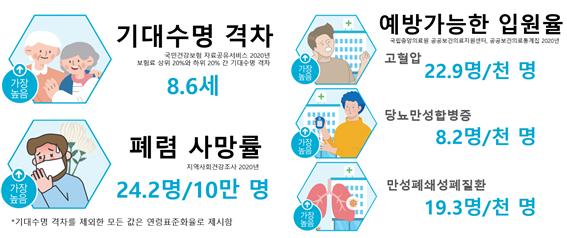
This decreasing trend appears to be consistent across the eight metropolitan cities, suggesting it is an effect of social distancing measures.
The current smoking rate of Gwangju citizens in 2020 was 18.5%, with the male smoking rate at 35.3%, ranking fifth among the eight metropolitan cities.
However, since 2008, the smoking rate has decreased by 4.0 percentage points overall and 5.9 percentage points among men, showing the smallest decrease among the eight metropolitan cities.
In 2020, the number of persons with disabilities in Gwangju was 70,061, accounting for 4.8% of the total population, and the elderly population ratio increased by 0.8 percentage points from the previous year to 14.2%, entering an aged society. The total fertility rate was 0.8 children per woman, a decrease of 0.1 from the previous year.
Meanwhile, "Health of Gwangju Citizens This Year" is an annual report created to understand the health status of Gwangju citizens in 2020 through 38 health indicators. The 38 health indicators are divided into four areas: ▲Population and Sociodemographic Characteristics ▲Health Behaviors ▲Medical Usage ▲Health Outcomes.
The values of the 38 health indicators were presented for the eight metropolitan cities and the five autonomous districts of Gwangju Metropolitan City, analyzing trends over the past 10 years and comparing with other metropolitan cities to understand the relative health level of Gwangju.
© The Asia Business Daily(www.asiae.co.kr). All rights reserved.
![Clutching a Stolen Dior Bag, Saying "I Hate Being Poor but Real"... The Grotesque Con of a "Human Knockoff" [Slate]](https://cwcontent.asiae.co.kr/asiaresize/183/2026021902243444107_1771435474.jpg)


















