[Seoul District News] Seongdong-gu, World's Patented Sign Language Voice Guidance System, Seoul's First 42 Essential Civil Complaint Information Guidance Inclusive Communication for Disabled and Non-Disabled without Discrimination to Expand Digital Divide Information... Dongdaemun-gu, Business Agreement with Seoul Credit Guarantee Foundation for Small Business Owners Providing 12 Types of Commercial Area Information and Comparative Analysis Pages... Jung-gu, Unmanned Civil Service Issuance of Real Estate Registration Certificate... Dongjak-gu, Proactive Discovery and Support of Welfare Blind Spots Using Big Data
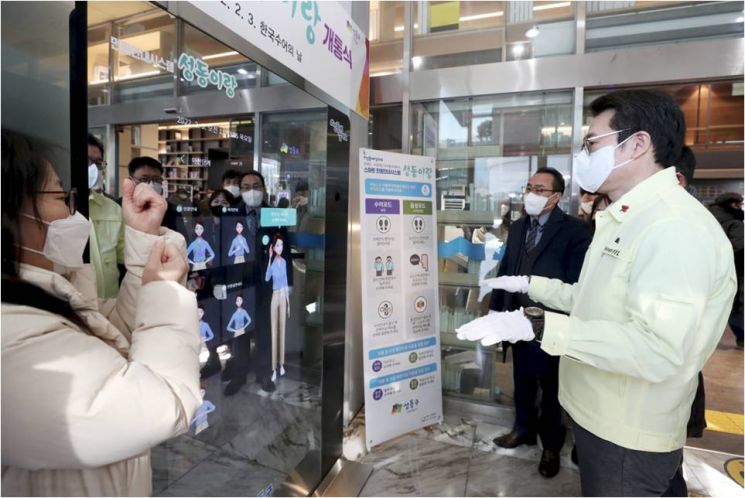 The sign language voice guidance system allows you to receive civil service information through sign language.
[Asia Economy Reporter Park Jong-il] Seongdong-gu (Mayor Jung Won-oh) has installed the ‘Seongdong-type Smart Civil Service Guidance System’ (hereinafter referred to as the ‘Smart Civil Service Guidance System’), which provides civil service guidance in sign language and voice, and began full-scale operation on the 3rd, the Day of Sign Language.
The Smart Civil Service Guidance System, introduced for the first time in Seoul, is an unmanned information kiosk equipped with artificial intelligence. When hearing- or visually-impaired individuals inquire about civil service tasks or building information, an avatar official appearing on the screen provides related information in voice or sign language.
Installed at the first-floor entrance for maximum visibility to residents entering the district office, it guides visitors on various civil service tasks such as family relation registration, passport issuance, building permits, as well as local taxes, automobile, real estate-related services, organizational charts, and convenience facilities?a total of 42 types of civil service information.
The screen height is positioned at the lower part for wheelchair users to conveniently use it, allowing direct touch operation, making it accessible and convenient for everyone regardless of disability.
The Smart Civil Service Guidance System, built as an innovative product pilot purchase project selected by the Public Procurement Service’s national subsidy contest last year, is the world’s first patented system based on AI sign language gesture recognition technology. The name was also selected by actively reflecting residents’ opinions.
Named ‘Seongdong-i-rang,’ the Smart Civil Service Guidance System expresses Seongdong-gu’s vision of implementing a ‘smart inclusive city of happiness together’ that embraces both disabled and non-disabled people, meaning ‘With Seongdong-i-rang, any difficulty can be solved.’ In the future, programs allowing users to learn simple sign language phrases such as ‘Mom, Dad, I love you’ on the spot will be added to enhance its value.
Jung Won-oh, Mayor of Seongdong-gu, said, “It is very meaningful to present a civil service guidance system that provides guidance in sign language, voice, and text on the occasion of Korean Sign Language Day,” and added, “We will continue to strive toward a smart inclusive city where no resident is left out or discriminated against.”
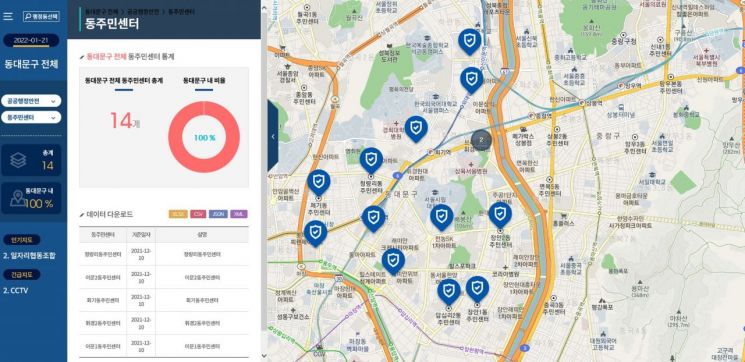
Dongdaemun-gu (Mayor Yoo Deok-yeol) unveiled its fully revamped data platform on the 7th to activate data-driven administration.
With this revamp, new menus such as ▲Our Neighborhood Market and Store Analysis ▲Our Neighborhood Smart Map ▲Dongdaemun-gu Statistics Plaza have been added, allowing users to view commercial districts, locations, and statistical data within the region at a glance.
In particular, hoping to revive the shrinking commercial districts and support small business owners, the district signed a business agreement with the Seoul Credit Guarantee Foundation to provide 12 types of commercial-related information such as residential population, business opening and closing rates, deposits, and rents, along with comparative analysis pages by region and year (last 3 years).
Also, reflecting Dongdaemun-gu’s regional characteristic of having many traditional markets, usage information and comparative analysis pages for each traditional market are provided, and promotional activities through market merchant associations will be conducted to increase usage rates.
Besides commercial district information, lifestyle-oriented information using administrative data such as permits within the district is also provided. Users can check store locations in their administrative dong, including general restaurants and academies, as well as statistical information by dong, with data download functionality available.
Those wishing to access the new data platform can click the ‘Dongdaemun-gu Data Platform’ link at the bottom of the Dongdaemun-gu Office website.
Yoo Deok-yeol, Mayor of Dongdaemun-gu, said, “We promoted the revamp of the ‘Dongdaemun-gu Data Platform’ so that residents can more conveniently check the data they need,” and added, “We will continue to strive to implement administration based on objective and scientific data.”
Dongdaemun-gu was selected as an excellent institution in the ‘2021 Data-Driven Administration Status Inspection,’ conducted for the first time last year targeting 288 central administrative agencies and local governments under Article 22 of the Act on Activation of Data-Driven Administration.
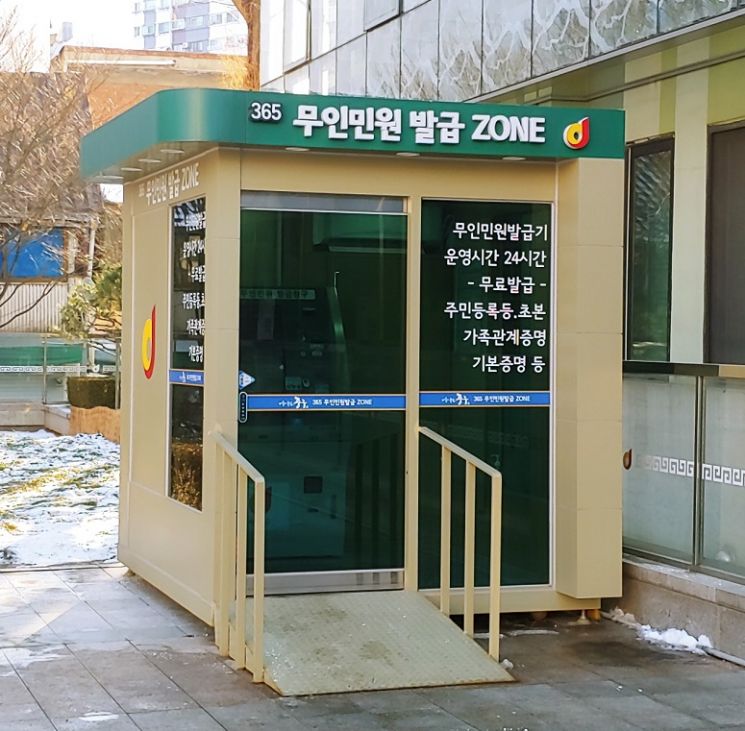
Jung-gu (Mayor Seo Yang-ho) announced on the 8th that from the new year, it has become possible to issue real estate registration certificates at unmanned civil service issuance machines in all community service centers.
Until now, residents had to visit the registry office or use court-exclusive unmanned civil service issuance machines installed at Jung-gu Office to obtain real estate registration certificates, causing considerable inconvenience.
With this new service, residents can easily obtain real estate registration certificates through unmanned civil service issuance machines at nearby community service centers.
To equip existing unmanned civil service issuance machines with the real estate registration certificate issuance function, the district has been preparing related channel openings with the Ministry of the Interior and Safety and the Court Administration Office since last year, and the service started in January this year.
The issuance fee for the real estate registration certificate is 1,000 KRW per case (cash payment only). Information on installation locations and operating hours of each machine can be found on the Jung-gu Office website or Government24.
Last year, the district installed ‘Yellow Boxes,’ free-use counters for residents in each community service center, enabling issuance of over 1,300 types of civil documents online through Government24, the electronic family relation system, and the internet registry office. Separately, ‘365 Unmanned Civil Service Issuance ZONE’ has been installed in each community service center for 24-hour operation.
Meanwhile, the district plans to discover digital transformation tasks by field and department to expand online and non-face-to-face administrative services so that residents can use administrative services without spatial or temporal constraints.
Seo Yang-ho, Mayor of Jung-gu, said, “We will continue to expand the scope of non-face-to-face administrative services such as unmanned civil service issuance to enhance resident convenience and ensure resident safety during the COVID-19 pandemic.”
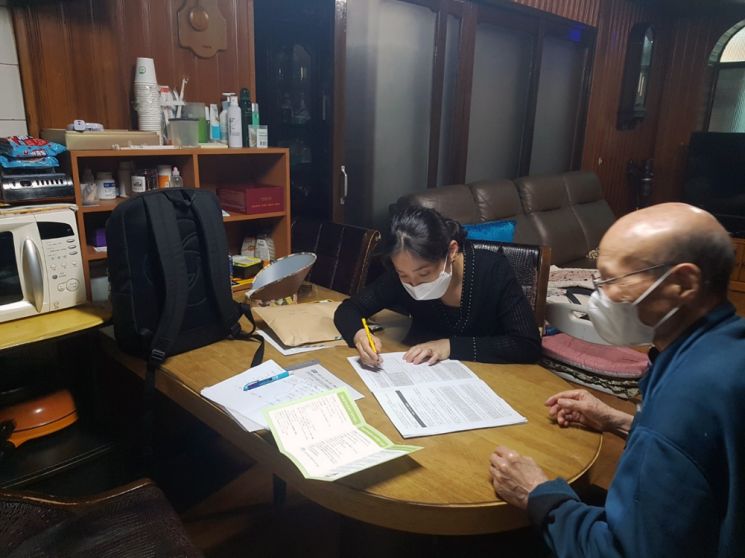
Dongjak-gu (Mayor Lee Chang-woo) will conduct a full survey of households identified through the crisis sign information big data-based detection system ‘Happiness e-Eum’ to minimize welfare blind spots.
The ‘Happiness e-Eum Social Security Information System’ collects and analyzes big data related to vulnerable group risk information such as power and water outages and social insurance arrears to proactively identify welfare blind spot targets.
This project was prepared to support vulnerable groups at risk of economic damage due to the prolonged COVID-19 pandemic and poor housing conditions.
Last year, the district identified a total of 7,446 households over six rounds and provided support such as general counseling, basic livelihood security (near-poverty) national emergency aid, other public services, and private services. This year, the first welfare blind spot detection and support is underway targeting 766 households.
The first project was planned to identify winter crisis households due to cold waves and infectious disease crisis situations. Accordingly, it identified ▲households with high-risk information or hidden crises among housing benefit and near-poverty groups ▲single-person vulnerable households showing risk signs ▲disabled households registered in the welfare membership who may be eligible for public support.
The first detection and support will check the risk information, counseling history, and welfare benefit history of the target individuals retrieved through Happiness e-Eum by March 11. Basic telephone counseling will be conducted by sending mail to the target households. Subsequently, welfare benefit applications and service linkage will be carried out through visits or home counseling.
Meanwhile, last year, the district identified and supported households with telecommunications fee arrears, risk information among existing welfare recipients, provided guidance on the COVID-19 temporary livelihood support project application for welfare blind spot detection targets, and expanded investigations of minor household heads with crisis information in phases.
Residents who discover welfare crisis households or have difficulty in living can inquire at the nearest community service center.
Park Mi-young, Director of Welfare Policy Division, said, “We will meticulously and systematically monitor to ensure vulnerable groups are not left in welfare blind spots due to the prolonged COVID-19 pandemic and provide necessary welfare services to help them live stable lives.”
Meanwhile, the district also provides emergency welfare support on a ‘support first, process later’ basis for low-income households facing sudden crisis situations. Support is available if income and assets meet ▲75% or less of the median income standard ▲general assets of 241 million KRW or less ▲financial assets of 6 million KRW or less. Applications can be made by visiting the resident’s community service center or the Dongjak-gu Office Welfare Policy Division (47-2 Noryangjin-dong).
© The Asia Business Daily(www.asiae.co.kr). All rights reserved.
![From Hostess to Organ Seller to High Society... The Grotesque Scam of a "Human Counterfeit" Shaking the Korean Psyche [Slate]](https://cwcontent.asiae.co.kr/asiaresize/183/2026021902243444107_1771435474.jpg)


















