Ministry of Education Announces 'Academic Operation Plan for 1st Semester of 2022'
Most Schools in 수도권 Expected to Have Difficulty with Normal Attendance
Four Types Classified from Normal Attendance to Full Remote Learning
Contacts Must Take Rapid Antigen Tests at Least 3 Times Over 7 Days
[Asia Economy Reporter Han Jinju] Starting from the new semester, school attendance criteria will be set by region and school without applying a uniform school density standard. Only schools where confirmed cases are less than 3% of enrolled students or where confirmed and quarantined students do not exceed 15% can hold normal in-person classes. Considering the spread of COVID-19, it is expected to be difficult for all students in metropolitan area schools to attend school in person.
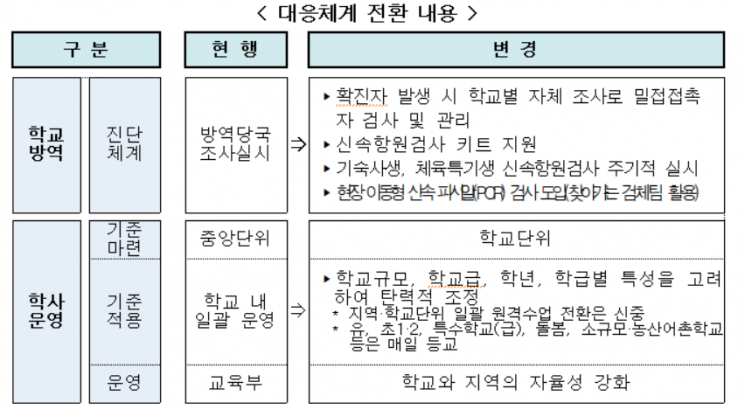
On the 7th, the Ministry of Education announced the "Omicron Response Plan for the 2022 First Semester for Kindergartens, Elementary, Middle, High, Special Schools, and Universities Regarding Quarantine and Academic Operations." Until now, the Ministry set school density standards, but the school quarantine and academic operation system has been completely reorganized to allow responses tailored to regional and school conditions.
The academic operation methods are divided into four types: ▲First, normal educational activities as before COVID-19 ▲Second, full attendance with restrictions on (non-)curricular activities ▲Third, partial attendance classes through density adjustment ▲Fourth, full remote classes. The choice of operation type will be determined by the region and school.
If the confirmed case ratio exceeds the criteria, normal attendance is not possible. The criteria for determining the operation type are twofold: a 3% rate of newly confirmed cases among enrolled students or a 15% rate of confirmed and quarantined (attendance suspended) students within the school. If either or both conditions are met, the school can autonomously select one of the second to fourth types. However, kindergartens, 1st and 2nd grades of elementary school, special schools, after-school care, and small or rural schools will attend daily.
Rather than applying uniformly, schools and regions can autonomously adjust based on these two criteria, reflecting characteristics by school level, grade, school size, and education support office. A Ministry of Education official said, "We will enable schools to comprehensively review the two criteria, and criteria may be set by grade or even by class to decide on remote classes. We aim to allow flexible and adaptive academic operations. During consultations with local education offices and field opinions, there was a request not to impose uniform standards but to respond flexibly since schools have been autonomously managing this."
For example, if a school with 600 students has 3% (20 students) confirmed cases concentrated in a specific grade, only that grade may have restrictions on extracurricular activities such as club activities. Even if confirmed cases do not reach 3%, if the number of self-quarantined students exceeds 100, class activities may be restricted.
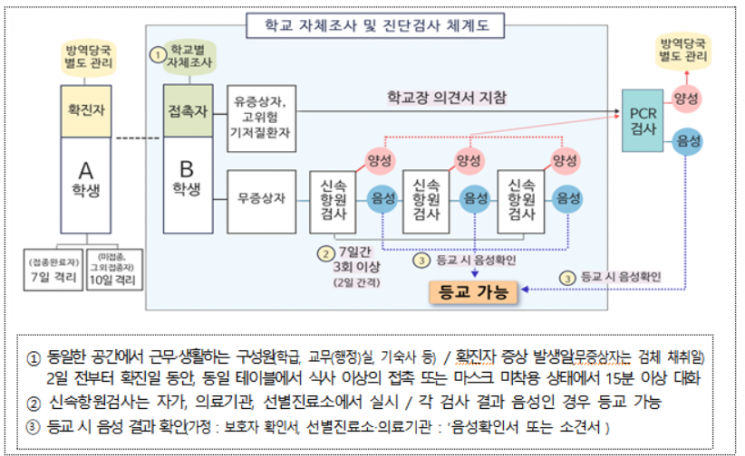
The school quarantine system will also change. Previously, epidemiological investigations were conducted by public health centers, but from the new semester, schools will classify contacts themselves and support rapid antigen tests or PCR (polymerase chain reaction) tests. Symptomatic individuals or those with high-risk underlying conditions will receive PCR tests at screening clinics and may attend school if negative. Confirmed cases must quarantine for 7 days if vaccinated, or 10 days if unvaccinated. Asymptomatic contacts must conduct rapid antigen tests at home, medical institutions, or screening clinics at least three times over 7 days and may attend school if negative.
The Ministry of Education will provide 6.5 million rapid antigen test kits, covering about 20% of all students and staff, stocked at education (support) offices using education office budgets. Considering the high number of unvaccinated kindergarten and elementary students, an additional 10% will be procured. Mobile PCR diagnostic labs will be installed in local education offices, and mobile specimen collection teams will operate concurrently.
Measures to protect the learning rights of students suspended from attending school due to confirmed cases or close contact have also been prepared. When providing alternative classes, interactive classes such as real-time broadcasting of lessons will be expanded. Each school must establish alternative learning and remote class plans within their remote class operation plans. Care services for kindergartens, elementary, and special schools will operate normally, and care will be provided even if partial attendance or full remote classes are implemented. After-school programs will operate normally in person or through online-offline combinations linked to academic operation methods, but will switch fully online during full remote classes.
To prepare for confirmed cases among staff and ensure smooth academic operations, the Ministry will deploy temporary teachers up to 3.5% of the regular teaching staff in elementary and secondary schools. It will secure 672 temporary special school teachers and 1,200 university-linked prospective special education teachers. As the number of schools conducting remote classes may increase, the public learning management system servers will be expanded to secure more than 30% capacity over the expected simultaneous users.
In preparation for full remote classes, regional and school-level Business Continuity Plans (BCP) must be established. These plans should include core tasks and their priorities, resource procurement methods, work methods for teachers unable to attend, and substitute plans for classes when teachers are confirmed positive. This emergency plan aims to prevent school operations from being interrupted and to set remote class criteria according to infection levels.
Deputy Prime Minister and Minister of Education Yoo Eun-hye said, "After careful consideration of the characteristics of the Omicron variant and consultations with various related agencies, the Ministry of Education has focused on three areas: a school field-centered academic response system, establishment of emergency plans (BCP), and a new school quarantine testing system. We will introduce rapid antigen tests and on-site mobile rapid PCR tests, provide quarantine supplies stably to minimize infection risk within schools, and shift the academic operation system toward a direction that enhances field autonomy."
© The Asia Business Daily(www.asiae.co.kr). All rights reserved.
![Clutching a Stolen Dior Bag, Saying "I Hate Being Poor but Real"... The Grotesque Con of a "Human Knockoff" [Slate]](https://cwcontent.asiae.co.kr/asiaresize/183/2026021902243444107_1771435474.jpg)

















