Automotive Research Institute Market Trend Analysis
Hyundai Motor Group Sells 240,500 Units
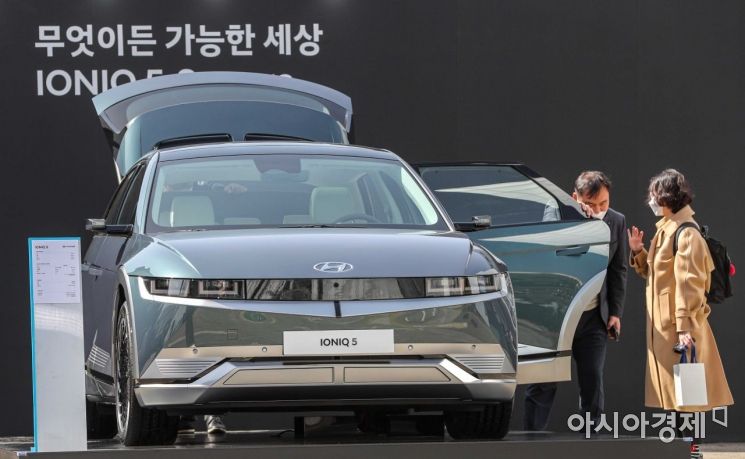 On the 17th, the 'Ioniq 5' was unveiled at Hyundai Motor Company's Wonhyo-ro building in Yongsan-gu, Seoul. Photo by Jinhyung Kang aymsdream@
[Asia Economy Reporter Seong Giho] Last year, global pure electric vehicle (EV) sales exceeded 4.72 million units, recording a 5.8% market share in the overall automobile market. Additionally, Tesla's dominance weakened, and established brands with mass production systems such as Volkswagen and Hyundai Motor Group have entered a full-scale chase.
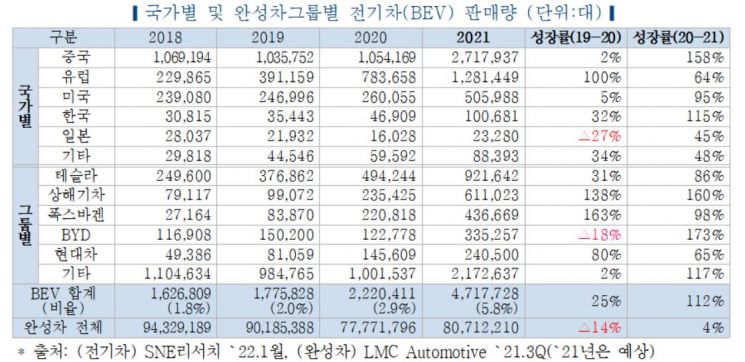
The Korea Automotive Research Institute announced on the 7th through the report "2021 Electric Vehicle Sales Performance and Market Trends" that last year's global EV sales totaled 4,717,728 units, a 112% increase compared to the previous year (2,220,411 units).
Considering that the overall automobile market (80,712,000 units) grew by 4%, the approximately 112% growth in EV sales is relatively remarkable. The market share also increased by 2.9 percentage points from about 2.9% the previous year to 5.8%.
The number one in the electric vehicle market was Tesla (921,642 units). Following were China's SAIC Motor (611,023 units), Germany's Volkswagen (436,669 units), and China's BYD (335,257 units) ranking in the top positions. Hyundai Motor Group ranked fifth by selling 240,500 units globally last year.
However, Tesla's dominance appears to be gradually weakening. While total EV sales increased by 112%, Tesla's growth rate remained at 86%. Conversely, China's SAIC Motor and BYD recorded growth rates of 160% and 173%, respectively, and Volkswagen and Hyundai Motor Group also showed high growth rates of 98% and 65%, respectively, as they pursue the leader.
Changes in the global electric vehicle market are also detected in Korea. Tesla's dominance has been broken, and a two-strong structure with Hyundai Motor Group has begun. Hyundai Motor Group, which sold 27,888 electric vehicles in the Korean market in 2020, sold 71,785 units last year, an increase of 157%. The top-selling electric vehicle in Korea last year was Hyundai Motor's Ioniq 5, with 22,671 units sold. Second was Hyundai Motor's Porter EV (15,805 units), third Kia EV6 (11,023 units), and fourth Kia Bongo EV (10,728 units). Tesla sold 17,828 units in the Korean market, led by Model 3 with 8,898 units and Model Y with 8,891 units.
The Automotive Research Institute forecasted that competition among companies in the global electric vehicle market will become even fiercer this year. It also analyzed that sales growth will vary depending on national purchase subsidy policies and predicted that the growth of electric vehicles from mass-market brands with price competitiveness will continue.
First, China plans to cut electric vehicle subsidies by 30% compared to last year. On the other hand, Japan, which is promoting the expansion of electric vehicles, raised purchase subsidies up to 800,000 yen.
In Korea, the national subsidy per electric vehicle will be reduced from 8 million won last year to 7 million won this year. Instead of reducing the subsidy per vehicle, the plan is to expand the overall subsidy recipients. The subsidy budget, which was about 800 billion won last year, will increase to 1.2 trillion won this year. The price cap for receiving 100% subsidy was also limited from 60 million won to 55 million won. The strategy is to induce manufacturers to lower electric vehicle prices by adjusting subsidy criteria.
© The Asia Business Daily(www.asiae.co.kr). All rights reserved.


















