South Korea, US, and Japan Foreign Ministers Discuss North Korea Response Strategy in Hawaii
UN Security Council Holds Closed Meeting to Condemn North Korean Missile Launch
[Asia Economy Reporter Yoo In-ho] South Korea, the United States, and Japan have strengthened their cooperative relationship to develop a response strategy against North Korea's missile provocations. This aligns with the international community's condemnation and calls for sanctions against North Korea's military provocations.
According to diplomatic sources on the 5th, the foreign ministers of South Korea, the United States, and Japan will hold a trilateral meeting for the first time since North Korea's successive missile provocations to discuss cooperation measures for responding to North Korea's nuclear threat.
The Ministry of Foreign Affairs and the U.S. Department of State announced on the 4th that Foreign Minister Chung Eui-yong, U.S. Secretary of State Antony Blinken, and Japanese Foreign Minister Hayashi Yoshimasa will hold a South Korea-U.S.-Japan foreign ministers' meeting on the afternoon of the 12th (local time) in Honolulu, Hawaii. This will be the first trilateral foreign ministers' meeting among the three countries in about four months since the meeting held in New York during the United Nations General Assembly last September.
The State Department stated in a press release that "(through this meeting) cooperation will be deepened regarding North Korea's nuclear and missile threats and the global challenges faced in the 21st century."
This meeting is notable as it is the first face-to-face consultation among senior officials of the three countries since North Korea escalated the situation on the Korean Peninsula with a series of ballistic missile launches earlier this year.
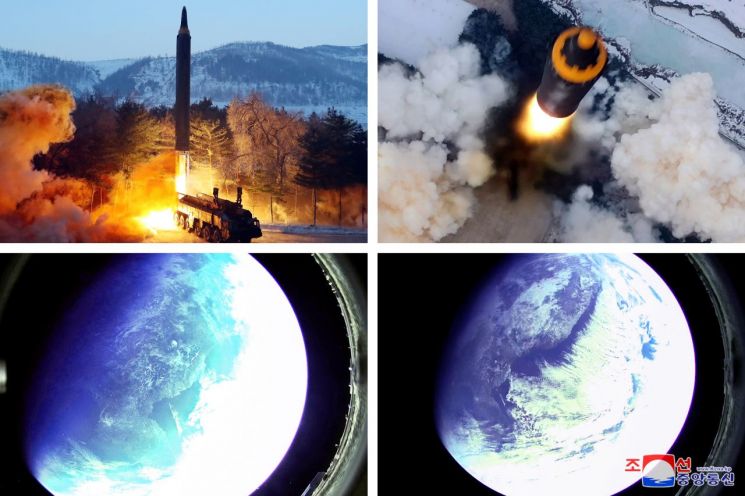
Recently, North Korea has threatened to withdraw the moratorium on nuclear tests and intercontinental ballistic missile (ICBM) launches that it had maintained since 2018, and on the 30th of last month, it launched a medium-range ballistic missile, the Hwasong-12. There is also a high possibility of large-scale strategic provocations such as ICBM launches.
Accordingly, the foreign ministers of South Korea, the United States, and Japan are expected to closely discuss cooperation measures to deter further provocations by North Korea and to resume dialogue.
Following North Korea's successive missile launches, the three countries have recently discussed response measures through meetings of their nuclear envoys (January 17) and telephone consultations among deputy foreign ministers (February 2).
The State Department also announced that Secretary Blinken plans to hold a separate bilateral meeting with Foreign Minister Chung Eui-yong. Additionally, he will meet with U.S. Indo-Pacific Command Commander John Aquilino.
If the trilateral foreign ministers' meeting is held in Hawaii, attention will also be on whether Foreign Minister Chung Eui-yong and Japanese Foreign Minister Hayashi Yoshimasa will hold their first separate bilateral meeting.
Meanwhile, on the 4th (local time), a closed meeting of the United Nations Security Council (UNSC) was held to discuss North Korea's recent ballistic missile launches.
Linda Thomas-Greenfield, U.S. Ambassador to the United Nations, after the Security Council meeting, issued a joint statement with ambassadors from eight countries including the United Kingdom, France, and Japan, condemning North Korea's launch of an intermediate-range ballistic missile (IRBM) in the strongest terms.
These ambassadors pointed out that North Korea conducted nine missile launches in January, the highest number in a single month. They warned, "The Security Council's continued silence will come at a high cost," expressing concern that "this emboldens North Korea to flagrantly violate Security Council resolutions and continue threatening international peace and security."
However, Ambassador Thomas-Greenfield and others emphasized the dialogue card, urging North Korea to "return to dialogue" and stating that "North Korea should respond positively to the U.S. proposal to meet without preconditions."
© The Asia Business Daily(www.asiae.co.kr). All rights reserved.
![Clutching a Stolen Dior Bag, Saying "I Hate Being Poor but Real"... The Grotesque Con of a "Human Knockoff" [Slate]](https://cwcontent.asiae.co.kr/asiaresize/183/2026021902243444107_1771435474.jpg)
















