'Shared Taxi' What Is the Problem?
"Taxi demand is not high except during late-night peak times"
"Concerns about disputes among passengers"
Kakao and others "No concrete plans"
Kona's 'Banban Taxi' is the only one
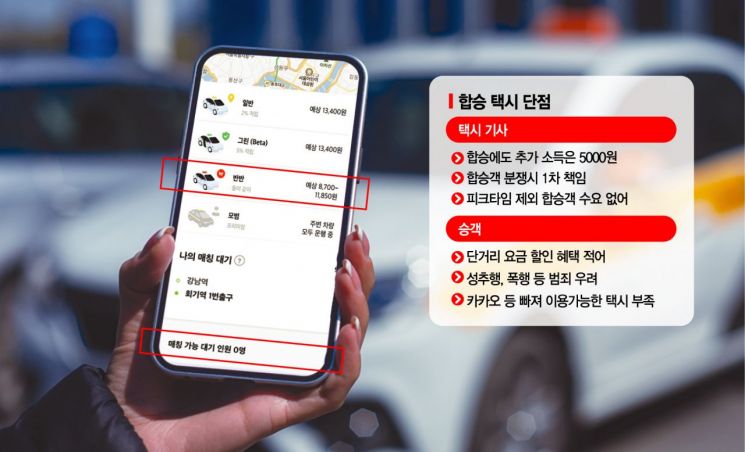
[Asia Economy Reporter Seungjin Lee] At 10:30 PM on the 3rd near Gangnam Station in Seoul, taxis with signs like ‘Empty’ kept passing by on the road, and although people heading home got into taxis one by one, the taxi application (app) on their mobile phones showed no response for 30 minutes. They tried to use the ‘Banban Taxi’’s ‘Banban Ride’ service, which is the only taxi ride-sharing service provided domestically since taxi ride-sharing was allowed for the first time in 40 years last month, but ultimately failed to find a ride-sharing passenger.
There is no one to ‘share a ride’
Although taxi ride-sharing was revived on the 4th, both taxi drivers and customers are dissatisfied. Taxi ride-sharing, operated exclusively by the startup Kona Taxi’s platform ‘Banban Taxi,’ is only available when the ride-sharing passengers’ routes match by more than 70%. The service is only available between 10 PM and 10 AM, when it is difficult to catch a taxi. The advantage of ride-sharing is that for long distances, passengers can use taxis at prices up to 40% cheaper.
However, after waiting for 30 minutes on the night of the 3rd, the ride-sharing experience ended in failure. The ‘matching available passengers’ count remained at zero. Even after changing the destination from Gangnam to Seoul Hoegi Station, Suwon, Incheon, and other places, the number of matching available passengers did not change. Low awareness of the taxi ride-sharing service was a problem, but since operators like Kakao Taxi do not support ride-sharing services, there were no users at all.
Drivers and customers both turn away
Gang Suhyun (33), whom I met while waiting for a taxi together, said, “I thought about using the ride-sharing service because taxi fares between Seoul and Suwon are expensive, but sharing a ride with a stranger for a long time late at night is very frightening.” She added, “Although ride-sharing is only allowed between people of the same gender, even among the same gender, sexual crimes and assault incidents are frequent, so there is no reason to share a ride just to save a few thousand won.”
Taxi drivers’ dissatisfaction is also high. When carrying ride-sharing passengers, drivers can earn an additional 5,000 won compared to the usual fare by collecting commissions from each passenger, but that’s all. Drivers also bear primary responsibility if disputes arise between ride-sharing passengers, which is a burden. Jo Youngdong (62, pseudonym), who drives a private taxi, said, “I haven’t seen a single driver around me who has tried ride-sharing yet,” and criticized, “The problem is that there are no passengers due to COVID-19, so who would waste time trying to pick up ride-sharing passengers?”
Administration obsessed with deregulation
The transportation industry and taxi users pointed out that although the government revised laws to ease regulations, it is nothing more than desk-bound administration that helps no one. Taxi driver Kim Youngmoon (54) said, “It overlooked the fact that the problem is not the shortage of taxis in major metropolitan areas, but that demand surges during peak times and many refuse rides, causing persistent late-night ride difficulties.”
When taxi ride-sharing was legalized, there was also an aim to activate platform competition through deregulation of IT companies, but it is uncertain whether this will have a significant effect. The joint platform of Uber and T Map Mobility, ‘UTI,’ is the only one that announced plans to launch a ride-sharing brokerage service within the first half of this year, but it is questionable whether the ‘ride-sharing’ service, which requires an increase in users to function properly, will work well.
Professor Yoo Jeonghoon of Ajou University’s Department of Transportation Systems Engineering explained, “Taxi ride-sharing is a service needed for long-distance users and is far from solving the late-night taxi shortage in urban areas,” adding, “Demand-responsive transport (DRT), which is a bus that comes when called, should be expanded to taxis, and ride-sharing services should be expanded to large van taxis.”
© The Asia Business Daily(www.asiae.co.kr). All rights reserved.

















