Moves to Amend Serious Accident Punishment Act
Expansion to Workplaces with Fewer Than 5 Employees
Small Business Owners and Micro Enterprises Face 'Sudden Crisis'
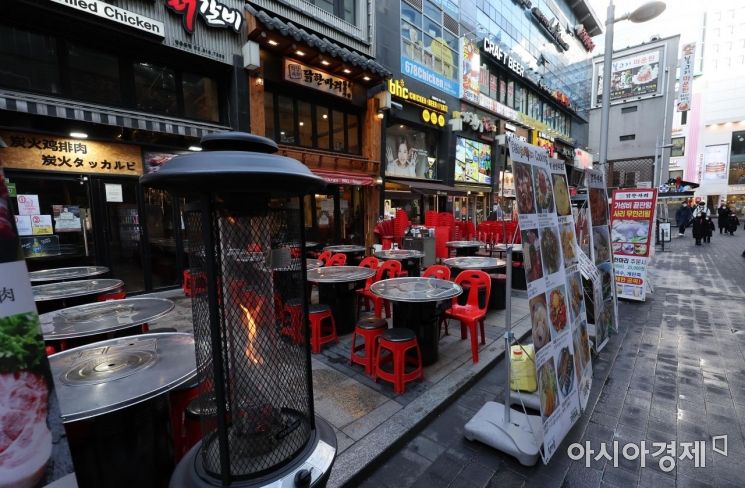 As the government announced a two-week extension of the current social distancing measures, restaurants in Seoul are showing a quiet atmosphere. Photo by Kim Hyun-min kimhyun81@
The political sphere is pushing for an amendment to apply the Serious Accidents Punishment Act to small business sites with fewer than five employees. Simply put, the law will be revised so that if an employee working at a local gimbap shop dies or if injuries occur due to entrapment accidents at a small printing shop, the business owner can be detained. This move is expected to face strong opposition as it further restricts small businesses already on the brink of collapse due to the prolonged COVID-19 pandemic.
According to the National Assembly on the 4th, recently, 10 lawmakers from both ruling and opposition parties, including Kang Min-jung of the Democratic Party of Korea, proposed an amendment to delete the exemption clause for workplaces with fewer than five regular employees under the Serious Accidents Punishment Act. The aim is to expand the scope of the law to all workplaces with fewer than five regular employees by next year. A provision was also added to punish business owners who destroy the scene of a serious industrial accident or obstruct investigations. Kang Eun-mi of the Justice Party also proposed an amendment to include workplaces with fewer than five employees within the law’s scope and to strengthen protections for trainees receiving on-site training.
The small business and micro-SME sectors, which had considered themselves exempt from the Serious Accidents Punishment Act, have expressed bewilderment. Amid the worsening local markets due to the ongoing COVID-19 crisis for three years, they show resistance to the political attempt to apply the law. Gu Mo (64), who runs a store in Inhyeon Market in Jung-gu, Seoul, said, "Most merchants in the market are elderly, so their understanding of the law is even lower," adding, "Large corporations can receive legal support, but our situation is different. Punishing workplaces with fewer than five employees is unfair."
The Ministry of SMEs and Startups, which oversees policies for small and medium enterprises and small business owners, reportedly participated in the legislative process of the Serious Accidents Punishment Act last year and expressed the opinion that workplaces with fewer than five employees should be excluded from the law’s application. The postponement of the law’s application to workplaces with fewer than 50 employees until 2024 reflected not only industry concerns but also the ministry’s stance. However, as soon as the law was enacted, lawmakers from the ruling coalition reversed this, causing discord between the government and the ruling party. Lawmakers from the Democratic Party of Korea, including Kim Du-kwan, Kim Seung-won, Yang Yi-won-young, and Yoo Jeong-ju, also participated in proposing the amendment. Confusion continues in the SME field due to ambiguous legal provisions, and there are calls to establish regulations that exempt business owners from liability if there is no intentional or gross negligence on their part.
© The Asia Business Daily(www.asiae.co.kr). All rights reserved.
![Clutching a Stolen Dior Bag, Saying "I Hate Being Poor but Real"... The Grotesque Con of a "Human Knockoff" [Slate]](https://cwcontent.asiae.co.kr/asiaresize/183/2026021902243444107_1771435474.jpg)
















