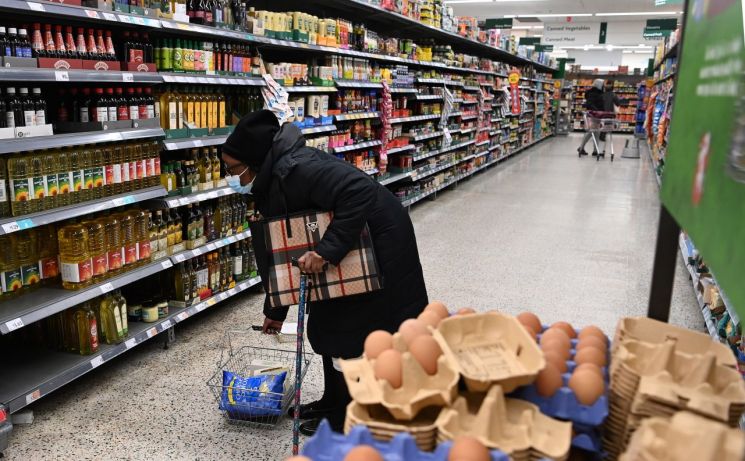
[Asia Economy Reporter Hyunwoo Lee] Inflation rates among member countries of the Organisation for Economic Co-operation and Development (OECD) have reached their highest levels in 30 years, raising global concerns over a surge in inflation. This is attributed to rising inflationary pressures caused by soaring prices of energy such as oil and natural gas, compounded by supply chain issues and geopolitical problems, along with a sharp increase in global food prices.
On the 3rd (local time), the OECD announced that the year-on-year inflation rate for its member countries in December last year was 6.6%, marking the highest level since July 1991. This phenomenon is seen as a result of overall increases in energy and food prices, combined with supply chain problems that have intensified following the COVID-19 pandemic.
In particular, the OECD reported that Turkey’s inflation rate surged to 36.1%, significantly raising the average inflation rate among all member countries. Excluding Turkey, the inflation rate among OECD members was 5.6%, up 0.3 percentage points from 5.3% the previous month. For the entire year of 2021, the annual average inflation rate for OECD member countries rose sharply to 4.0% from 1.4% the previous year, marking the highest record since 2000.
Global food prices also rose to record levels. The United Nations Food and Agriculture Organization (FAO) reported that the global food price index (FFPI) for last month reached 135.7, the highest since the international food price surge during the 'Arab Spring' in 2011. The FFPI is calculated by the FAO based on the international trade prices of five commodities: grains, vegetable oils, dairy products, meat, and sugar.
The New York Times (NYT) analyzed that the sharp rise in international food prices is due to a combination of global supply chain disruptions following the COVID-19 pandemic, abnormal climate phenomena, and soaring energy prices. The NYT pointed out that the price of containers used for food exports has increased by an average of 170% compared to a year ago.
Maurice Obstfeld, senior researcher at the Peterson Institute for International Economics in the United States, warned in an interview with the NYT that "there is a risk of rapid spread of social instability." He noted that the combination of low growth rates, high unemployment, and a food crisis amid governments’ fiscal shortages due to COVID-19 responses could lead to unstable situations.
Christian Borgmans, an economist at the International Monetary Fund (IMF), forecasted that "if conflicts occur near the borders of Ukraine, a major producer of wheat and corn, or if abnormal climate phenomena worsen, international food prices could become even more unstable."
© The Asia Business Daily(www.asiae.co.kr). All rights reserved.
![Clutching a Stolen Dior Bag, Saying "I Hate Being Poor but Real"... The Grotesque Con of a "Human Knockoff" [Slate]](https://cwcontent.asiae.co.kr/asiaresize/183/2026021902243444107_1771435474.jpg)
















