Household Loan Balance of 707.6895 Trillion Won as of the 31st of Last Month
1.3634 Trillion Won Less than at the End of December
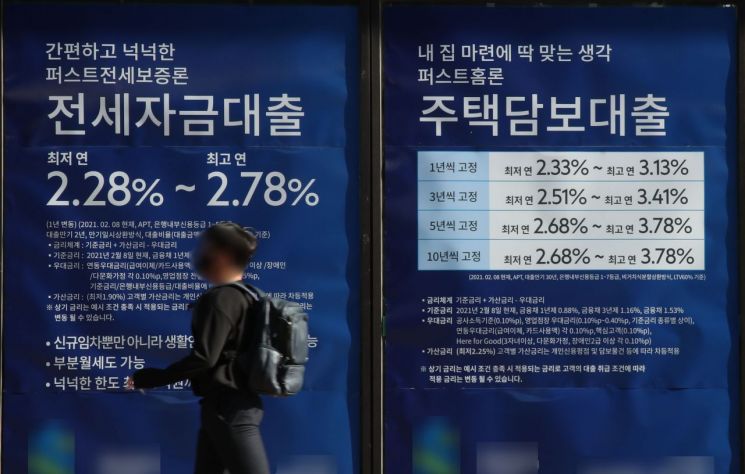
[Asia Economy Reporter Shim Nayoung] The outstanding household loans of the five major commercial banks decreased for the first time in eight months in January. This was due to the simultaneous impact of tightened loan limit policies at the beginning of the new year, rising interest rates, and the stagnation of the housing and stock markets. There is speculation that the "Yeongkkeul" and "Bitt" phenomena, which spread like wildfire last year, may have come to an end.
According to KB Kookmin, Shinhan, Hana, Woori, and NH Nonghyup banks on the 3rd, the outstanding household loan balance of the five major banks as of the 31st of last month was 707.6895 trillion KRW. This is 1.3634 trillion KRW less than the end of December last year (709.0528 trillion KRW).
By loan type, mortgage loans including jeonse deposit loans increased by 1.4135 trillion KRW. Credit loans decreased by 2.5151 trillion KRW. Jeonse deposit loans also decreased by 181.7 billion KRW.
The halt in loan growth is due to a combination of factors: reduced borrowing limits, rising loan interest rates, and difficulty finding profitable investment opportunities with borrowed funds. The DSR (Debt Service Ratio) regulation, which limits borrowers' principal and interest repayment to 40% of their annual income, has been applied from January for total loans exceeding 200 million KRW, reducing the amount that can be borrowed. Following the Bank of Korea's base rate hike last month, interest rates on credit loans and jeonse loans (based on the four major banks) also rose to 4.70% and 4.86% per annum, respectively, and are expected to soon reach 5%. Mortgage loan interest rates also increased to a variable rate of 3.71% to 5.21% per annum.
A representative from a commercial bank said, "Seoul apartment prices have shifted to a downward trend, and the KOSPI index dropped sharply by 10% in January, so the asset market's full recovery timing is uncertain, leaving no place to invest even if money is borrowed. This is evident from the fact that loans that temporarily surged during the LG Energy Solution IPO subscription last month have returned to the banks."
Deposits at the five major banks saw a sharp increase in time deposits by 11.841 trillion KRW (from 654.9359 trillion KRW to 656.7769 trillion KRW) last month due to rising deposit interest rates. However, demand deposits, which can be withdrawn at any time, decreased by 10.5628 trillion KRW.
© The Asia Business Daily(www.asiae.co.kr). All rights reserved.

















