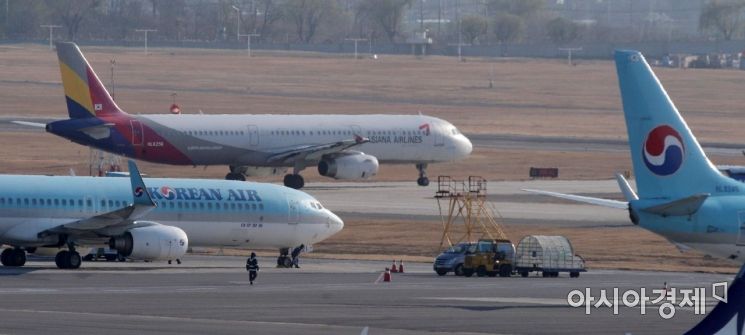
 As the court's decision on Korean Air's acquisition of Asiana Airlines approaches, on the 30th, Korean Air and Asiana Airlines passenger planes were moving toward the runway at Gimpo Airport apron in Gangseo-gu, Seoul. The Seoul Central District Court is expected to deliver a ruling today or tomorrow on the injunction request filed by activist private equity fund KCGI against Hanjin KAL to prohibit the issuance of new shares. If the court dismisses the injunction request, the acquisition process will accelerate, but if the injunction is granted, the acquisition is likely to be canceled. Photo by Kim Hyun-min kimhyun81@
[Asia Economy Sejong=Reporter Dongwoo Lee] As the Fair Trade Commission (FTC) approaches the final decision on whether to approve the M&A (merger and acquisition) between Korean Air and Asiana Airlines in one week, internal disagreements have emerged regarding the scope and level of adjustments. The key issue is the extent to which the conditional approval will limit monopolistic routes and traffic rights if the two companies merge. In particular, it is expected that the establishment of conditions and environment for domestic low-cost carriers (LCCs) to enter new routes to prevent a decline in global competitiveness after the integration will be a major variable in the final approval.
According to the government and the aviation industry on the 3rd, the FTC will hold a plenary meeting (deliberation) on the corporate merger between the two companies on the 9th. Previously, the FTC examiners submitted a review report to the plenary meeting that included a 'conditional approval' involving adjustments to some traffic rights (government-allocated flight operation rights to airlines) and slots (allowed takeoff and landing frequencies per hour) on monopolistic routes of the two companies.
Although the FTC has not disclosed specifics, the monopolistic routes subject to conditional approval reportedly include Incheon-origin routes to Los Angeles (LA), New York, Seattle, Sydney, and European cities such as Paris, Rome, Frankfurt, and Barcelona. Some Asian routes departing from Gimpo, such as Tokyo, are also included.
The FTC has reached a consensus on returning some traffic rights and slots on these routes upon corporate merger. Routes such as Frankfurt and LA are known to be likely candidates so far. A representative from the FTC’s Corporate Merger Division said, "Since slot returns and traffic rights readjustments are the first cases of corporate mergers domestically, there are no precedents to refer to, so the deliberation has been prolonged," but added, "The possibility of disapproval at the plenary meeting is currently very low."
Upon finalizing conditional approval, traffic rights for 'air routes subject to aviation liberalization'?which require traffic rights to operate?will be allocated exclusively to domestic airlines excluding foreign carriers, thereby fundamentally preventing a decline in the competitiveness of the domestic aviation industry.
However, some anticipate that the final conclusion of the plenary meeting may be delayed considering that only domestic low-cost carriers (LCCs) can receive redistributed new routes. These LCCs are under financial pressure due to COVID-19 and lack the investment capacity to acquire aircraft necessary for medium- to long-haul flights, which needs to be prioritized in review.
There are also calls for additional discussion on exception clauses prepared by the FTC in case traffic rights adjustments prove difficult. The FTC previously set conditions allowing the integrated airline to operate the routes by restricting fare increases and prohibiting supply reductions if traffic rights adjustments are not feasible.
An official from the FTC’s General Adjudication Office explained, "If a majority of the plenary members approve, the review passes, but sometimes consensus is not reached on the day depending on the content," adding, "Since the deliberation also considers the future impact on the domestic aviation industry related to this M&A, it could become complicated."
© The Asia Business Daily(www.asiae.co.kr). All rights reserved.

















