"Decision on Extension Needed for Companies to Plan Finances"
"No Chance to Do Business... Additional Extension Required"
Experts Call for Soft Landing Measures to Prevent Insolvency
Support Plans Include Staggered Repayment and Assistance for Re-challenge After Closure
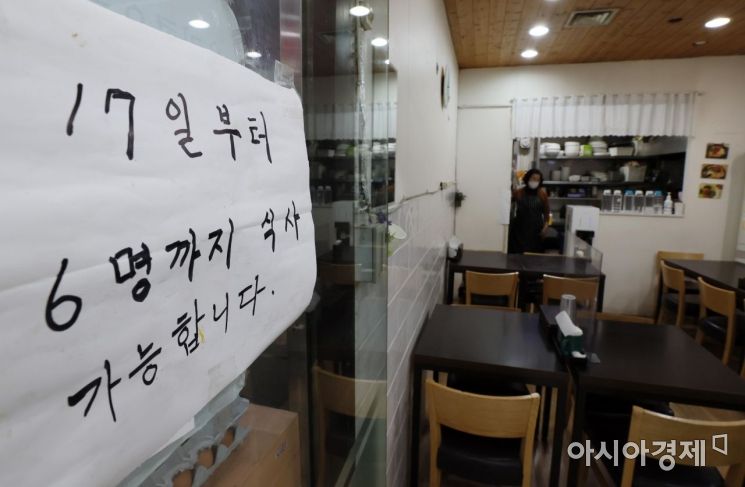 On the 14th, when the government announced the social distancing adjustment plan, a notice about the limit on the number of people was posted at a restaurant in downtown Seoul. Photo by Hyunmin Kim kimhyun81@
As the loan maturity extension measures for small and medium-sized enterprises (SMEs) and small business owners approach their end in late March, the government plans to decide on whether to extend the maturity within March. However, the SME industry is urging for a decision on the extension to be made within this month. Financial authorities and government officials agree on the need for a soft landing plan that mitigates default risks while supporting SMEs and small business owners in repaying their debts.
◆ SME Industry "Additional Extension Decision Needed in February" Government "Decision Possible in Early March"= On the 3rd, Choo Moon-gap, Head of Economic Policy at the Korea Federation of SMEs, stated, "Loan maturities should be extended until the COVID-19 situation calms down," adding, "The decision on additional extension must be made as soon as possible so that companies can plan their finances on the ground; it must be finalized within this month."
The Korea Federation of Small and Medium Business also said, "With daily confirmed cases exceeding 20,000, it will be difficult for the government to ease social distancing and business restrictions," and argued, "The loan maturity extension should not be stopped without giving small business owners a chance to operate. An announcement of an additional extension must be made as soon as possible."
According to a survey by the Korea Federation of SMEs, 8 out of 10 SMEs (78.3%) who used the loan maturity extension and interest repayment deferral measures responded that it was helpful, and 87% of SMEs hoped for an additional extension of these measures.
The government’s stance is that it needs to observe market conditions and can only make a decision next month. The Financial Services Commission is currently diagnosing the management and actual conditions of small business owners and SMEs, and the decision on additional extension will be made considering specific statistics and economic conditions.
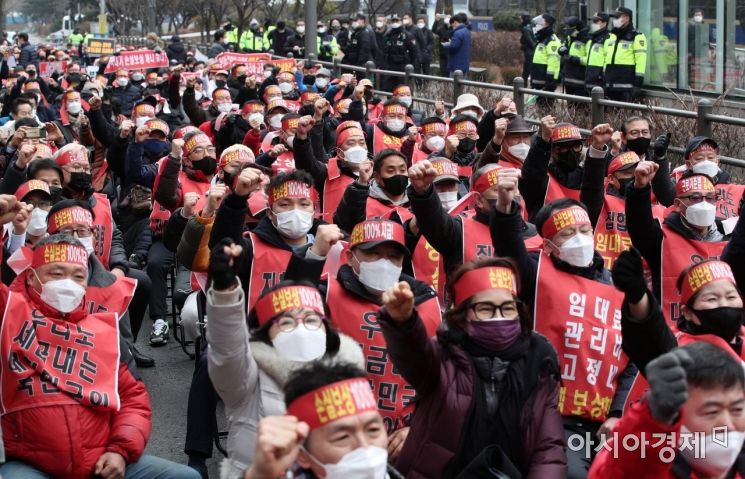 Officials from the Solidarity of Business Owners Affected by COVID-19 held a "Shaved Head Protest by Angry Self-Employed" on the 25th in front of the National Assembly in Yeouido, Yeongdeungpo-gu, Seoul, urging for substantial compensation for COVID-19 damages. Photo by Hyunmin Kim kimhyun81@
The Ministry of SMEs and Startups, responsible for policy fund loans to SMEs and small business owners, faces the task of discussing additional extensions with the Ministry of Economy and Finance. Among SMEs that received policy fund loans through the Korea SMEs and Startups Agency under the Ministry of SMEs and Startups, 42,000 companies are scheduled to mature between April and September this year, with loans amounting to approximately 1.44 trillion KRW. The Small Enterprise and Market Service also implemented maturity extensions for 128,000 small business policy fund loans with principal repayments due between October last year and March this year.
An official from the Korea SMEs and Startups Agency said, "If loan maturities are extended further, there is a possibility of risk to the SME fund, so consultation with the Ministry of Economy and Finance is necessary," adding, "We plan to decide in March on a soft landing plan that does not harm SMEs or on whether to extend or end the maturity extension."
◆ Experts United in Calling for a Soft Landing Plan= Various opinions have been proposed as soft landing measures to prevent financial sector default risks and reduce shocks to SMEs and small business owners. These include spreading out repayment schedules or shortening the extension period from the existing six months to three months. Another option is to limit the support targets. For example, restricting maturity extensions and repayment deferrals to small business owners in face-to-face service industries hit hardest by COVID-19 or prioritizing the termination of deferral measures for SMEs above a certain size. Additionally, installment repayments based on credit ratings are also possible.
Nam Chang-woo, Deputy Director of the Korea Development Institute (KDI), said, "With the Omicron variant still spreading, and considering the U.S. tightening monetary policy and interest rate hikes, as well as the weakening real economy in China, there is little room for economic growth," adding, "Rather than ending the loan maturity extension measures all at once at the end of March, a phased approach seems more appropriate." He added, "There could be additional extensions for companies with low credit ratings or those in face-to-face service sectors like lodging and restaurants while monitoring market conditions. If certain conditions are met, debt restructuring or interest reductions could be implemented to prevent shocks from spreading to the financial market."
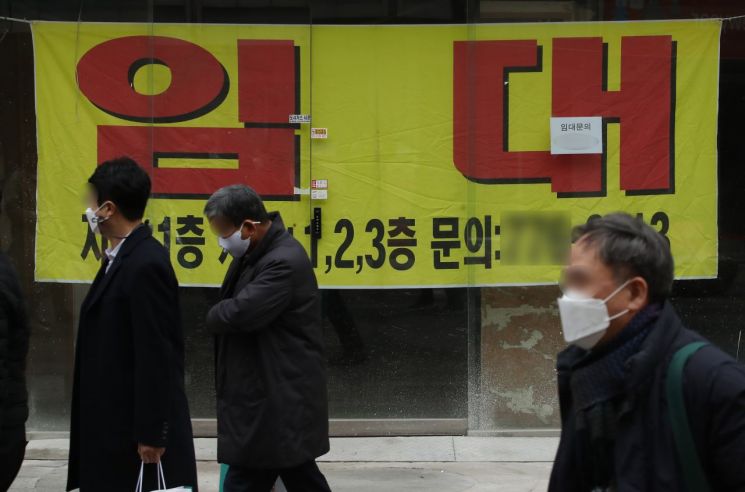
Hong Woon-sun, Deputy Director of the Korea Institute for Startup & Entrepreneurship Development, stated, "Borrowing more debt to repay existing debt can lead to the worst vicious cycle," and emphasized, "The government should create a cycle that allows for re-challenge even after business closure."
Financial authorities also revealed they are preparing for a soft landing. They are establishing repayment plans with borrowers and reviewing additional support for principal and interest repayment deferrals and extensions of payment periods. They are also considering separate support measures for borrowers who find a soft landing difficult due to insufficient repayment capacity.
A KB Kookmin Bank official explained, "When evaluating the credit of SMEs affected by COVID-19, we fully reflect their recovery potential and support minimizing interest rate hikes even if credit ratings decline," adding, "If continuous repayment burdens are expected after the deferral period ends, we plan to check the feasibility of normalization and self-rescue plans and prevent defaults through internal workout systems to guide a soft landing."
© The Asia Business Daily(www.asiae.co.kr). All rights reserved.



















