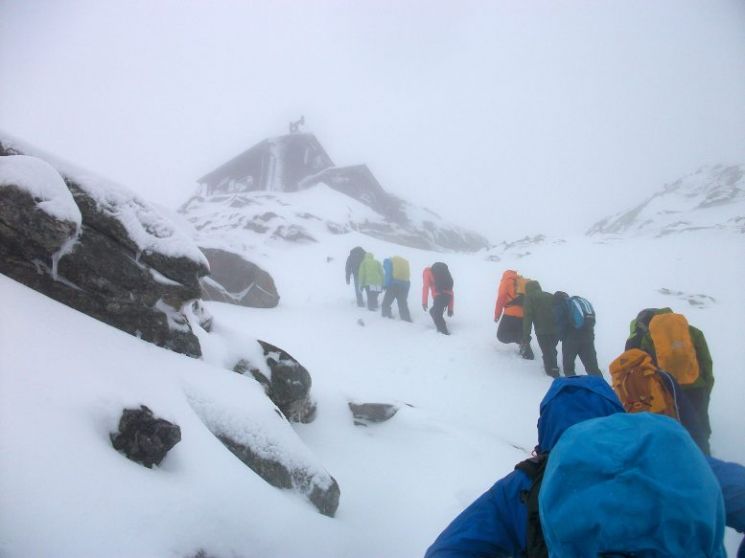
 A research team including members from the Swiss Federal Laboratories for Materials Science and Technology (EMPA) and Utrecht University in the Netherlands analyzed snow falling in the high-altitude areas of the Alps and confirmed the detection of a large amount of nanoplastics.
 [Photo by SciTechDaily]
[Asia Economy Reporter Sumi Hwang] An international study has revealed that snow mixed with microplastics falls in the Alps, one of the world's representative pristine regions.
On the 2nd, according to the scientific community, a research team including members from the Swiss Federal Laboratories for Materials Science and Technology (EMPA) and Utrecht University in the Netherlands published a paper last November in the international journal Environmental Pollution, confirming the detection of a large amount of nanoplastics in snow falling in the high-altitude areas of the Alps.
The research team collected snow daily at 8 a.m. for about 40 days starting from mid-February 2017 near the weather geophysics central research institute observation station at the summit of Hoher Sonnblick Mountain in Austria, at an altitude of 3,106 meters.
Analysis of the snow samples collected by the research team showed an average nanoplastic concentration of 46.5 ng (nanograms) per 1 ml of snow.
Based on this figure, the annual average nanoplastic deposition rate in this area is 42 kg per 1 km², which is much higher than the figures identified in previous studies.
It was analyzed that about 20 billion nanoplastic particles fall weekly on an area of 1 m by 1 m. The research team explained that approximately 3,000 tons of nanoplastics fall annually across Switzerland.
The types of nanoplastics detected were mainly polypropylene (PP) and polyethylene terephthalate (PET), which are plastic materials commonly found around us.
The research team analyzed the origin of the nanoplastics based on European meteorological data. Nanoplastics are plastic particles smaller than 1 μm (micrometer), very small and light, allowing them to be carried by air over long distances.
As a result, about 30% of the detected amount was found to have originated from cities within a 200 km radius of the observation station. Additionally, 10% of the detected amount was carried by winds from the Atlantic Ocean, 2,000 km away from the observation station.
The research team stated, "Further studies on nanoplastic pollution in urban, rural, and remote areas are necessary," adding, "This will provide insights into the levels of nanoplastic exposure."
© The Asia Business Daily(www.asiae.co.kr). All rights reserved.
![Clutching a Stolen Dior Bag, Saying "I Hate Being Poor but Real"... The Grotesque Con of a "Human Knockoff" [Slate]](https://cwcontent.asiae.co.kr/asiaresize/183/2026021902243444107_1771435474.jpg)











