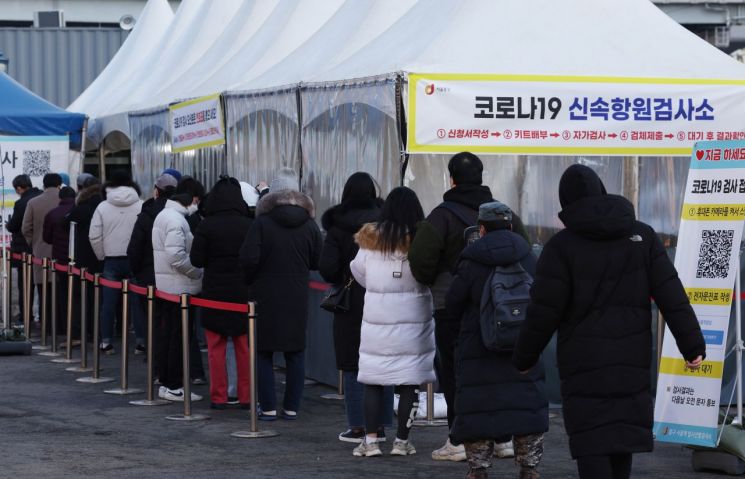
 On the morning of the 31st, one day before Seollal, citizens who visited the temporary COVID-19 screening site set up at Seoul Station Plaza are lining up and waiting to get tested. [Image source=Yonhap News]
[Asia Economy Reporter Jeong Dong-hoon] On the 2nd, for the first time since the outbreak of COVID-19 in South Korea, the number of new confirmed cases exceeded 20,000. This surge in new cases during the ongoing Lunar New Year holiday is expected to trigger an emergency in quarantine measures.
The Central Disease Control Headquarters announced that as of midnight, there were 20,270 new confirmed cases, bringing the total to 884,310. The number of new domestic cases had reached 18,342 the previous day, marking the first time it exceeded 18,000, but it increased by more than 1,900 in just one day, surpassing 20,000.
This is analyzed to be due to the rapid spread of the Omicron variant. It is known to be more than twice as transmissible as the existing Delta variant, and with the Omicron variant detected in 80% of domestic COVID-19 cases, Omicron has firmly established itself as the dominant strain.
Meanwhile, increased population movement and contact during the Lunar New Year holiday appear to be accelerating the spread of Omicron. Considering the possibility that testing volume may have somewhat decreased during the holiday period, the number of confirmed cases is expected to increase even more sharply after the holiday.
Although confirmed cases have surged, this has not led to an increase in critically ill patients or deaths. As of midnight, the number of critically ill patients was 278, six fewer than the previous day. Deaths increased by 15, bringing the total to 6,787. The cumulative fatality rate stands at 0.77%.
The COVID-19 fatality rate was 0.91% in early to mid-last month, but as Omicron, which has a critical illness rate one-fifth that of Delta, became the dominant strain, the rate has gradually decreased.
As of 5 p.m. the previous day, the nationwide COVID-19 severe bed occupancy rate was 15.9% (376 out of 2,370 beds in use), leaving 1,994 beds available for hospitalization nationwide. The number of patients receiving home treatment was 89,420 as of midnight, an increase of 6,560 from the previous day (82,860). As of midnight the previous day, there were 436 medical institutions managing home treatment, capable of managing a total of 102,000 patients.
© The Asia Business Daily(www.asiae.co.kr). All rights reserved.

















