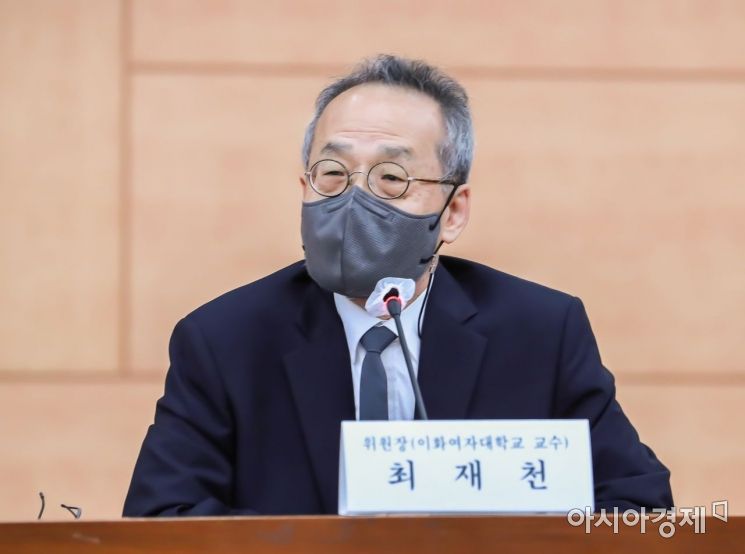
 On the 13th of last month, the first meeting of the Daily Recovery Committee was held at the Seoul Government Complex Annex in Jongno-gu, Seoul. Professor Choi Jae-cheon, who serves as co-chairman, is giving opening remarks before the meeting. Photo by Kim Hyun-min kimhyun81@
[Asia Economy Reporter Seoyoung Kwon] Choi Jaecheon, Ewha Womans University Distinguished Professor and co-chair of the COVID-19 Daily Recovery Support Committee, expressed a cautiously optimistic personal opinion as an evolutionary biologist regarding the Omicron variant, which has become the dominant strain, saying, "If I may speak very carefully on the premise that this is a personal opinion of an evolutionary biologist, Omicron is actually quite welcome."
On the 1st, Professor Choi appeared on KBS Radio's 'Choi Young-il's Current Affairs Headquarters' and commented on the COVID-19 situation. He explained, "This (COVID-19) is not something that will end. How can we possibly kill every last bit of the virus on the Korean Peninsula?" He added, "Throughout human history, we have only won a war against a virus once. We defeated smallpox once, and now all other viruses coexist with us."
Professor Choi said, "We should not treat the fight with nature like a war," and added, "Nature is about adapting appropriately and living together. We should proceed until we reach a point where we can cautiously return to normal life." He further explained, "(The virus) may have strong transmissibility, but it can never have strong lethality because if it kills too many, it cannot spread."
He likened the emergence of the Omicron variant by saying, "Viruses also undergo competitive evolution. At first, the stronger ones dominate, but since they do not spread well, their competition diminishes, and the weaker ones that you might not even realize you caught start to spread." He also said, "As it spreads like this, at some point it becomes a disease that is roughly like a cold and ends after a mild illness," and concluded, "From the perspective of an evolutionary biologist like myself looking at the overall trend, this is a welcome development."
However, Professor Choi warned, "We cannot say this too easily," and cautioned, "If people think it's over and recklessly lift (quarantine rules), a strong strain could dominate again in that gap." He said, "It is not easy to maintain an appropriate level of quarantine," and added, "There is one more complicated variable, which is that this (COVID-19) being zoonotic is somewhat problematic." This means that since the COVID-19 virus can jump to animals and then back to humans, it remains a formidable opponent.
When asked, "When can we re-enter the phased daily recovery (With COVID) that was attempted once last November?" Professor Choi replied, "I expect that if the public makes rational judgments and acts accordingly, the current quarantine system will roughly end by the end of this year."
Meanwhile, according to the Central Disease Control Headquarters, the domestic detection rate of the Omicron variant in the fourth week of January was 80.0%, up 29.7 percentage points from 50.3% in the third week. The transmissibility of the Omicron variant is two to three times that of the Delta variant, but its fatality rate is known to be about one-fifth that of Delta. Compared to the flu, this fatality rate is slightly higher, and the Central Disease Control Headquarters analyzed, "Although the domestic detection rate of Omicron has become dominant, the rates of severe and critical cases and fatality are significantly lower compared to Delta."
© The Asia Business Daily(www.asiae.co.kr). All rights reserved.

















