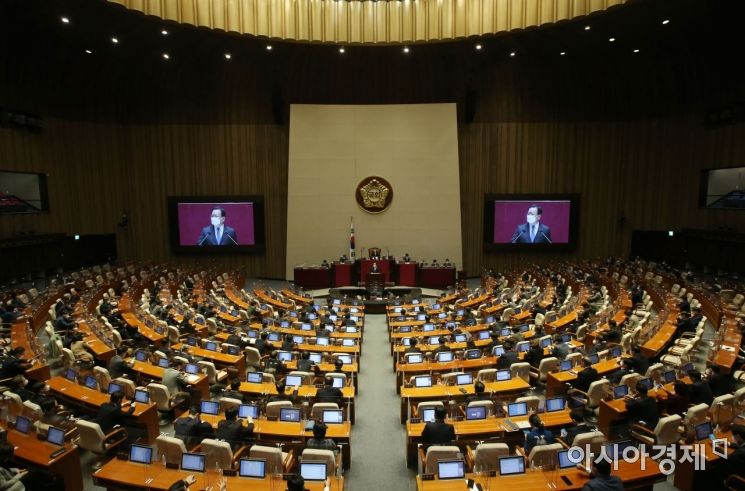
 Prime Minister Kim Boo-kyum is delivering a policy speech related to the supplementary budget at the National Assembly plenary session on the 27th of last month. Photo by Yoon Dong-joo doso7@
[Asia Economy Sejong=Reporter Son Seon-hee] The government has submitted a supplementary budget (추경) plan worth a total of 14 trillion won to the National Assembly last month, and the National Assembly plans to begin reviewing it immediately from the 3rd, right after the Lunar New Year holiday.
Although the supplementary budget was prepared by issuing additional deficit bonds amid a national debt that has already surpassed 1,000 trillion won, the political circles, ahead of the presidential election, are eager to increase the budget regardless of party lines. The financial authorities have repeatedly sent messages asking to "respect the government proposal," but if both ruling and opposition parties unanimously demand an increase during the review process, it is expected to be difficult to hold out.
According to the government and the National Assembly on the 2nd, each standing committee of the National Assembly will conduct the supplementary budget review from the 3rd to the 8th. From the 7th of next month, the Special Committee on Budget and Accounts will conduct a review based on this.
The government previously submitted a supplementary budget plan worth 14 trillion won to the National Assembly based on last year's excess tax revenue. It includes 11.5 trillion won for small business owners' quarantine support funds and loss compensation, 1.5 trillion won for strengthening quarantine measures, and 1 trillion won for contingency funds. Approximately 3.2 million small business owners whose sales decreased due to COVID-19 quarantine measures will receive an additional 3 million won in quarantine support funds, and the minimum payment for loss compensation has been increased from the existing 100,000 won to 500,000 won.
As for the supplementary budget resources, the government said it would use tax revenue that exceeded last year's government estimates. However, under the National Finance Act, excess tax revenue cannot be used until the settlement procedure is completed in April, so practically about 11.3 trillion won worth of additional deficit bonds will be issued, and various fund surpluses will be mobilized.
The national debt was 1,064.4 trillion won at the time of this year's main budget formulation, having already surpassed the "1,000 trillion won" mark for the first time. Adding the national bonds to be issued for this supplementary budget plan, the national debt is expected to increase to 1,075.7 trillion won. The national debt ratio relative to Gross Domestic Product (GDP) rose from 50.0% based on the main budget to 50.1% based on the supplementary budget plan. If the National Assembly later demands an increase in the supplementary budget size, the scale of bond issuance will also increase, inevitably raising the debt ratio.
Furthermore, even after the settlement in April is completed, the amount of last year's excess tax revenue that can actually be used for bond repayment is expected to be limited. Excluding the excess tax revenue (31.5 trillion won) already revised in July last year, about 29 trillion won of excess tax revenue is expected to have occurred in the second half of the year. Of this, 40% (7.6 trillion won) of the government's previously predicted amount (19 trillion won) was sent down as local allocation tax, and 5.3 trillion won of the remaining tax revenue was used for livelihood measures such as support for small business owners. After spending 2.5 trillion won to reduce bond issuance volume, 3.6 trillion won went into the world surplus fund.
Considering local allocation tax and contributions to public funds for the 10 trillion won of tax revenue exceeding the government's prediction, the actual resources available for bond repayment are expected to be limited. Moreover, there is a possibility that this will be used as resources for a second supplementary budget reflecting the new government's state philosophy, which will come into effect in early May after the April settlement.
Hong Nam-ki, Deputy Prime Minister and Minister of Economy and Finance, said at a meeting on the 17th of last month regarding the use of excess tax revenue after settlement, "There are several choices, such as using it to pay off debt or for a new supplementary budget, so it is a matter to be judged at that time."
© The Asia Business Daily(www.asiae.co.kr). All rights reserved.

















