Japanese Ambassador to the US: "Depends on the ongoing National Security Strategy review"
Japan pushes to possess 'enemy base attack capability' citing North Korea and China missile threats
[Asia Economy International Desk Reporter] The U.S. political media outlet Politico reported on the possibility of Japan deploying U.S. intermediate-range missiles.
Koji Domita, Japan’s ambassador to the United States, said in an interview with Politico on the 31st of last month (local time) that Japanese leaders are weighing options to deploy ground-based ballistic missiles (surface-to-surface missiles) or cruise missiles capable of striking China and North Korea on Japanese territory.
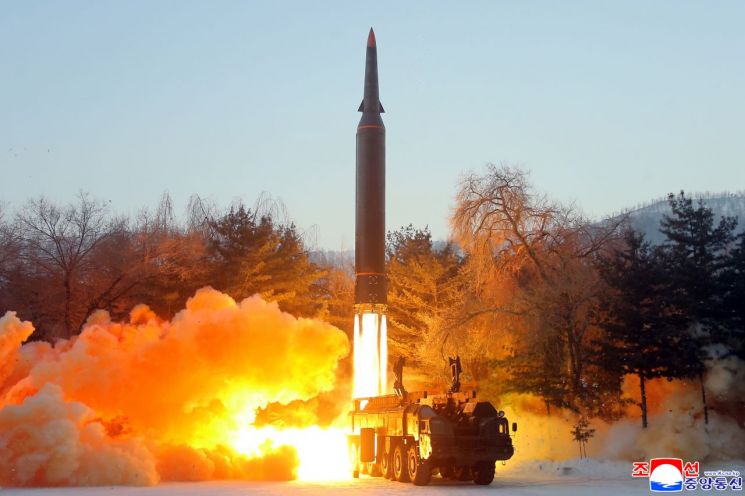
The deployment of U.S. intermediate-range missiles could serve as a means to deter threats from China and North Korea. However, Ambassador Domita mentioned that Japan is neither open nor opposed to this plan yet, stating that it depends on the results of the ongoing review of Japan’s national security strategy.
He also said, "We look forward to making progress and engaging with our American friends," adding, "We see the security environment becoming increasingly difficult. The security environment is becoming very serious."
Japan is currently discussing security strategies, including the possession of “enemy base strike capabilities,” which implies having long-range precision strike means.
Until recently, the development of intermediate-range missiles by the U.S. was delayed due to the Intermediate-Range Nuclear Forces (INF) Treaty with Russia. The INF Treaty, signed between the U.S. and the Soviet Union in December 1987 during the height of the Cold War, eliminated 2,692 intermediate- and short-range missiles with ranges of 500 to 5,500 km by June 1991 and subsequently served to curb missile development competition between the two countries.
However, former President Donald Trump withdrew from the treaty in 2019, citing Russia’s failure to comply properly, thereby removing the shackles on intermediate-range missile development.
There was also an interpretation that the U.S. withdrawal decision was partly aimed at countering China, which was not a party to the treaty and had been developing intermediate-range missiles without any restrictions.
One of the concerns after the INF Treaty withdrawal was which country the U.S. would deploy intermediate-range missiles to overseas. Then U.S. Secretary of Defense Mark Esper publicly expressed a desire to deploy them in Asia without specifying any particular country, and China strongly opposed, warning it would take countermeasures if the U.S. proceeded with missile deployment. Foreign media reported that Japan, South Korea, and Australia?U.S. allies in Asia?were the main candidates. At that time, South Korea stated it had no official discussions or plans to consider such deployment, and Australia also expressed its refusal to accept it.
Then Japanese Prime Minister Shinzo Abe also said that Japan had not received any proposals from the U.S., but Ambassador Domita’s recent interview is interpreted as leaving open the possibility of deployment in Japan.
However, the possession of enemy base strike capabilities contradicts Japan’s constitutional Article 9, which renounces war as a means of resolving disputes and prohibits maintaining war potential, based on the principle of exclusive self-defense (defense force can only be exercised when attacked). This is expected to spark controversy. Furthermore, if intermediate-range missiles are deployed in Japan, China will inevitably strongly oppose it, which could lead to severe conflicts not only during the discussion process but also even if a deployment decision is made.
© The Asia Business Daily(www.asiae.co.kr). All rights reserved.

















