Full Efforts for Crime Prevention and Victim Support for Socially Vulnerable Groups like Children Amid COVID-19 Surge
Establishing Pedestrian-Friendly Traffic Systems and Improving Children's School Routes to Protect Traffic-Vulnerable Groups
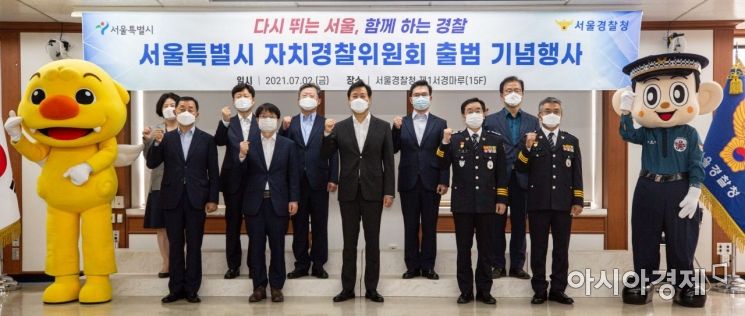 Seoul Mayor Oh Se-hoon, Seoul Metropolitan Police Agency Commissioner Jang Ha-yeon, Autonomous Police Committee Chairman Kim Hak-bae, and members of the Autonomous Police Committee are attending the 'Seoul Autonomous Police Committee Launch Ceremony' held at the Seoul Metropolitan Police Agency in Jongno-gu, Seoul on the 2nd, posing for a commemorative photo. Photo by Kang Jin-hyung aymsdream@
[Asia Economy Reporter Lim Cheol-young] The Seoul Metropolitan Autonomous Police Committee announced on the 2nd that it will set this year’s regional public safety vision as “One Year of Autonomous Police, Seoul as a Fair Public Safety Capital Where Citizens Are Safe” and will actively promote customized public safety policies to make the daily lives of Seoul citizens safer.
The Seoul Metropolitan Autonomous Police Committee has designated this year as the “Year of Autonomous Police Leap” and plans to implement various autonomous police public safety policies that can actually make citizens’ daily lives safer.
The committee aims to establish a “public safety system where everyone is safe,” focusing on proactive crime prevention in response to COVID-19 as well as support for socially vulnerable groups.
First, noting the sharp increase* in child and elder abuse crimes due to prolonged COVID-19 leading to more time spent at home last year, efforts will be made to build a social safety net for socially vulnerable groups. Joint home visit investigations with related agencies will be expanded to enable early detection of abused children, and rapid investigations will be initiated if abuse is suspected.
Active medical protection support for abused children will also be newly promoted. Necessary supplies will be provided to abused children according to their age groups, and nursing care fees of up to 300,000 KRW per day will be supported for infants and toddlers hospitalized without guardians. Costs for transferring abused children to specialized medical institutions after emergency treatment will also be supported.
For abused elderly and disabled persons, the committee will actively promote designation of medical institutions and support treatment costs, implementing detailed pre-crime prevention and victim support policies to protect socially vulnerable groups. Last year, various crimes against women, especially violent crimes centered around women’s residences, increased public concern about residential safety. In response, the committee plans to focus on managing residential safety in areas densely populated by single-person households to alleviate citizens’ anxiety and establish a safe local public safety system.
Among areas densely populated by single-person households, locations requiring environmental improvements such as routes home will be selected through public contests, and emergency bells and LED lighting will be intensively installed. Additionally, CCTV installation and collaboration with related departments’ projects such as Safe Village Security Guards will be organically linked to fundamentally improve residential environments. Furthermore, prevention publicity will be strengthened for crimes against women that have become social issues, such as stalking, dating violence, illegal filming crimes, and digital sex crimes, and victim-tailored protection support measures will be implemented to create a public safety environment where women feel secure.
In the field of traffic safety, the focus will be on protecting vulnerable traffic participants such as children. To ensure safety on children’s school routes, the “Seoul-type Child Protection Zone Standard Model” will be expanded by introducing yellow traffic lights and dark red pavement markings to minimize pedestrian accidents involving children. Especially, with the “Road Traffic Act Amendment” scheduled to be enforced in July, which requires vehicles to stop temporarily when pedestrians intend to cross at crosswalks without traffic lights, active publicity will be conducted to establish a “pedestrian-first” traffic environment. Signal systems and traffic safety facilities will also be improved and reinforced with pedestrian safety as the top priority.
For Seoul autonomous police centered on citizens, the committee will actively listen to citizens’ opinions and prioritize reflecting them in policies this year. To discover and improve local public safety issues, the committee plans to revitalize and operate the “Seoul Autonomous Police Citizen Policy Advisory Group,” composed of about 300 ordinary citizens formed last year, by visiting public safety sites and preparing improvements that meet citizens’ perspectives.
To actually reflect public safety policies proposed directly by citizens, the “Autonomous Police Public Safety Policy Contest” held since last December received as many as 283 citizen-submitted policies. Among these, 24 policies to be decided through judging on the 9th will be incorporated into Seoul autonomous police public safety policies and implemented. Furthermore, through active support and cooperation with private organizations that play a central role in local public safety, such as model drivers’ associations, Green Mothers’ Clubs, and voluntary crime prevention squads, the committee plans to create a community-tailored traffic and crime prevention cooperation system, building a Seoul autonomous police centered on citizens.
Active promotional activities will also be carried out. By appointing Seoul autonomous police ambassadors and strengthening participatory promotional activities such as “mobile events” that citizens can join, the committee will actively publicize the autonomous police system so that citizens can experience it in their daily lives. More than half a year after the full implementation of the autonomous police system, various issues regarding the system, such as insufficient personnel authority granted to cities and provinces during implementation, have emerged, and active proposals for improvements will be pursued.
Kim Hak-bae, Chairman of the Seoul Metropolitan Autonomous Police Committee, said, “The year 2022, marking the first anniversary of the introduction of the autonomous police system, will definitely be a year of clear achievements in improving regional public safety,” adding, “Along with active protection of socially vulnerable groups, which citizens are most concerned about, we will expand citizen participation and create a Seoul autonomous police that accompanies citizens’ safe lives.”
© The Asia Business Daily(www.asiae.co.kr). All rights reserved.
![Clutching a Stolen Dior Bag, Saying "I Hate Being Poor but Real"... The Grotesque Con of a "Human Knockoff" [Slate]](https://cwcontent.asiae.co.kr/asiaresize/183/2026021902243444107_1771435474.jpg)
















