First Trial: 2 Years Imprisonment → Second Trial: 5 Million Won Fine → Third Trial: All Charges Overturned and Case Remanded
[Asia Economy Reporter Choi Seok-jin, legal affairs specialist] A man who entered a married woman's home to have sexual relations and sent 42 mocking messages to her husband after their affair was exposed has avoided criminal punishment.
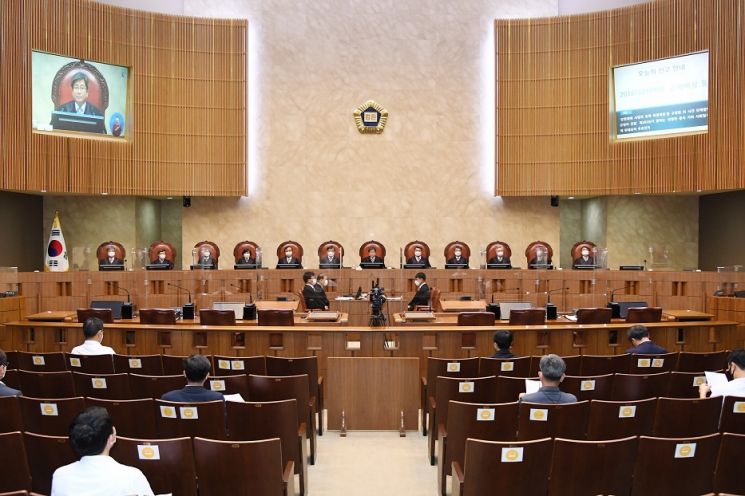
The Supreme Court's First Division (Presiding Justice No Tae-ak) announced on the 1st that it overturned the original ruling which recognized the defendant A's guilt for trespassing and sentenced him to a fine of 5 million won, and remanded the case to the Incheon District Court in the appeal trial for trespassing and violation of the Information and Communications Network Act (transmitting messages causing anxiety, etc.).
A was charged with entering a small room in the residence of B, a married woman, and her husband C in Michuhol-gu, Incheon, around 3 a.m. in December 2018 to have sexual relations with B.
Additionally, A was accused of repeatedly sending a total of 42 messages via KakaoTalk messenger to C from his residence in Suyeong-gu, Busan, between 7:52 p.m. on June 21, 2019, and the morning of June 24, 2019, including phrases such as "Just die and bury your face in the sewage," which caused anxiety after their affair was discovered.
Article 44-7 (Prohibition of Distribution of Illegal Information, etc.) Paragraph 1, Item 3 of the Information and Communications Network Act prohibits the distribution of information through information and communication networks that repeatedly causes fear or anxiety through codes, texts, sounds, images, or videos to the recipient, and Article 74 (Penalties) Paragraph 1, Item 3 stipulates that violations are punishable by imprisonment of up to one year or a fine of up to 10 million won.
In the first trial, both trespassing and violation of the Information and Communications Network Act charges against A were found guilty, and A was sentenced to two years in prison. Since A's whereabouts were unknown, the court served the indictment copy to A by public notice delivery and proceeded with the trial in A's absence.
At that time, the first trial court stated, "Considering the bad nature of the crime, the considerable mental suffering inflicted on the victim, the defendant's age, character, environment, relationship with the victim, motive, means, results, and circumstances after the crime, the sentence is determined as ordered."
However, the conclusion regarding the violation of the Information and Communications Network Act was overturned in the second trial.
A claimed he could not attend the trial because he did not receive the summons and requested restoration of appeal rights. The court found his claim reasonable and granted the restoration of appeal rights.
The second trial court stated, "Since the defendant was not at fault for failing to attend the first trial proceedings, there is a reason for retrial under the retrial regulations, so the original judgment cannot be maintained," and revoked the first trial ruling and reissued a judgment.
The court acknowledged that A sent messages to C similar to the prosecution's allegations but judged that the messages did not cause fear or anxiety to C.
The court pointed out, "Most of the messages in this case appear to mock the victim by crudely describing matters between the defendant and the victim's wife, and there is no indication that the defendant threatened harm or implied such events could occur."
Furthermore, the court noted, "The victim testified to the police that she felt fear about what might happen and, above all, the greatest anxiety was that her family might collapse. This feeling is more likely due to anger at the defendant's behavior rather than fear or anxiety caused by the messages themselves."
Finally, the court concluded, "Considering that the victim expressed mainly anger towards the messages by stating that the defendant kept mocking and angering her, and that she wanted to kill the defendant and even did not want to live, it is difficult to see that the messages objectively caused fear or anxiety."
The prosecution appealed this not guilty verdict.
However, the Supreme Court dismissed the prosecution's appeal, stating, "There is no error in the legal interpretation regarding 'codes, texts, sounds, images, or videos that cause fear or anxiety' under Article 44-7 Paragraph 1 Item 3 of the Information and Communications Network Act."
Moreover, the Supreme Court judged that the trespassing charge, which was recognized as guilty in the first and second trials, is difficult to uphold according to the recently changed Supreme Court plenary session ruling.
Only the prosecution appealed the second trial ruling, and the defendant C did not appeal, but the Supreme Court reviewed the case ex officio.
The court explained, "According to Articles 384 and 383 Paragraph 1 of the Criminal Procedure Act, the appellate court may review ex officio even if the grounds for appeal are not included in the appeal brief when there is a violation of law affecting the judgment. This applies even if only the prosecution appeals for reasons other than those raised by the defendant, and it is clear that the prosecution's appeal is not for the defendant's benefit."
Although A did not appeal the second trial ruling that recognized guilt for trespassing, and the prosecution only appealed the acquittal on the violation of the Information and Communications Network Act, the Supreme Court can ex officio review the second trial's erroneous judgment on trespassing.
The court cited the Supreme Court plenary session ruling from September last year, stating, "If an outsider enters a shared residence with the actual consent of a current resident who is present, following the usual method of entry, even if it is against the presumed intention of another absent resident, trespassing does not occur."
Before the plenary session ruling last year, the Supreme Court regarded the protected legal interest of trespassing as the 'actual peace of residence' and maintained the position that "even if the husband is temporarily absent, the husband's control over the residence continues, and entering the residence for the purpose of adultery is against the husband's intention, so trespassing occurs even if the wife consents."
However, academic opinion mostly held that if the protected legal interest of trespassing is the actual peace of residence, and there is genuine consent from the current resident, the actual peace is not disturbed, so trespassing does not occur. The Supreme Court changed its view to this position through the plenary session ruling on September 9 last year.
According to this changed Supreme Court precedent, the Supreme Court judged that the second trial ruling on A's trespassing charge is difficult to maintain.
The court stated, "The original ruling that found guilt for trespassing based on the legal principles before the plenary session ruling contains an error in the legal interpretation regarding the establishment of trespassing. Therefore, the guilty part of the original ruling is overturned, and the case is remanded to the original court for retrial and judgment."
The Incheon District Court, which received the case again from the Supreme Court, is expected to acquit A of the trespassing charge in accordance with the Supreme Court's remand decision.
Ultimately, A, who was sentenced to two years in prison in the first trial for adultery, was reduced to a fine of 5 million won in the second trial, and it is highly likely that he will be acquitted of all charges in the final judgment.
© The Asia Business Daily(www.asiae.co.kr). All rights reserved.

















