Vaccination for High-Risk Groups to Begin Mid-Month
Standards Established to Allow Cross and Additional Vaccinations
Low Side Effect Risk with Recombinant Antigen Method
Single-Dose Prefilled Syringe Method Also Advantageous
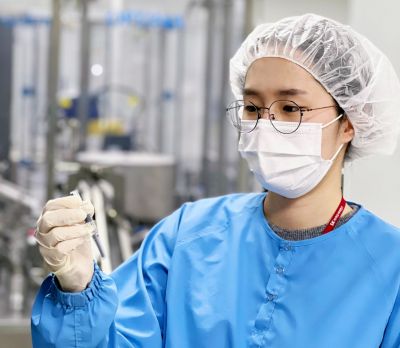 Novavax COVID-19 vaccine 'Nuvaxovid Prefilled Syringe' is being produced at the L House factory of Andong SK Bioscience. (Photo by SK Bioscience)
[Asia Economy Reporter Lee Chun-hee] The Novavax COVID-19 vaccine, developed using a synthetic antigen (recombinant DNA) method, will be used for actual vaccinations in South Korea starting this month. Since it is developed using a traditional vaccine manufacturing method, concerns about side effects are relatively low, making it a promising alternative for unvaccinated individuals who have delayed vaccination due to fears of side effects.
According to the COVID-19 Vaccination Response Promotion Team (Promotion Team) on the 1st, the Novavax vaccine is expected to be introduced for vaccination starting the second week of this month. This comes just over a month after receiving approval from the Ministry of Food and Drug Safety on the 12th of last month.
The vaccination target group is unvaccinated individuals aged 18 and older. It will be primarily used for high-risk groups such as hospitalized patients in medical institutions, residents and inpatients of nursing hospitals and facilities, homebound elderly, and severely disabled individuals with mobility difficulties. Notably, the Novavax vaccine supplied domestically has been developed into a single-dose syringe through additional research and development (R&D) by SK Bioscience, and can be refrigerated at 2?8 degrees Celsius for up to five months without requiring separate thawing. Considering these factors, it will be prioritized for on-site vaccinations at medical institutions and facility visit vaccinations.
From mid-month, full-scale on-site and visit vaccinations for high-risk groups will begin, and other eligible individuals who wish to be vaccinated will be able to receive same-day vaccinations using Naver or Kakao applications (apps) or preliminary lists at medical institutions.
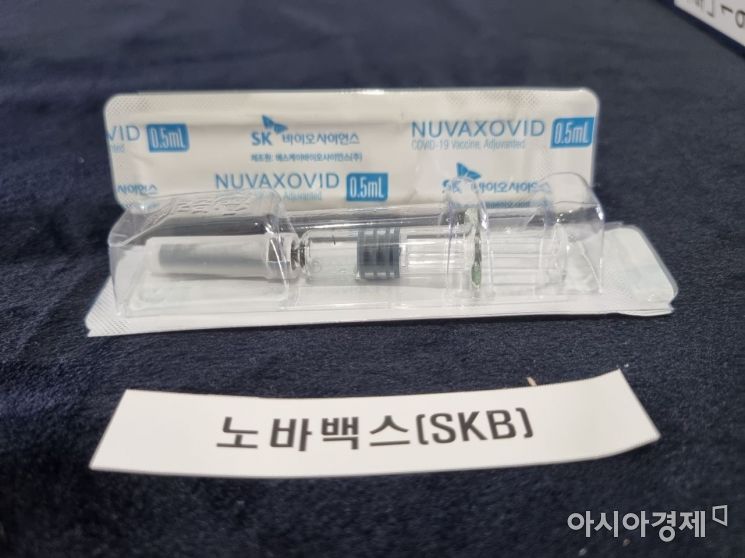 Novavax COVID-19 vaccine contracted for development and manufacturing (CDMO) by SK Bioscience. Photo by Lee Chunhee
The greatest advantage of the Novavax vaccine lies in its manufacturing method. It is a synthetic antigen vaccine made by directly injecting antigen proteins produced using recombinant technology to induce antibody production in the body. This method has been traditionally used in various vaccines such as influenza, hepatitis B, and cervical cancer vaccines. Unlike the relatively newer viral vector (AstraZeneca (AZ), Janssen) and messenger RNA (mRNA, Pfizer, Moderna) vaccines, it is developed using a traditional vaccine manufacturing method. Currently, viral vector vaccines are associated with thrombocytopenic thrombosis syndrome (TTS), and mRNA vaccines with myocarditis and pericarditis as representative side effects, which has caused some unvaccinated individuals to delay vaccination; thus, Novavax is seen as an alternative.
According to clinical phase 3 trial data conducted in the UK (15,139 participants) and the US (29,582 participants), submitted by SK Bioscience, which holds domestic production and commercialization rights for the Novavax vaccine, concerns about side effects are minimal. The final review committee, which examined these data for approval, judged that most reported adverse events related to safety were expected and generally mild. Common adverse events included tenderness, pain at the injection site, erythema, and swelling, with symptoms mostly mild to moderate and resolving within 1?3 days.
However, myocarditis cases were reported in clinical results for the Novavax vaccine. Serious adverse drug reactions possibly related to vaccination included one myocarditis case in the UK trial and four cases in the US trial: angioedema, central nervous system inflammation/facial nerve palsy/peripheral neuropathy, Graves' disease/hyperthyroidism, and thrombocytopenia. All had recovered or were recovering at the time of clinical data submission. Since myocarditis and thrombocytopenia are not diseases caused solely by vaccination, a definitive causal relationship between vaccination and side effects has not been established.
The final review committee mandated a post-approval risk management plan to monitor safety preventively for myocarditis and other conditions, collecting and evaluating adverse events occurring during ongoing clinical trials and post-approval use.
High supply stability is another advantage of the Novavax vaccine. The domestically approved Novavax vaccine is not the general Novavax vaccine but the 'Nuvaxovid prefilled syringe' manufactured entirely by SK Bioscience from raw material to finished product. SK Bioscience signed a contract for contract development and manufacturing organization (CDMO) with Novavax in August 2020 and, in February last year, signed a technology transfer contract enabling production of both raw materials and finished pharmaceuticals, allowing independent production of the Novavax vaccine.
Notably, the Novavax vaccine is mostly distributed overseas in vials containing 10 doses. However, the Nuvaxovid prefilled syringe has been improved through SK Bioscience's additional R&D into a single-dose syringe containing one dose per vaccine unit. This eliminates the need for dilution or aliquoting, reducing contamination risk and easing the workload for medical personnel. This is the only COVID-19 vaccine approved domestically in this form; all other vaccines are packaged in multi-dose vials and require aliquoting before administration.
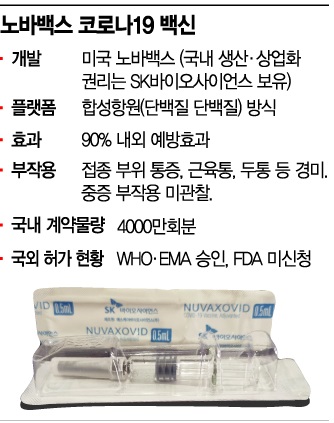
At the time of approval by the Ministry of Food and Drug Safety, there were concerns that the Novavax vaccine might not be used for third doses or heterologous (mix-and-match) vaccinations, but the Promotion Team plans to establish specific implementation criteria allowing heterologous vaccination with Novavax for cases where additional vaccination is medically difficult after mRNA vaccination.
Hwang Kyung-won, head of the Vaccination Planning Team at the Promotion Team, explained, "The general principle is that if the same vaccine cannot be used for medical reasons after a previous vaccination, heterologous vaccination with a different vaccine is possible. Even if a different vaccine was previously administered, heterologous vaccination with Novavax can be done based on a physician's opinion."
Although the Ministry of Food and Drug Safety initially stated that Novavax could not be immediately used for third or heterologous doses, considerable research has been conducted, making it feasible to proceed. Currently, COVID-19 vaccines approved for first and second doses require either approval changes or sufficient clinical data for third-dose use. At the time of approval, the Ministry noted that Pfizer, Moderna, and Janssen vaccines were being used for third doses based on sufficient clinical data despite no approval changes, whereas it was premature to make such a judgment for Novavax.
Hwang added, "Overseas studies analyzing cases where Novavax was used only for the third dose showed meaningful effectiveness. Based on this, we are reviewing implementation criteria for the Novavax vaccine." He also clarified that using Novavax after heterologous vaccinations such as AZ-Pfizer is not considered a misadministration.
© The Asia Business Daily(www.asiae.co.kr). All rights reserved.
![User Who Sold Erroneously Deposited Bitcoins to Repay Debt and Fund Entertainment... What Did the Supreme Court Decide in 2021? [Legal Issue Check]](https://cwcontent.asiae.co.kr/asiaresize/183/2026020910431234020_1770601391.png)

















