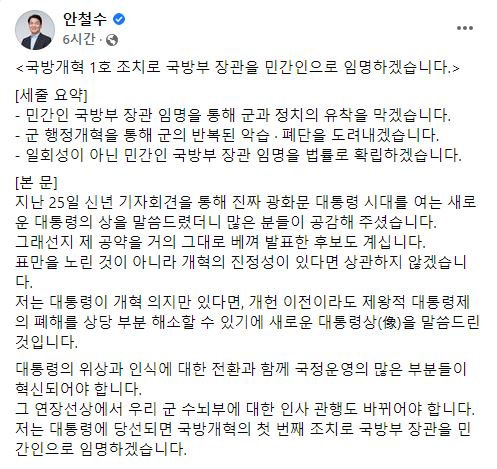
 Ahn Cheol-soo, the presidential candidate of the People’s Party, unveiled his top national defense reform pledge.
 [Photo by Ahn Cheol-soo, presidential candidate of the People’s Party, Facebook capture]
[Asia Economy Reporter Seoyoung Kwon] Ahn Cheol-soo, the presidential candidate of the People’s Party, announced that he will appoint a civilian as the Minister of National Defense as his first pledge for defense reform.
On the 29th, Candidate Ahn posted on his Facebook titled "I will appoint a civilian as the Minister of National Defense as the first measure of defense reform," stating this intention. Summarizing the content of his pledge, Ahn said, "By appointing a civilian Minister of National Defense, we will prevent collusion between the military and politics," adding, "Through military administrative reform, we will eradicate repeated bad practices and corruption in the military," and "We will establish the appointment of a civilian Minister of National Defense by law, not as a one-time measure."
Ahn also wrote, "At the New Year’s press conference on the 24th, I spoke about a new president who will open the true Gwanghwamun era, and many people sympathized with this," continuing, "Perhaps because of that, some candidates have almost copied my pledge and announced it. If the reform sincerity is genuine and not just for votes, I do not mind." This is interpreted as a direct reference to Yoon Seok-youl, the People Power Party candidate, who mentioned the "Gwanghwamun President era" at the New Year’s press conference and announced the transfer of the presidential office to the Gwanghwamun Government Seoul Office two days later.
Furthermore, Ahn argued, "Along with a change in the status and perception of the president, many parts of state administration must be innovated," and "In that context, the personnel practices for the military leadership must also change." He emphasized, "If the existing method continues, where generals who have received regime privileges are promoted to minister immediately after retirement, there are limits to performing the military’s original duties independently of politics," adding, "The reason the Minister of National Defense is overly political and always has to consider the Blue House’s stance on security issues is because of this."
Ahn also wrote, "Appointing a civilian Minister of National Defense will prevent unnecessary internal networking and power struggles within the military, and enable proper defense reform that is unrelated to ‘intra-service selfishness’ among the Army, Navy, and Air Force." He pledged, "By appointing an expert with not only military security expertise but also administrative innovation capabilities as the Minister of National Defense, we will eradicate various current military malpractices, bad customs, and corruption, laying the foundation for defense reform."
He also pledged, "We will promote legislation for appointing civilian Ministers of National Defense so that retired military personnel can be appointed as ministers seven years after retirement, and for open positions such as directors and bureau chiefs in the Ministry of National Defense, appointments will be possible three years after retirement." Ahn expressed his determination, saying, "Appointing a civilian minister is a very natural measure to establish civilian control over the military, but we have not done so until now," and "Through appointing civilian ministers, we will create a foundation to enhance the military’s self-purification ability against various bad practices and corruption, accelerating the defense reform that the people desire."
© The Asia Business Daily(www.asiae.co.kr). All rights reserved.

















