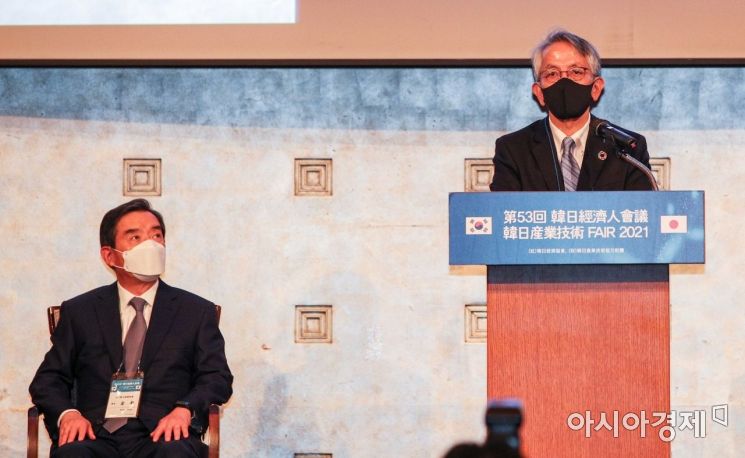
 Aiboshi Koichi, the Japanese Ambassador to Korea, is delivering a greeting at the '53rd Korea-Japan Business Meeting' held on the 2nd at Lotte Hotel in Jung-gu, Seoul. Photo by Kang Jin-hyung aymsdream@
[Asia Economy Reporter Seungjin Lee] On the 28th, the Ministry of Foreign Affairs summoned Koichi Aiboshi, the Japanese Ambassador to Korea, to protest the Japanese government's decision to recommend Sado Mine as a UNESCO World Heritage site.
Choi Jong-moon, the 2nd Vice Minister of Foreign Affairs, summoned Ambassador Aiboshi to the Ministry of Foreign Affairs building in Sejong-ro, Seoul, that evening.
This summons came after Prime Minister Fumio Kishida ultimately decided to recommend Sado Mine as a UNESCO World Heritage site despite the Korean government's objections.
Earlier, the Ministry of Foreign Affairs issued a spokesperson's statement expressing "strong regret over the Japanese government's decision to proceed with the registration of Sado Mine, a site of forced labor of Koreans during World War II, as a UNESCO World Heritage site despite repeated warnings from our side," and "sternly urged the cessation of such attempts."
An official from the Ministry of Foreign Affairs explained, "The government's firm position will be conveyed to the Japanese side not only through the spokesperson's statement but also via channels in Seoul and Tokyo going forward."
The Ministry of Foreign Affairs also recalled that the World Heritage Committee expressed serious regret last July over Japan's failure to fulfill its promise to explain the forced labor of Koreans at Japanese modern industrial sites such as Hashima (commonly known as 'Gunkanjima').
Another site of forced Korean labor, the Japanese modern industrial facilities, was registered as a World Heritage site in 2015, and at that time, Japan promised the international community to disclose the facts of forced Korean labor.
The Ministry of Foreign Affairs stated, "We reiterate that the Japanese government must faithfully implement the follow-up measures it pledged when the site was registered as a World Heritage in 2015."
Meanwhile, Prime Minister Fumio Kishida told reporters at the Prime Minister's Official Residence that evening regarding the recommendation of Sado Mine as a UNESCO World Heritage site, "We have reached the conclusion that applying this year and starting discussions early is the shortcut to achieving registration."
The Japanese government will hold a Cabinet meeting, equivalent to Korea's State Council, on the deadline of next month’s 1st to approve the procedure and send the recommendation letter for Sado Mine's World Heritage registration to UNESCO.
Going forward, the International Council on Monuments and Sites (ICOMOS), UNESCO's advisory body, will conduct a review including an on-site investigation over about a year and a half, and will decide on the registration of Sado Mine around June to July next year.
© The Asia Business Daily(www.asiae.co.kr). All rights reserved.